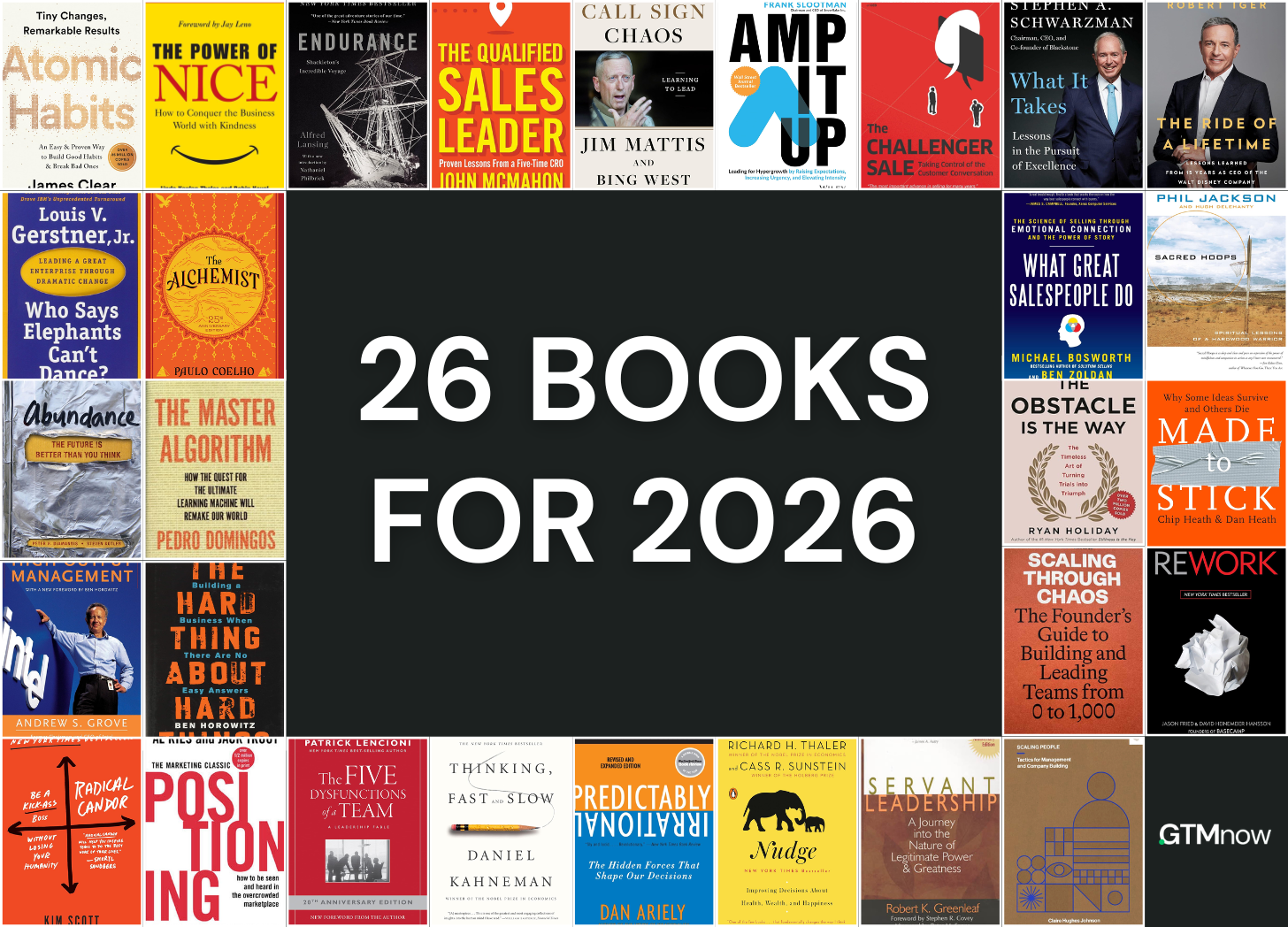
At the end of every conversation on The GTMnow Podcast, I ask guests which books have made the biggest impact on their careers and lives.
It’s one of my favorite questions because it provides a window into how the top 1% of operators, founders, and investors think. Books are inputs. They’re mental models, stories, and frameworks that compound over time. They reveal what someone values, how they reason, and which ideas have shaped their worldview.
And if one belief has proven true across hundreds of conversations, it’s this:
If you want to elevate your output, you have to upgrade your input.
This edition is built on that premise. It’s a tour through the books that shaped some of the best minds in tech – a map of the ideas behind those performing at the highest level. Hopefully it helps bring some inspiration into the new year.


They handle everything from venues to experiences, so you can focus on the delights of meeting in person, not the logistics.
Being part of GTMnow, you’re eligible for full-service event planning for just $99 per person (terms apply). Head to boompop.com/gtmfund to explore seamless support for your events.
26 Books to Read in 2026

Paul Williamon (CRO at Heidi Health, formerly at Plaid):
So I mentioned before this idea of improving the business and making today just a little bit better than yesterday. I’ve talked about that concept for a long time, but it wasn’t until I read this book — I read it a couple of years ago — that it really clicked. It was Atomic Habits by James Clear.
Essentially, it’s about how to build repeatable habits inside a business. It really resonated with me. I had articulated versions of that idea for a while, but the book hit home personally. I know it’s very popular, but it was truly impactful. In fact, we brought James Clear to our revenue kickoff in 2021 or 2022, and he spent time with the entire Plaid team. That was incredibly impactful.
Guy Yalif (former founder / Chief Evangelist at Webflow):
I’m a big fan of Atomic Habits. A classic.
Kyle Norton (CRO at Owner):
For personal development, Atomic Habits is something I recommend to every rep and every leader.

Stevie Case (CRO at Vanta):
I think a lot about intensity. Frank Slootman talks about this in Amp It Up — the idea that most companies are operating at half-speed without realizing it. When you actually raise the standards, increase urgency, and trim the things that don’t matter, everything starts to move faster. And people rise to meet that bar.
That book really shaped how I think about pace and expectation-setting. You don’t ‘burn people out’ by operating with intensity, you burn them out by being unclear. When the mission is clear and the bar is clear, people actually get energy from speed.

James Roth (CRO at ZoomInfo):
Bob Iger’s The Ride of a Lifetime (he was the Disney CEO) is one I loved. It’s full of amazing stories and tons of useful insights. I try to read broadly across industries and different vocations, and I love mapping back what exceptional people do to my own work.

Kyle Norton (CRO at Owner):
I think everybody should read is Thinking, Fast and Slow by Daniel Kahneman. He and Amos Tversky are the creators of the field of behavioral economics. It’s much more in our zeitgeist today than it was when I read it when it came out over a decade ago. But it’s about how humans operate, and why we act in these very irrational ways sometimes

Ghazi Masood (CRO at Replit):
The book that’s made the biggest impact for me recently, at both of my last two companies, is The Five Dysfunctions of a Team.
It’s a really, really good book to understand the dynamics of a team and how to collaborate and work effectively as a leadership organization. And it’s not just for the leadership team, it applies to the entire org.
It helps you set your operational discipline, the cadence for how you run the business, what you want to prioritize, what you want to focus on.

Tessa Whittaker (VP of Revenue Operations at ZoomInfo):
Ross Rich, he’s the CEO of Accord, sat down and gave me a book. It was The Alchemist, which I had never read before. And I don’t think there’s been a single book in my life that has been more impactful. I think about it every single day.

Chris Degnan (former CRO at Snowflake):
One of the books I always recommend, especially for anyone running or building a sales organization is The Qualified Sales Leader by John McMahon. It’s the closest thing I’ve seen to a field manual for modern enterprise sales.
John breaks down how to actually run a deal, how to coach reps, how to qualify pipeline so you’re not living in fantasy-land, and how to drive a predictable enterprise motion. It’s the book I wish I had 15 years ago. Every leader who comes into my org reads it.
People talk about ‘MEDDICC’ like it’s a checklist, but McMahon explains the why behind each part — the psychology of champions, identifying real pain, understanding how your customer buys. That’s the difference. It’s not a process book, it’s a leadership book.

Christina Cordova (COO at Linear):
Claire Hughes-Johnson, who was Stripe’s COO and is now a corporate advisor, wrote a book called Scaling People. It’s a lot about organizational growth: what are we doing to build the company as we’re also trying to grow the business?
It’s a fantastic book about many of the things we did at Stripe. Some of it I saw firsthand, but a lot of it I didn’t as it was the behind-the-scenes thinking, the reasoning. So I find myself going back to chapters when I feel: Okay, we’ve hit that point in our journey where something needs to change. Understanding the mental models in that book has been really helpful.

Stevie Case (CRO at Vanta):
Right now I’m reading a book called Endurance. It’s not a business book, but kind of a leadership book. It’s great. It’s about a shipwreck and the way the crew led themselves out of this very dire situation. So that’s what I’m enjoying right now.

Brian Weinberger (CRO at Sisense):
One book changed me while I was managing at Salesforce. I had just gotten promoted — I was running a team, we were going upmarket. I came from SMB to upmarket, and I was like, ‘Oh my God, this is a little overwhelming…what am I going to do?’
And I came across this book called What Great Salespeople Do, and that changed everything I thought about. It really dissected why 20% of your sellers do 80% of your sales. And that was the whole thing. You had a lot of underperformers, and they dissected the 20% — and what it came down to was the ability to tell stories.
Stories have been the history of life. People sit around a campfire, they listen… and stories beget other stories. I tell a story, and then you’re like, ‘Oh, that reminds me of a story.’ So the art of selling is getting people to open up. Because if you’re trying to solve a problem, you really need to know what the problem is.
We ended up bringing in the author of the book. We did 200 workshops at Salesforce. It started in my world and then went all the way up to the largest enterprise teams. I became a facilitator of this, it was phenomenal. Total game changer.

Chris Degnan (former CRO at Snowflake):
I just read a book — really more of a life book — about the economy and things like that, called Abundance, which I think is a super cool book.

Peter Grant (CRO at You.com):
I liked Lou Gerstner’s book Who Says Elephants Can’t Dance? from many, many years ago. It’s the IBM one and it is transformative.

Kyle Norton (CRO at Owner):
I think there are a bunch of interesting things in the behavioral economics world that, once you start to understand them, you’re like: oh yeah, that’s why my reps do this, that’s why people operate this way.

Brian Weinberger (CRO at Sisense):
A great book is about being nice to people in business, and how that becomes a more sustainable long-term way to operate.
It talks about being friendly with the doormen in buildings. Because in New York, when we used to sell in New York, it was vertical. You had to get into a building and then go knock on every door. And to do that, you had to be friends with everybody in the building. So The Power of Nice is another one I just take with me.

Peter Grant (CRO at You.com):
The Hard Thing About Hard Things is simply a really really good book.

Brian Weinberger (CRO at Sisense):
A great book is Sacred Hoops. I’m a big basketball fan, and it’s Phil Jackson’s book.
It basically dissects what it took when he had to coach the greatest player to ever play (Jordan) and get Jordan to buy into the entire system and the program. There’s a lot of psychology behind it, and that’s the coaching side for me.

James Roth (CRO at ZoomInfo):
I’m always a big fan of business biographies. I love reading about people who’ve actually done great things and learning from their stories. I just finished Call Sign Chaos, which was great.

Peter Grant (CRO at You.com):
The Master Algorithm is great. It’s about having all the different five core algorithms and one master algorithm that could solve literally every single sort of problem in the world.

Stevie Case (CRO at Vanta):
I still think The Challenger Sale is one of the most important frameworks in modern sales. Not because you follow it dogmatically, but because the core idea is timeless: your job is to teach, tailor, and take control. Especially in security and compliance, customers don’t always know what good looks like. They need someone who can bring insight, not just take an order.
Where teams misinterpret Challenger is they think it means being aggressive. It’s not. It’s about delivering perspective. The best reps at Vanta succeed because they can challenge constructively — they help prospects see the cost of doing nothing, the risk in status quo workflows, and the path to a stronger posture. That’s Challenger done well.

Guy Yalif (Chief Evangelist at Webflow):
It’s about building products, but I think it’s about how to run teams. And it is a lot about rapid iteration, quick learning, lots of communication on small teams. And so the team that created Backpack and a few other products created this. And it’s not a long book — it’s a bunch of a paragraph on a page, and then the next thought and the next thought and the next thought. It’s very actionable.

James Roth (CRO at ZoomInfo):
Kim Scott is a favorite, especially from a leadership standpoint. Radical Candor is great.

Kyle Norton (CRO at Owner):
I love Made to Stick. That’s one that I recommend a lot.

Michel Tricot (Co-Founder & CEO of Airbyte):
In 2014, maybe 2013, I was just starting to manage my first team. And my CTO gave me this book: High Output Management. I think now it’s a standard.
When you go from being an IC to starting to manage people, it’s very hard to find the right feedback loop for ‘are you doing a good job or not?’ Like what does it mean to be doing a good job? And also how do you build teams as systems?
And I think that book was just transformational for me because I like good theory — and the theory was very strong. It’s about how you create, how you build the system, how you monitor these systems, and how you take pride in the work when you’re not the one doing the work yourself.

This is on my leadership mandatory list!

Paul Williamson (CRO at Heidi Health, ex-Plaid):
I think it’s a really important book for not only founders to read — it’s largely directed at founders — but I think it’s also really important for go-to-market people to read it, largely because it helps you get into the mind of what it is like to work with a founder.
The pressures, the challenges, the issues they face daily, and where our role as go-to-market leadership should fit relative to founders. So I think that’s an important kind of industry read for anyone.

Jenny He (Founder and GP of Position Ventures):
The number one book everyone should read is Positioning: The Battle for Your Mind.
It’s an old book, almost 20 years old, but it’s the 101 in all things positioning and the go-to book.
Tag @GTMnow so we can see your takeaways and help amplify them.
More for your eyeballs
At TechCrunch DISRUPT, GTMfund GP Max Altschuler joined leaders from Google Cloud and OpenAI to break down how AI is reshaping go-to-market. AI gives you leverage, speed, and precision, but the edge still comes from teams that understand real GTM fundamentals and know how to apply them.
Writer – CEO May Habib took the AWS re:Invent keynote stage to unveil the company’s new agent supervision suite, giving enterprises real visibility, governance, and control as they scale AI agents. The launch also deepens Writer’s Amazon Bedrock integration, now supporting third-party and fine-tuned models across the platform.
More for your eardrums
GTM 172: Why Old Playbooks Are Breaking and How AI Assisted GTM Actually Works | Dave Boyce
Get a sneak preview here. For the full thing, listen on Apple, Spotify, YouTube or wherever you get your podcasts by searching “The GTMnow Podcast.”
Startups to watch
Jeeva AI – raised $9 million to scale its agentic platform that automates the entire top of funnel. The company’s AI finds and enriches leads, writes personalized outreach, and builds ROI forecasts, giving sales teams leverage from day one.
Amper Technologies – was acquired by ECI Software Solutions, bringing AI-powered factory visibility and operational intelligence deeper into ECI’s manufacturing stack. Amper’s real-time insights help manufacturers spot bottlenecks, boost uptime, and drive efficiency on the shop floor, exactly where margins are won or lost.
Hottest GTM jobs of the week
- Vice President of Customer Success at CaptivateIQ (Hybrid – Austin, TX / Menlo Park, CA)
- Senior Manager, Strategic Customer Success at Vanta (Remote – US)
- Head of Customer Success at Esper (Hybrid – Austin, TX / Denver, CO)
- Director, Revenue Operations at Pavilion (Remote – US)
- Account Executive, SMB at Closinglock (Austin, TX)
See more top GTM jobs on the GTMfund Job Board.
GTM industry events
Upcoming events you won’t want to miss:
- GTMfund 2026 schedule coming soon!
- Above the Fold (for marketers): February 9-11, 2026 (Fort Lauderdale, FL)
- Spryng (for marketers): March 24-26, 2026 (Austin, TX)
GTMnow community love
Some GTMnow community (founder, operator, investor) love to close it out – we appreciate you.