Hello and welcome to The GTMnow Newsletter by GTMnow – a weekly publication by VC firm, GTMfund. Build, scale and invest with the best minds in tech.
This is Part III in our series on lessons from some of the top 1% leaders in B2B SaaS. In case you missed them:
- Part I: Canva’s CCO on CPG discipline and human-centric marketing.
- Part II: Vanta’s CRO on execution, competition, and post-sales loyalty.
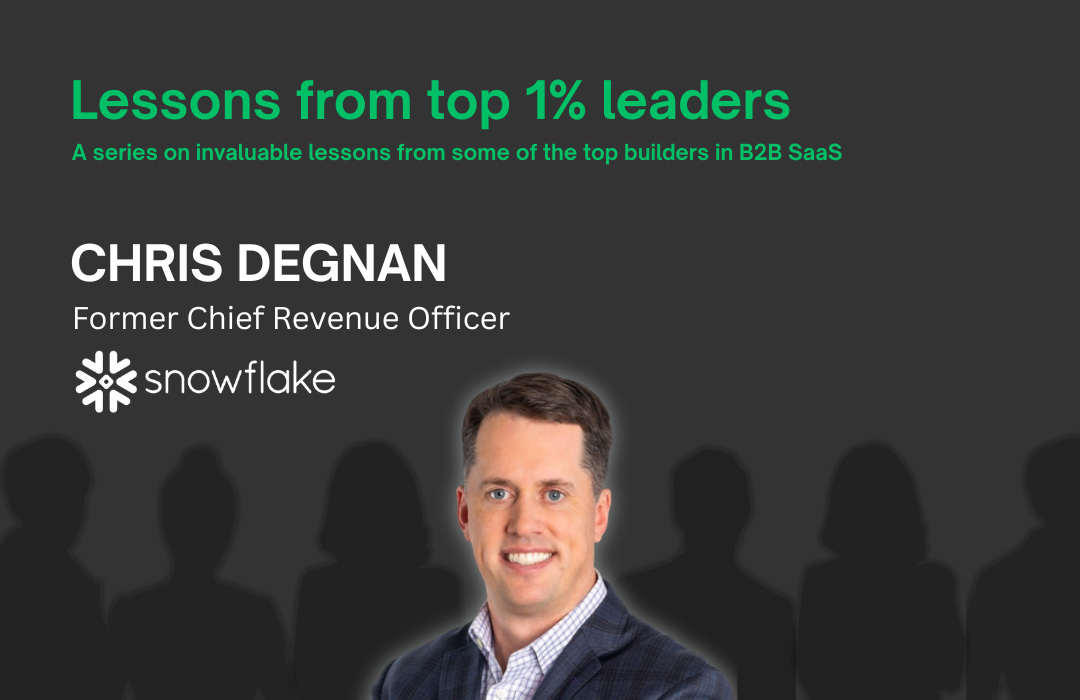
Chris Degnan was Snowflake’s first sales hire and scaled Snowflake from a stealth startup to $4B ARR and a $100B IPO.
He jokes that he didn’t buy a motorcycle for his midlife crisis.
Instead, he joined a stealth startup with no product, no customers, and a name nobody took seriously. That company was Snowflake.
He became the first and only sales hire, then spent 11 years scaling revenue from zero to more than $4B, surviving multiple near-death outages, competing with both hyperscalers and Databricks, and working under four different CEOs along the way.
The average CRO tenure is 18 months and Chris was there for over a decade.
He was Snowflake’s first sales hire and scaled it from a stealth startup to $4B ARR and a $100B IPO. After sitting down to unpack his scaling story, we’ve distilled four core lessons:
Lesson 1: Early hires must build the system.
Lesson 2: Operate off one shared truth.
Lesson 3: Acquisition means nothing without activation.
Lesson 4: Methodology and humility beat hero culture.
Below, we dive into each lesson.


ZoomInfo is the go-to-market platform built for sales, marketing, and RevOps.
With tools like Copilot for real-time sales guidance, GTM Studio for launching plays without BI, and ZoomInfo Marketing for intent-based campaigns, it brings your entire revenue team into one system.
It’s trusted by the fastest-growing companies, with 72% of revenue now coming from larger upmarket customers and the largest TCV deal in company history underscoring that confidence. Check them out at zoominfo.com.
Lesson 1: Early hires must build the systems
When Chris joined Snowflake, there was no infrastructure. No SDR team, no Salesforce instance, no brand, no inbound. Just a few founders, a stealth product, and a simple promise that “we’ve done something really unique.”
So he did what true zero-to-one builders actually do:
- He started by cold outreaching out to potential customers, asking for 15 minutes to walk them through what Snowflake was building and gather feedback.
- He spent nights building lists by hand, scraping websites and job boards.
- He set a personal non-negotiable: 8 customer meetings per week, no matter what.
Only then did he start hiring: first an intern, then an SE, then two SDRs, and only after that, AEs.
This order is the lesson: your first sales hires must build the system.
Early Snowflake wasn’t a place for “big company” salespeople who needed enablement decks and polished territories. This lesson is something that Chris is blunt about this when he advises founders today:
“If you hire someone from a big company into an early-stage startup, they’re used to infrastructure being there. If they walk in and say “Where’s Salesforce?” and all your customer context is in the founders’ phones… that’s not your person.”
He screens for:
- Self-starters who’ve had to build from scratch.
- People who have overcome tough, non-obvious challenges in their life.
- Operators from places like the reseller ecosystem, where you’re forced to juggle multiple products and build your own motion.
His favorite interview opening question? “Tell me your life story…where you were born to how you got here.” In first sales hires, he is looking for grit, pattern of ownership, and hunger.
Lesson 2: Operate off one shared truth
Snowflake’s GTM machine wasn’t just “great salespeople and a great product.” It was a company where sales, marketing, product, and the CEO were aligned on one operating reality. That alignment became Snowflake’s multiplier.
Two relationships stand out:
1. Sales + Marketing: When Denise Persson arrived, everything changed
When Denise joined as CMO, Snowflake was doing around $3M ARR — and stuck in the classic early-stage fight: marketing optimizing for MQLs while sales just wanted real conversations.
Denise killed the debate instantly.
“We are not going to talk about MQLs.”
“We’re going to talk about qualified meetings for your salespeople.”
Then, she got in the trenches. Every week, she sat 1:1 with SDRs and AEs, asking which leads were good, which were useless, and why. She learned the motion from the ground up, and only then built processes and programs around what she heard.
She redesigned Snowflake’s demand engine, building it on firsthand truth from sales data. She earned trust through behavior, not slide decks.
2. Sales + Product/Engineering: CEOs in the details
Multiple Snowflake CEOs went deep with the GTM org, but one of the clearest examples is Bob Muglia. He forced sales, product and engineering to operate off the same truth.
Take contracts, for example. Bob personally rewrote them, then handed them to Chris and said: “Read this. Redline it. You need to understand exactly what you’re selling.”
It was more than paperwork. It was about making sure the GTM motion, pricing structure, and product reality were perfectly aligned.
Another great example: Every Monday, in front of the entire company, Bob called on individual engineers by name: “{{Brian}} – how are you doing on this feature?”
For some engineers, it was uncomfortable. For GTM, it was oxygen. It meant that the roadmap, the contract, and the sales motion were tied together.
Great leaders balance strategy with being “in the details.”
The best GTM outcomes come from sales and marketing acting as one team, with product and engineering held to the same bar of urgency and accountability.
Lesson 3: Acquisition means nothing without activation
From the early days, Snowflake’s mandate from investor-founder Mike Speiser was clear: “We have to get market share before the competition gets product.”
That obsession translated into a very specific GTM design: a GTM motion built around acquisition.
Reps carried aggressive new-logo quotas (usually 4–8 per quarter) and Snowflake hired people who could open new doors, not just grow existing accounts. Customer wins in the Global 2000 were celebrated internally like trophies.
It worked. But Chris admits there were stretches when Snowflake took its foot off the new-logo gas pedal, and the business felt it. Acquisition discipline has to be consistent.
At the same time, Snowflake did something that companies should copy: they paired new-logo intensity with a system that forced usage.
Because Snowflake was a consumption business, most early deals were essentially paid pilots in the $40-60K range. Importantly:
- Reps were paid on both bookings and consumption
- Sales couldn’t win unless customers actually used the product
This created a self-correcting system: reps chased the right logos and were personally motivated to ensure those customers were successful. Chris also re-architected Customer Success to reinforce this:
Chris also re-architected Customer Success to reinforce this motion. He rolled CS and Professional Services under sales, eliminating the idea of “free, feel-good customer success” and replacing it with a paid services engine that got customers live, fully implemented, and expanding.
Sales reps quickly realized that when PS was involved, customers consumed far more. Since compensation was tied to consumption, everyone cared deeply about usage.
The big takeaways from this lesson:
- Don’t confuse expansion with growth. If new logos slow down, the business stalls long before you see it in revenue.
- In a consumption or PLG model, comp plans must reward usage, not just signatures.
- Paid, accountable implementation beats free CS every time. What matters is whether customers activate, adopt, and expand.
Lesson 4: Methodology and humility beat hero culture
On paper, Chris’ career could easily be framed as a “lone hero CRO” narrative. He rejects that idea outright. He credits Snowflake’s success to three things: a world-class product, a go-to-market machine rather than any one person, and a culture where leaders were coachable, urgent, and ego-light.
When he asked mentor and board member John McMahon how he managed to stay CRO through 4 CEOs and 11 years, McMahon’s answer was simple: “You ask good questions, you take feedback, and you act on that feedback.”
That combination (curiosity + humility + speed) became Chris’ operating system. It’s a fantastic system for anyone to take inspiration from.
He applies the same philosophy to methodology. Chris is still a believer in MEDDICC, but not as a checklist or a corporate formality. To him, it’s a compass – a way to understand whether a deal is real, who has power, and where the gaps are. When he interviews sales leaders today, he isn’t evaluating which methodology they prefer; he’s listening for whether they live one. He compares it to company values: you can put them on the wall, but if you don’t use them to guide decisions, they don’t matter. Methodology works the same way.
This is the through-line across his entire Snowflake journey. The companies that scale aren’t the ones that rely on lone heroes or charismatic rainmakers. They’re the ones that build a culture where people adapt faster than the company changes, where leaders model the behaviors they expect from others, and where systems carry the load. In hypergrowth, humility and methodology make you impossible to break.

Tag @GTMnow so we can see your newsletter takeaways and help amplify them.
More for your eyeballs
At TechCrunch DISRUPT, GTMfund GP Max Altschuler joined leaders from Google Cloud and OpenAI to break down how AI is reshaping go-to-market. AI gives you leverage, speed, and precision, but the edge still comes from teams that understand real GTM fundamentals and know how to apply them.
Writer – CEO May Habib took the AWS re:Invent keynote stage to unveil the company’s new agent supervision suite, giving enterprises real visibility, governance, and control as they scale AI agents. The launch also deepens Writer’s Amazon Bedrock integration, now supporting third-party and fine-tuned models across the platform.
More for your eardrums
GTM 171: How to Build a Partner Ecosystem That Sells for You | Brian Weinberger
Get a sneak preview here. For the full thing, listen on Apple, Spotify, YouTube or wherever you get your podcasts by searching “The GTMnow Podcast.”
Startups to watch
Anything – introduced Anything Max after raising at a $100M valuation, positioning it as the next evolution of vibe coding. Max gives full-stack control, autonomously tests apps in its own browser, and fixes issues with high accuracy, helping builders create production-ready apps that already generate real revenue.
Jeeva AI – raised $9 million to scale its agentic platform that automates the entire top of funnel. The company’s AI finds and enriches leads, writes personalized outreach, and builds ROI forecasts, giving sales teams leverage from day one.
Hottest GTM jobs of the week
- Director of Account Management at Vanta
- Growth – Remote US
- Early Stage – Remote US
- Enterprise Account Executive at Gorgias (Hybrid – Paris)
- Senior Experiences Marketing Lead at Patch (San Francisco)
- Senior Product Manager, Guest Experience at Owner (Remote – US or Canada)
- Business Development Representative at TrustLayer (Tampa, FL)
See more top GTM jobs on the GTMfund Job Board.
GTM industry events
Upcoming events you won’t want to miss:
- GTMfund 2026 schedule coming soon!
- Above the Fold (for marketers): February 9-11, 2026 (Fort Lauderdale, FL)
- Spryng (for marketers): March 24-26, 2026 (Austin, TX)
GTMnow community love
Some GTMnow community (founder, operator, investor) love to close it out – we appreciate you.