This is an important edition addressing sentiments around a looming “SAASpocalypse.” It was first published yesterday on X and is an article written by GTMfund’s General Partner, Max Altschuler. If you’re wondering about AI’s impact on software as a whole, this is a deep dive written in Max’s first person perspective below. Let’s get into it.

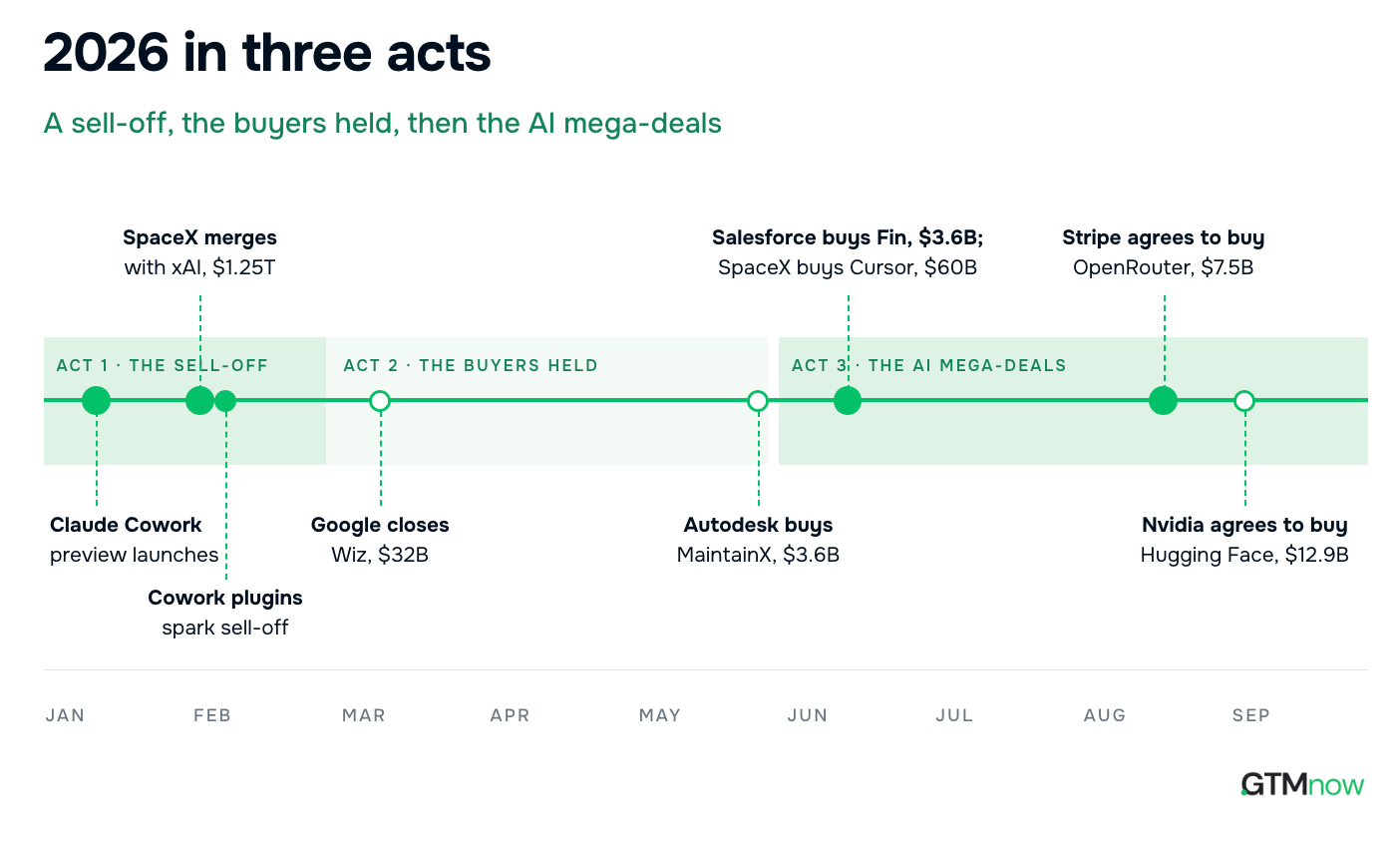
In the 5+ years we’ve been building GTMfund, I’m not sure there’s been a more narrative-dense month. At a minimum, not since ChatGPT launched in late 2022.
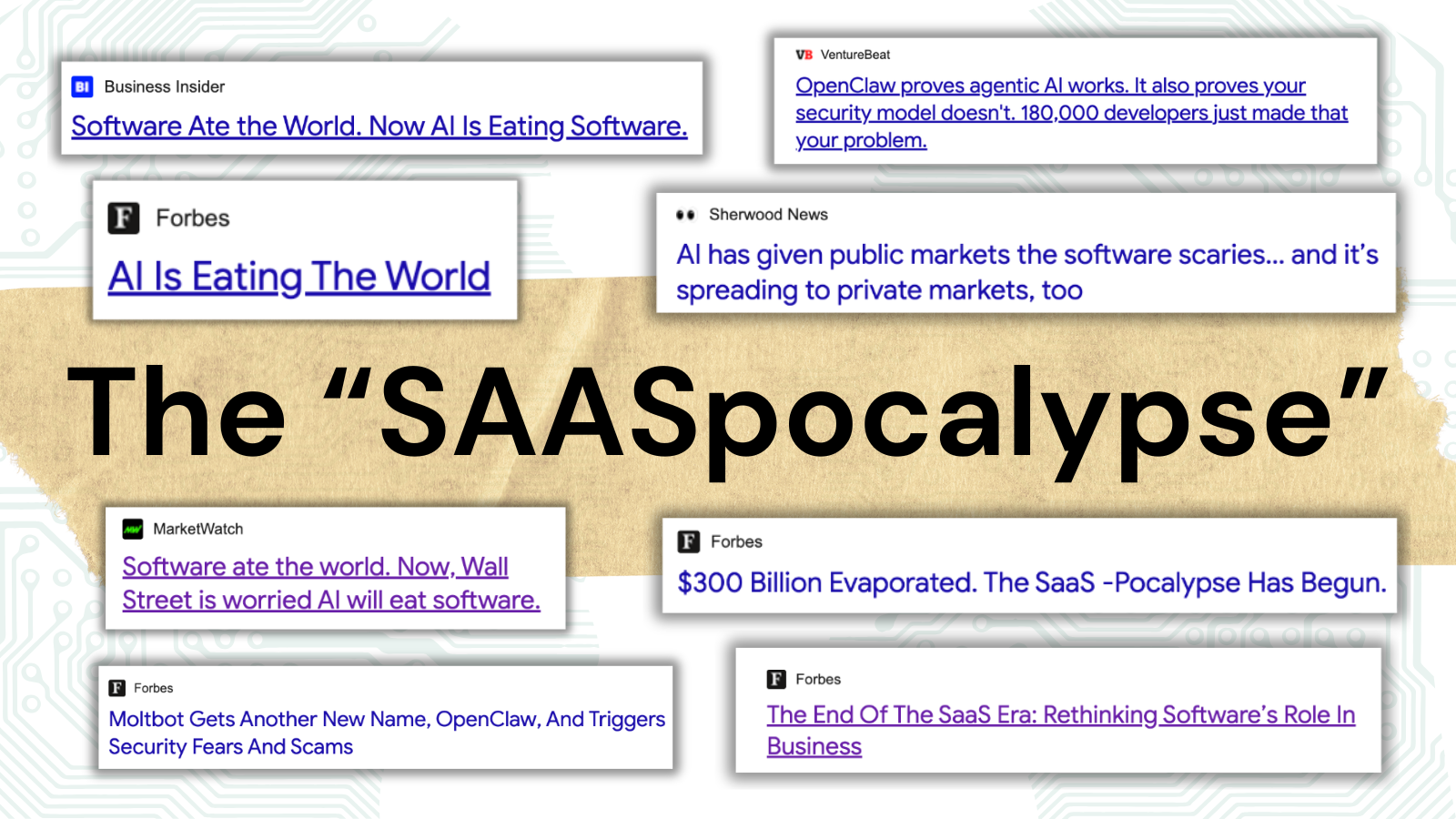
B2B SaaS is dead. Public market software reset. OpenClaw. AI is eating the world.
I wrote this for anyone watching these headlines and feeling uncertain about what they mean. It’s our thoughts on the “SaaSpocalypse,” public markets, and what that means for the startup ecosystem.
Let’s start with the death of SaaS. It’s important to split this conversation into two distinct and important points:
- SaaS is dead because customers will vibe code their own solutions.
- Public markets are revaluing software multiples because of disruption on the horizon.
These are the two primary drivers of panic in the market. We have a lot less concern about the first point.


HockeyStack is the AI platform for modern GTM teams. It unifies all your sales and marketing data into a single system of action. Built-in AI agents help teams prospect the right accounts, improve conversions, close and expand deals, and scale what works.
That’s why teams like RingCentral, Outreach, ActiveCampaign, and Fortune 100 companies rely on HockeyStack to eliminate wasted spend, take better decisions, and make space to think. Learn more at hockeystack.com
SAASpocalypse reason #1: customers will vibe code their own solutions.
AI has created a reality where the incremental cost and difficulty to produce software are declining rapidly. It’s never been easier or faster to code. For the first time in history, non-technical people are writing code and creating products. Even if most of those are prototypes today, the trend is obvious and inevitable – the barriers to entry for creating a usable piece of software are declining to zero.
Naturally, that begs the question: if the cost of creating net-new software continues to decline, won’t customers create their own custom version of the applications they need instead of buying from a vendor? This is the thesis behind vibe coding killing modern SaaS.
The problem with that position is it misses the primary reason most companies buy software. Historically, companies haven’t purchased software because there was no pathway for them to create the tools internally. That was a constraint, but it was never the core driver of purchasing behavior.
Let’s take DocuSign as an example. For an enterprise buyer, the decision isn’t about whether their team could technically build an e-signature tool. It’s about trust, compliance, and legal enforceability. Contracts need to hold up in court. And for the cost of a DocuSign seat (or per-contract pricing if they shift to a usage-based pricing model), that tradeoff is obvious. The expenditure is justified because every signed agreement is legally binding and defensible. The workflows and additional functionality are a bonus, but no serious company is going to risk the legality of its contracts just to save $10 per seat per month and vibe code a replacement.
A similar principle applies to more complex or foundational systems, like CRMs or ERPs. The constraint isn’t technical feasibility. In many cases, a company could build an internal version. The real question is whether it’s rational to do so.
The cost to host, manage, secure, patch, and continuously maintain a platform of that complexity far outweighs the perceived savings of building in-house. Those resources are better allocated toward core product innovation and differentiated capabilities that actually move the business forward. Any OpEx savings are quickly eroded by the long-term operational burden of maintaining and evolving that system.
So, what does vibe coding kill? It kills point solutions. It kills surface-layer applications where a highly customized internal tool may deliver more marginal value than a generic off-the-shelf product. But the thing is, many of those companies were structurally fragile even before AI. They were going to struggle either way – AI just makes the pain of that realization more acute. Historically, some point solution companies could go on to raise Series A, Series B, and sometimes beyond. They would show early traction and promise. But eventually, they would hit a ceiling. AI has accelerated the timeline to that ceiling, but it’s always existed. This is why we have never oriented our investment strategy around point-solution application companies, and never will.
Finally, in the technology ecosystem, we have a tendency to look inward. We live in an echo chamber to an extent. Just because an AI-native Series B company is building a swarm of GTM agents on top of their open-source database vs. buying a CRM doesn’t mean Avis or Coca-Cola is going to do the same. Or any non-tech company. They don’t have the resources, expertise, or interest to divert that level of mindshare away from their core product or mission. It’s just not worth the trade-off. They’ll become AI native, but they’ll do that by purchasing AI-native software – just like they always have. After all, global business software spend is at its highest level in history and accelerating.
This brings us to SAASpocalypse reason #2: public markets are revaluing software company durability and future cash flows.
This challenge is real. It’s more visible in the public markets, but the late-stage and growth-stage private markets are undergoing the same shift. Historically, software companies get better multiples than the average company in the public market because of the reliability of their cash flows. Companies invest a lot in R&D upfront, but once they reach a certain state of maturity, they sell recurring annual contracts at attractive margins (often 80%+) with accounts that expand organically (100%+ NRR). To investors, these businesses were treated almost like annuities. Even without significant net-new growth, a traditional software company could generate predictable internal expansion, low churn, and high-margin revenue.
AI is changing the equation, and it’s changing the math on two fronts:
- Increased competition (and therefore higher potential churn).
- Value squeeze on the middle layer of the technology stack (will expand on this below).
First, the core concern with the declining cost and difficulty of producing usable software is not that customers will vibe code their own enterprise platforms, as outlined earlier. The more material impact is on competitive dynamics. In the cloud era, engineering talent was a bottleneck. Companies could build defensibility by getting to market first, hiring strong engineering teams, and compounding product advantage over time. That bottleneck no longer exists. A small, highly capable team can now build in weeks what previously took years. The market will get flooded with competitive solutions (it already is), and customers will have more choice than ever for which vendor to go with.
On top of this, one of the pillars of software defensibility in the cloud era was switching costs. If you wanted to rip and replace an existing vendor, you had to convince the customer that it would be worth the data transformation, retraining their entire staff, managing change, etc. Well, today, a swarm of AI agents can do the data transformation. You don’t need to relearn a new technology platform if the UI of your application can be reduced to a chat interface and some simple workflows. Declining switching costs directly challenge the defensibility of application-layer SaaS. The markets are responding to this. If someone can’t reliably forecast that Customer X is going to pay a company $100k+ a year for the next decade, well, they’re going to discount those future cash flows more than they previously did. That will lower the company’s market multiple.
The second phenomenon in the revaluation story is the “Middle Squeeze.” There are lots of great reads on this topic specifically, but we’ll reference a mental model shared by David Ondrej (full article in the Quality Reads section).

In an AI-native reality, where value accrues is shifting. Traditional application SaaS existed a lot in the middle layer. Sure, there were some actions you could execute from your SaaS platform (top layer), but they weren’t true agentic outcomes. Middle-layer platforms just made the humans using software on the other end more efficient, but the humans were still the top layer.
AI is pushing value accrual to either end of the equation – the top layer (agents executing workflows and driving outcomes autonomously) and the bottom layer (data that powers these agents). If you’re a Middle-Layer public market software company, you might be in trouble. Agents are coming for your workflow, and they’ll be able to execute it faster and at scale. Over time, they’ll likely be able to execute it better than humans.
If you are a Middle-Layer and Bottom-Layer company (like Salesforce or HubSpot), the public markets will value you more for your bottom-layer capabilities. If you become a database company in the future, suddenly you may not be able to charge the same price per seat, expect the same growth in seats over time, or both. You either need to build a top-layer solution (like Agentforce) that the market loves or risk being relegated to the bottom layer for good. It’s no wonder investors are revaluing these businesses, as this is a tectonic shift in the ecosystem.
Now, what does that mean for us as investors in early-stage B2B technology? Or what does that mean if you’re an operator at early-stage software companies? Not as much as you’d think. Software isn’t dead. Where the value accrues is shifting and shifting rapidly. This means a larger-than-normal portion of incumbents are at risk. And because of how fast AI moves, that risk is building faster than ever before.
However, the underlying principles of value remain: B2B technology spend is growing faster than ever before. AI will capture portions of traditional software budgets but also expand into services, agency, and labor spend. The opportunity is larger than ever; you just need to be thoughtful and deliberate about where you invest and where the value will accrue over time.

Traditional SaaS might be dying. B2B technology is not – it’s alive, well, and growing. Our job is to invest in the future of B2B technology, not the software platforms of yesterday.
Tag @GTMnow so we can see your takeaways and help amplify them.
More for your eyeballs
Who is actually accelerating in B2B right now. Software stocks are way, way down in 2026, but that doesn’t mean growth is down for many of the best.
In defense of vertical software. Right now everyone in this industry is asking some version of the same question: in a world where Anthropic, OpenAI, and Google are pouring hundreds of billions of dollars into building the most powerful general-purpose AI systems in the world, why does vertical software need to exist?
More for your eardrums
For the full thing, listen on Apple, Spotify, YouTube or wherever you get your podcasts by searching “The GTMnow Podcast.
Startups to watch
Nominal – Hardware testing startup hits $1B valuation, raises $155M in 10 months. Nominal on Thursday announced a fresh $80 million Series B extension round at a $1 billion valuation.
Nooks – just launched AI Sequencing, extending beyond its dialer into full multi-channel outbound. Lists, research, email drafting, signals, coaching — all inside what they’re calling the Agent Workspace.
Hottest jobs of the week
- VP of Sales at Spekit (Hybrid – Denver, CO)
- Strategic Account Executive (Central) at Writer (Remote – US)
- AI Native Growth Marketer at Wynter (Remote)
- Growth Development Representative at Northbeam (Hybrid – San Francisco / Los Angeles)
- Sales Manager, Vanta for Government at Vanta (Remote – US)
- Sales Manager at Owner.com (Remote – Toronto, ON)
- AI Engineer, Reinforcement Learning at Oureon (Austin, TX)
- Software Engineer, Autonomy at Oureon (Austin, TX)
- Backend Engineer at Oureon (Austin, TX)
- Software Engineer, Forward Deployed at Oureon (Austin, TX)
- Frontend Engineer at Oureon (Austin, TX)
See more top GTM jobs on the GTMfund Job Board.
GTM industry events
Upcoming events you won’t want to miss:
- MicroConf 2026: April 12–14, 2026 (Portland, OR)
- SaaStock USA: April 15–16, 2026 (Austin, TX)
- Forrester B2B Summit: April 26–29, 2026 (Phoenix, AZ)
- SaaStr Annual: May 12–14, 2026 (San Mateo, CA)
- Demand & Expand: May 19-20, 2026 (San Francisco, CA)
- Dreamforce 2026: September 15–17, 2026 (San Francisco, CA)
- INBOUND: September 16–18, 2026 (Boston, MA)
- Pavilion GTM2026: September 28–October 1, 2026 (NYC, NY)
- Customer Success Week: October 5-9, 2026 (NYC, NY)
- TechCrunch DISRUPT: October 13–15, 2026 (San Francisco, CA)
GTMnow community love
Some GTMnow community (founder, operator, investor) love to close it out – we appreciate you.