

Outbound sales today is still built around manual work: writing emails, building lists, and managing sequences across disconnected tools.
Nooks is breaking the mold. With their AI Sequencing product, Nooks is an agent workspace where AI works alongside reps, helping them understand accounts, prioritize the right prospects, and generate context-rich outreach based on actual first-party interactions.
No more wasting time in multiple tools – it’s one unified workspace for all your outbound channels. Arm your sales team with intelligent outbound. Learn more at https://www.nooks.ai/gtmfund
Build your AI second brain for GTM
You’ve probably heard the term “second brain.” Most people use it to mean one thing: the place you keep what you know, so an AI can work from your context instead of from nothing.
That’s half of it.
AI is exceptional at looking outward. Ask it to research your market and it’ll map your ICP, your competitors’ pricing, and how you position against them. That knowledge gets produced, and it expires. When a competitor repositions, the right move is to overwrite the file.
The other half is what you learned by doing this work. Think of this more as qualitative learning, so you don’t end up relearning the same lessons in the future.
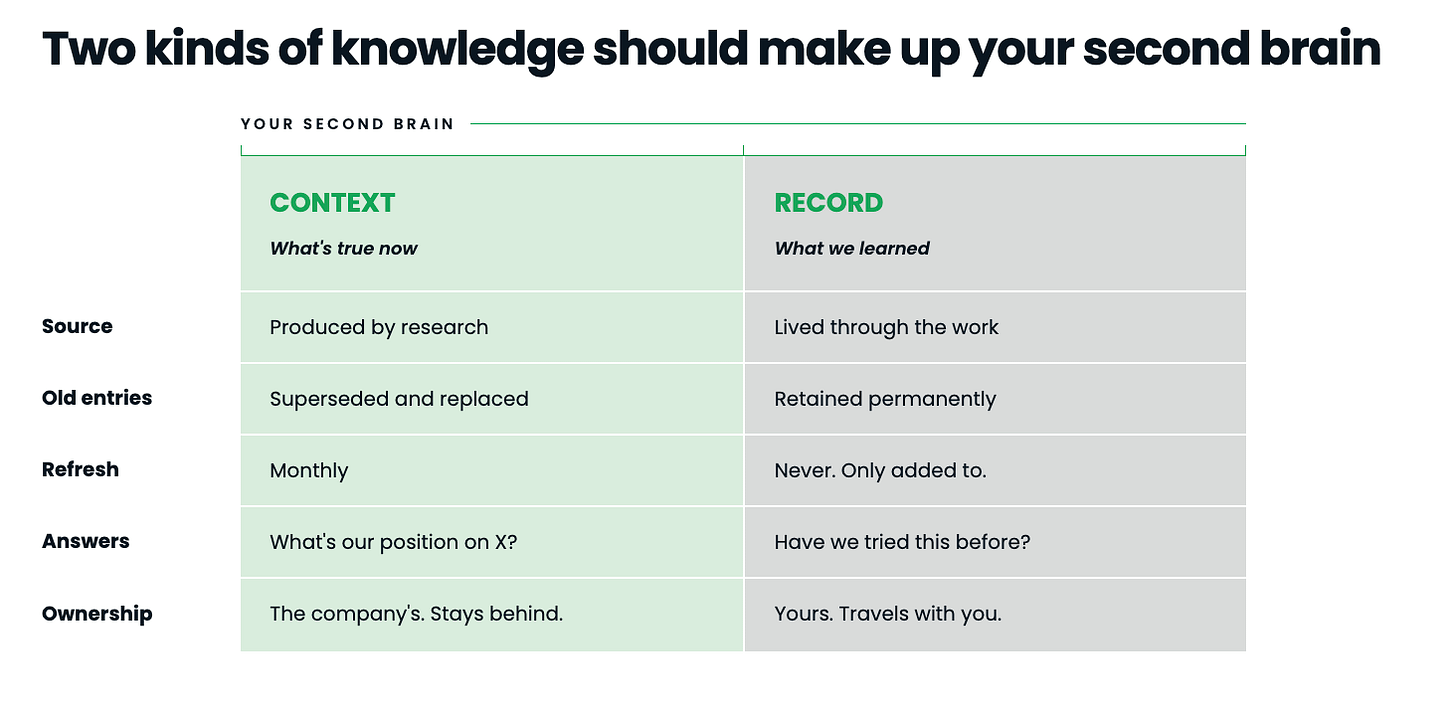
So your second brain needs two stores, and they run different processes within them. Might sound complicated, but that isn’t a new idea. Engineers call it event sourcing, data teams know it as Type 1 versus Type 2, and accountants have run it for five centuries. It has just never been pointed at a revenue team – until now.
This edition breaks down how to build both: two stores with different rules – with under an hour of setup.
Two kinds of knowledge
Many teams treat knowledge as a single asset: collect it, organize it, keep it current.
In practice, there are two different systems.
The first is context: what is true today. For example: your IC and your pricing. Context is operational and constantly changing.
The second is the record: the accumulated record of decisions, experiments, and lessons that got you here. For example: the hypothesis around why an experiment failed. Unlike context, the record compounds. It is the source of judgment, pattern recognition, and intuition.
The challenge is that most organizations store both in the same place.
What happens is that when things change, the history of why behind things gets buried. For example, if a repositioning happens, positioning.md gets updated, and the rationale behind the old positioning gets lost.

Our earlier Claude Code for GTM Teams edition outlines the foundations.
The layers on top
Over the last year, two new things emerged on top of the context layer that we all know well by now. Together, they changed how teams structure AI workflows.
The first is Agent Skills and the second is MCP (more on MCP in this edition).
None of those systems preserve the hard-earned lessons that accumulate along the way, however. That is the job of the record.
Where the second brain fits
Context, skills, and MCP all solve for the present. They tell an agent what’s true today, how work gets done, and where the information lives. None of them preserve judgment.
The record bridges that gap and it operates differently.
Context gets rewritten to ensure it’s most up to date. The record, on the other hand, gets appended. So context preserves current thinking and truth, whereas the record preserves the path that produced it.
Many people have a personal second brain in place. What’s important to also have is the organizational version.
In practice, four categories capture most of what’s worth keeping:
- Plays that worked, along with the conditions that made them work.
- Plays that failed, along with the signals that predicted failure.
- Customer and segment truths learned through churn, discounting, cycle length, or lost deals.
- Decisions and their rationale, so future teams inherit the reasoning instead of only the outcome.

How to build it
The good news is it will take you under an hour to build.
Step 1: set up your folders
gtm-brain/
├── context/     what's true now
│   ├── icp.md
│   ├── positioning.md
│   ├── pricing.md
│   ├── competitors.md
│   └── messaging.md
└── record/       what we learned
    ├── plays-that-worked.md
    ├── plays-that-failed.md
    ├── segment-truths.md
    └── decisions.md
Even if files are empty to start, that’s fine. The structure is the most important part to build because it tells both you and the model where to apply things.
Step 2: establish the routing rule
One paragraph at the top of your CLAUDE.md or project instructions: files in context/ describe the current state and may be overwritten, files in record/ are a permanent record, never edit or delete an entry in record/, append new entries with a date, and if a new entry contradicts an existing one, flag the contradiction and keep both.
Step 3: verify at ingest
Because you never delete from record/, correctness has to be enforced at write time. Every entry carries a date, a source (the deal, the campaign, or the person), and a one-line confidence note. Then turn off the instinct to rank by recency, which is the default in nearly every retrieval system and is actively wrong for this situation. An old lesson is not necessarily a worse lesson.
This is helpful for both individuals in their careers and for companies.
For individuals, every time you leave to go to a new company, you now no longer have to rebuild all the learnings from past experiences.
For companies, any turnover doesn’t impact the accumulated knowledge as heavily.
Use prompts to tell
The cleanest test of whether the split is actually working isn’t the folder structure. It’s the prompts.
Two questions can sound almost identical and still belong to entirely different systems, and the only way to see it is to watch where the answer comes from.
Context prompts ask about the current state. What’s our positioning against X? Draft outbound for the ICP in icp.md using messaging.md for tone. What’s our current mid-market pricing, and what discounts are pre-approved? Each of these is trying to retrieve the latest answer, and the latest answer is the only one that’s useful. Anything older isn’t accurate.
Record prompts do something different. Have we run this play before, and what happened? What did we learn the last three times we sold into mid-sized companies? Why did we decide against usage-based pricing, and who made the call? Across every failed campaign we’ve documented, what patterns show up most often? None of these want the current answer. They want evidence, and evidence gets better as it accumulates.
Tag @GTMnow so we can see your takeaways and help amplify them.
More for your eyeballs
Profound raised $180M Series D at a $1.8B valuation, seven months after its Series C. Sequoia and Kleiner Perkins led. Revenue is up 3x in six months, with 1,000+ enterprise customers including Walmart, Comcast, and Estée Lauder. Brands are finally paying serious money to show up in AI search — and Profound is building the platform that gets them there.
Owner welcomed Matt Rosenberg as Chief Revenue Officer. The challenge he signed up for: building a GTM system that can absorb Owner’s pace of innovation — average engineers are 400% more productive than November 2025, and half of the 2027 roadmap has already shipped. There’s no playbook for that. GTMfund portfolio company.
More for your eardrums
GTM: Why More AI Won’t Grow Your Revenue (and What Will) | Loreal Lynch
Listen through the links in the page above or by searching wherever you get your podcasts “The GTMnow Podcast.”
Startups to watch
Dock (YC S26) launched as a multiplayer agent workspace, where specialized agents work as a team instead of isolated chat boxes. Founded by Mike Molinet and Govind Kavaturi (who previously scaled Branch to $100M+ ARR, then built Thena), Dock lets agents pursue goals, hand off work, and share persistent context so a small human team can steer rather than babysit a dozen chats. Product is at trydock.ai.
AIUC – raised a $40M Series A to certify and insure AI agents. Founded by Anthropic’s first product hire, AIUC audits agents against 5,000 attack and failure combinations for customers like Cursor, Harvey, and KPMG, because risk, not capability, is now what actually blocks enterprise AI deployment.
MIND – raised a $72M Series B to rebuild data loss prevention for the AI era. They grew revenue more than 17x in a year, a sign that there’s big security spend right now is on stopping employees from pasting company secrets into AI tools.
Hottest GTM jobs of the week
- Demand Generation Manager at Gorgias (Hybrid – Toronto)
- VP of Revenue at Cube (Hybrid – New York)
- Sales Development Representative, Early Stage at Vanta (Hybrid – New York)
- Customer Success Manager at Spekit (Remote – US)
- Associate Account Executive, TCG at Alt (Remote – US)
See more top GTM jobs on the GTMfund Job Board.
GTM industry events
Upcoming events you won’t want to miss:
- Pavilion GTM2026: September 28–October 1, 2026 (NYC, NY)
- Moment 2026: October 6, 2026 (NYC, NY)
- CVC Week by Counterpart Ventures: September 29, 2026 (San Francisco, CA)
- Customer Success Week: October 5-9, 2026 (NYC, NY)
- TechCrunch DISRUPT: October 13–15, 2026 (San Francisco, CA)
- GTMfund AGM/Retreat: October 15-17, 2026 (San Francisco & Napa, CA)
More for your GTMnow community love
Some GTMnow Network love to close it out – we appreciate you.