


Outbound sales today is still built around manual work: writing emails, building lists, and managing sequences across disconnected tools.
Nooks is breaking the mold. With their AI Sequencing product, Nooks is an agent workspace where AI works alongside reps, helping them understand accounts, prioritize the right prospects, and generate context-rich outreach based on actual first-party interactions.
No more wasting time in multiple tools – it’s one unified workspace for all your outbound channels. Arm your sales team with intelligent outbound. Learn more at https://www.nooks.ai/gtmfund
The AI-Native Vendor Evaluation Framework
There are more tools than ever, and new ones entering the market every day.
Companies used to win on feature differentiation. Now, companies can ship features with unprecedented speed. While this is still extremely important, there are now new layers that are imperative to assessing vendors in an AI-native go-to-market environment.
We spoke to many GTM leaders about how they’re assessing vendors now, and interoperability came up in every conversation. What matters now is whether tools connect and talk to each other.
This edition outlines a framework you can use to assess vendors with this new AI-native necessity around interoperability.
The Framework
This framework runs alongside your existing feature evaluation, to ensure that the products you partner with support an AI-native GTM approach.
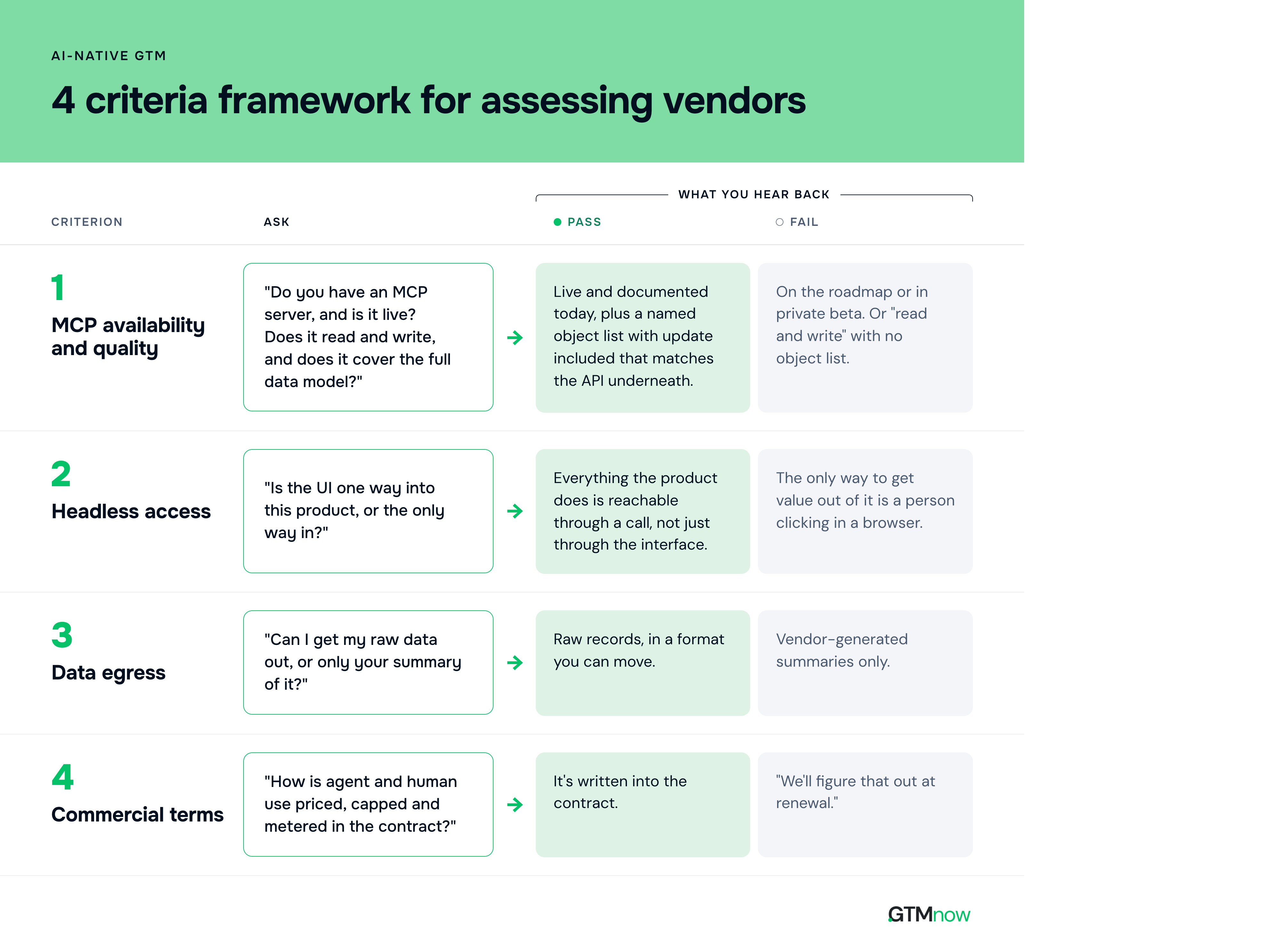
1. MCP availability and quality
Tools need to talk to each other, and MCP is how that happens now. So score it in every vendor eval, and score it with two questions.
Do you have an MCP server, and is it live? Not on the roadmap. Not in a private beta with a waitlist. Not a community project someone at the company starred on GitHub. Live, documented, and something you could connect to on the call. Nearly everyone says yes to the first half of that question now, and noticeably fewer survive the second half.
Does it read and write, and does it cover the full data model? This is where the evaluation actually happens. “Read and write” is a marketing phrase, and it covers three different failure modes. Some servers create and delete but deliberately won’t update, on the reasoning that models behave unpredictably against existing records. Some write to activity logs but not to the records those activities describe. Some write everywhere except the one custom object your process depends on.
MCP is a completely new layer, but API has been around forever. These are just newer layers stacked on top of each other. A layer sitting on an API can expose all of it, some of it, or almost none of it, and nothing about the label tells you which.
So push on coverage from both sides. Ask what the MCP server can write, then ask what the vendor’s REST API could already write. Most servers today expose less than the API sitting behind them, and the size of that gap tells you how much work the vendor has actually done here.
2. Headless access
The word comes from architecture, and the “head” is the interface. Applied to a vendor, the test is simple: is the UI one way into this product, or the only way in?
Everything the tool can do should be reachable without a person rendering a page. That mat sound obvious, but it can be harder to assess in practice. None of it typically shows up in a demo, because a demo is a person driving the UI.
You really have to intentionally probe on this.
List what your team actually does in that tool in a given week, then ask the vendor which of those specific actions have an API or MCP call behind them. Not “do you have an API” broadly – specifically which of these.
3. Data egress (raw data access)
This means: can you get the raw record out, or only the vendor’s summary of it?
A server can be live, well built, and genuinely useful and still hand back nothing but its own interpretation of your data. That stays invisible for as long as you work inside that vendor’s own workflow, because in there a summary looks like an answer. It surfaces the day you want the analysis to happen somewhere else, or want to feed the inputs into a model you control, or simply want to switch. Then you find out the hard way.
So ask this question: Can I pull the full transcript, the message body, the raw activity list, in a format I can move?
4. Commercial terms
This is an obvious but important one. Per-seat pricing doesn’t survive agents, and we’re seeing many vendors shift to consumption-based, outcome-based or other pricing models.
It’s already showing up in multiple ways:
Some gate agent access behind a paid add-on sitting on top of the seat license.
Some meter queries against credits, so cost scales with how curious your reps get.
Some park the capability behind an edition floor you’d have to upgrade into.
Some charge per outcome, a resolved ticket or a booked meeting rather than a token burned.
So ask to clearly document and understand the pricing model for agent and human use before committing to anything.
Product features are still extremely important, and leaders are well-versed in assessing those. These four are now just as important for assessing vendors in an AI-native GTM environment.
Tag @GTMnow so we can see your takeaways and help amplify them.

Row Zero, a GTMfund portfolio company, has been acquired by Databricks. Row Zero is the best spreadsheet for big data. It’s a cloud tool that can scale beyond 1 million live spreadsheet rows – which became a game changer for Databricks.
Databricks serves 20,000+ organizations, including 70% of the Fortune 500. Row Zero’s engineers are already hard at work integrating Row Zero throughout the Databricks platform.
DeepSeek raised API prices by as much as 4.5x and its revenue run rate doubled to $1B, with a reported $7.5B round at a $74B valuation now closing. Its founder reportedly told investors customers stayed after the price hike, which suggests the race to the bottom on inference pricing may already be over. Figures come from The Information, not the company.

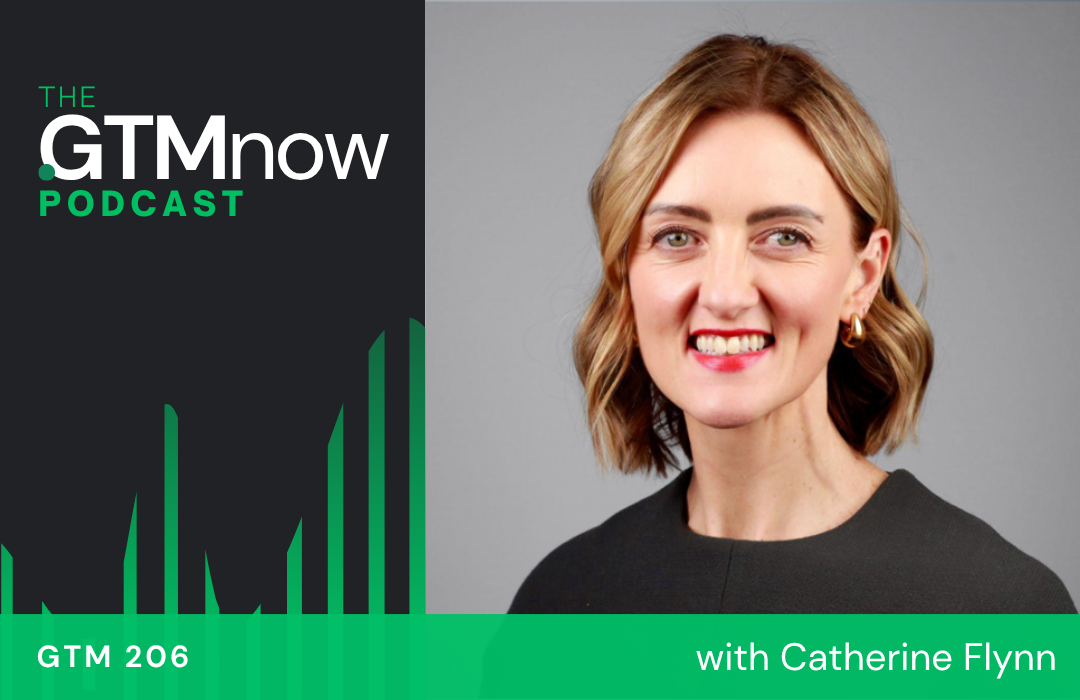
GTM: Inside LinkedIn: How to Grow Your Profile, Buyer Behavior and Social Selling | Catherine Flynn
Listen through the links in the page above or by searching wherever you get your podcasts “The GTMnow Podcast.”

Numeral – raised $100M Series C led by Insight Partners, with Salesforce Ventures and Benchmark participating, to solve sales tax, VAT, and GST compliance for 3,500+ global businesses. Customers include Supabase, Eight Sleep, and Graza. Sales tax is getting more complex — states like California are adding new software taxes and using AI for enforcement. Numeral is building the compliance system that keeps up.
Trebellar – raised an $18M Series A to run corporate real estate on AI instead of spreadsheets. Led by Blossom Capital, with Meta, Uber, and Merck already customers, it’s a bet on the last back office function still living in spreadsheets.
Chamelio – raised a $26M Series A to put AI agents to work inside corporate legal teams, not just store their contracts. Led by Entrée Capital, the New York company quadrupled ARR in five months, with Wiz and monday.com as customers.
Baselayer – raised a $35M Series A to verify that the business, or now the AI agent, on the other end of a transaction is who it claims to be. Led by M13, it serves more than 2,000 financial institutions and says it has prevented over $1B in fraud losses.
Firecrawl – raised a $75M Series B and launched Alexandria, a curated data library built for AI agents to search instead of the open web. Led by Smash Capital, it has 1.5 million users, on the thesis that agents are limited by data access, not reasoning.
Ema – raised a $77M Series B to deploy AI “employees” across enterprise HR, IT, and finance. Led by Creaegis with Accel and S32 following on, Ema grew revenue 50x in two years, a sign AI budgets now come out of headcount, not software.

Senior Content Marketing Manager at CaptivateIQ (Remote – USA / Toronto)
Revenue Enablement Manager at Owner.com (Hybrid – Toronto)
Customer Success Manager at BlueCargo (Remote – Atlanta, GA)
VP of Revenue at Cube (Hybrid – New York)
Partner Marketing Programs Manager, Global at Vanta (Remote – US)
Demand Generation Manager at Gorgias (Hybrid – Toronto)
See more top GTM jobs on the GTMfund Job Board.

Upcoming events you won’t want to miss:
Pavilion GTM2026: September 28–October 1, 2026 (NYC, NY)
Moment 2026: October 6, 2026 (NYC, NY)
CVC Week by Counterpart Ventures: September 29, 2026 (San Francisco, CA)
Customer Success Week: October 5-9, 2026 (NYC, NY)
TechCrunch DISRUPT: October 13–15, 2026 (San Francisco, CA)
GTMfund AGM/Retreat: October 15-17, 2026 (San Francisco & Napa, CA)

Some GTMnow Network love to close it out – we appreciate you.