
Go-to-market has never been more nuanced. What works at one company breaks at the next, and the same framework can look completely different depending on your motion, your buyer, and your stage.
But a handful of foundational frameworks hold up almost everywhere.
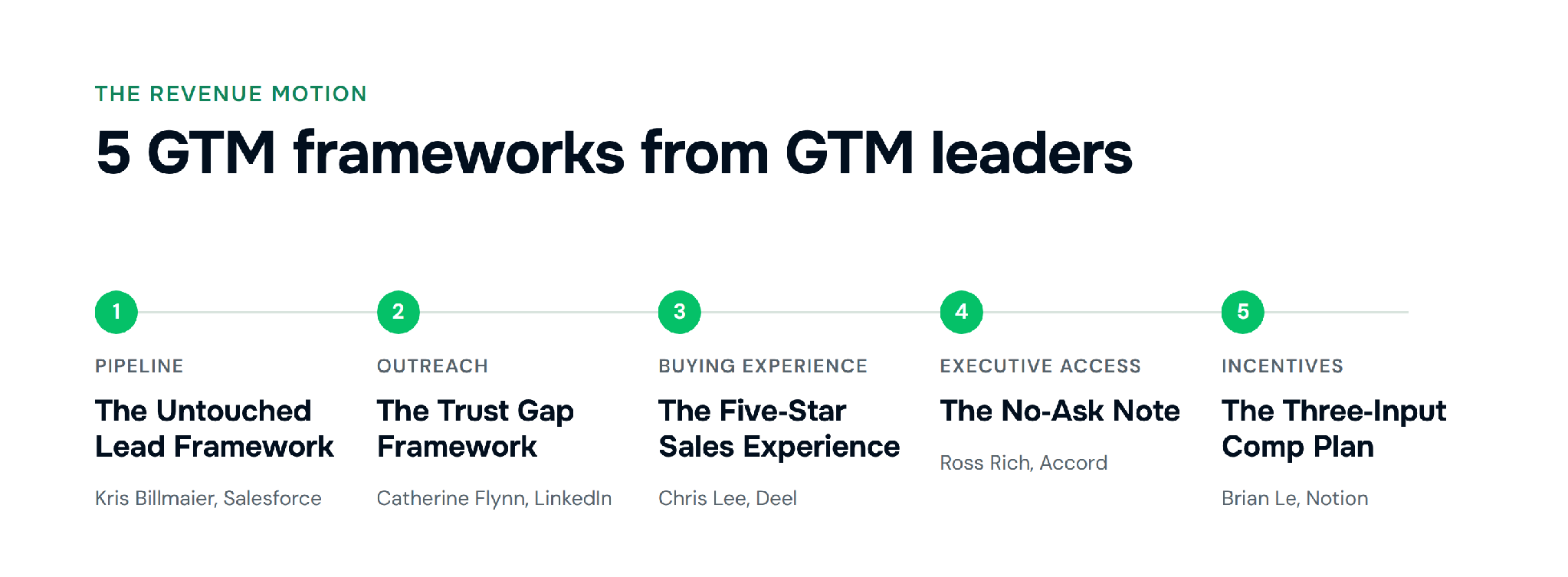
We handpicked five of them, each shared by a GTM leader, and each covering a different stage of the revenue motion: the pipeline you already have, how you earn the first conversation, how buying feels, how you reach the executive, and how you pay the team doing all of it.
This edition breaks them down. Let’s get into it.


For the ABM folks: Influ2 built an MCP connector that lets Claude or ChatGPT read your contact-level ABM data and act on it.
That means your AI tool now knows who your buyers are, so you can build programs, check performance, gather Sales intel, and more – right from the chat.
Influ2 also put together 30+ ready-to-use AI prompts, organized by what you’re trying to get done. Get them for free here!
5 GTM Frameworks
We handpicked five of them, each shared by a GTM leader, and each covering a different stage of the revenue motion.
1. The Untouched Lead Framework
Kris Billmaier, EVP and GM of Agentforce Sales, Salesforce
Every sales team has a pile of leads nobody works on.
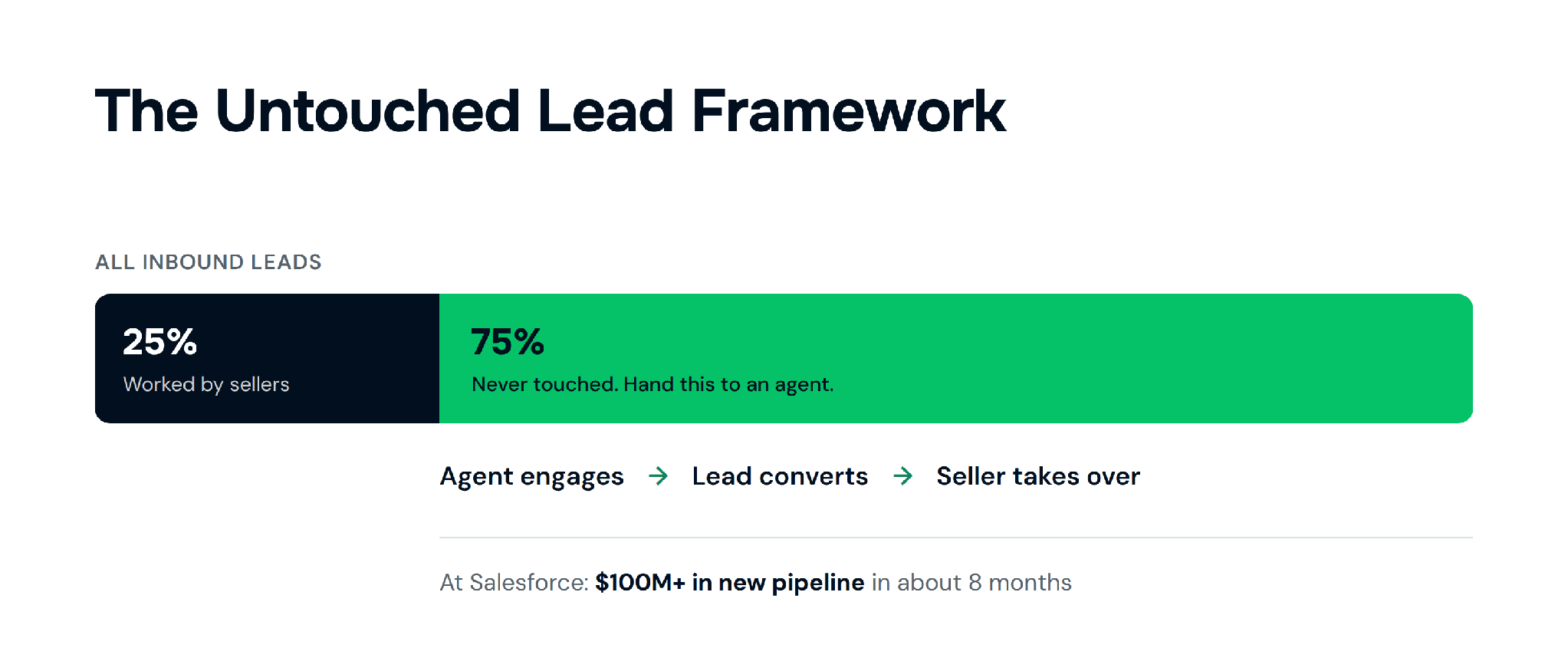
At Salesforce, inbound leads are scored from 1 to 5. Sellers worked the 3s, 4s and 5s. The 1s and 2s made up about 75% of all lead volume, and no human ever touched them.
Most teams are stuck debating whether AI should replace their SDRs (our opinion at GTMfund: don’t replace outbound SDRs with AI…). This framework skips that debate entirely though and focuses upon the work that nobody was doing before.
Find the dead zone. Pull last quarter’s leads by score and calculate the share no seller ever contacted. That number is the size of the opportunity, and for most teams it’s bigger than they’d guess.
Give the dead zone to an agent, and only the dead zone. The agent’s lane is everything below your human threshold. Keep it out of the leads your sellers already work on. That boundary is what stops agents and reps from colliding and what keeps reps bought in.
Score it on the pipeline, not activity. The only question that matters is whether the pile produces a qualified pipeline that didn’t exist before.
Hand back when it converts. Once a lead engages and qualifies, it moves to a human seller. The agent warms, the seller closes.
Salesforce pointed an engagement agent at exactly that pile. Their BDR leader now runs a team of about 100 reps, with agents adding the output of roughly 400 more.
“In about eight months’ time, we drove over $100 million in pipe that was totally unseen otherwise.” – Kris Billmaier, Salesforce
2. The Trust Gap Framework
Catherine Flynn, Global Marketing Lead, LinkedIn Sales Solutions
Buyers have never had more information. Trust has never been harder to earn.
LinkedIn surveyed B2B buyers on what makes them trust a seller. 86% said expertise. But only 45% described the sellers they actually meet as trustworthy.
Then they surveyed sellers. Sellers think they’re trustworthy…that’s a 41-point gap, that’s a problem.
To fix this gap and come across as more trustworthy, sellers can do so with better signals – sellers can do less outreach than ever and make each touch count.
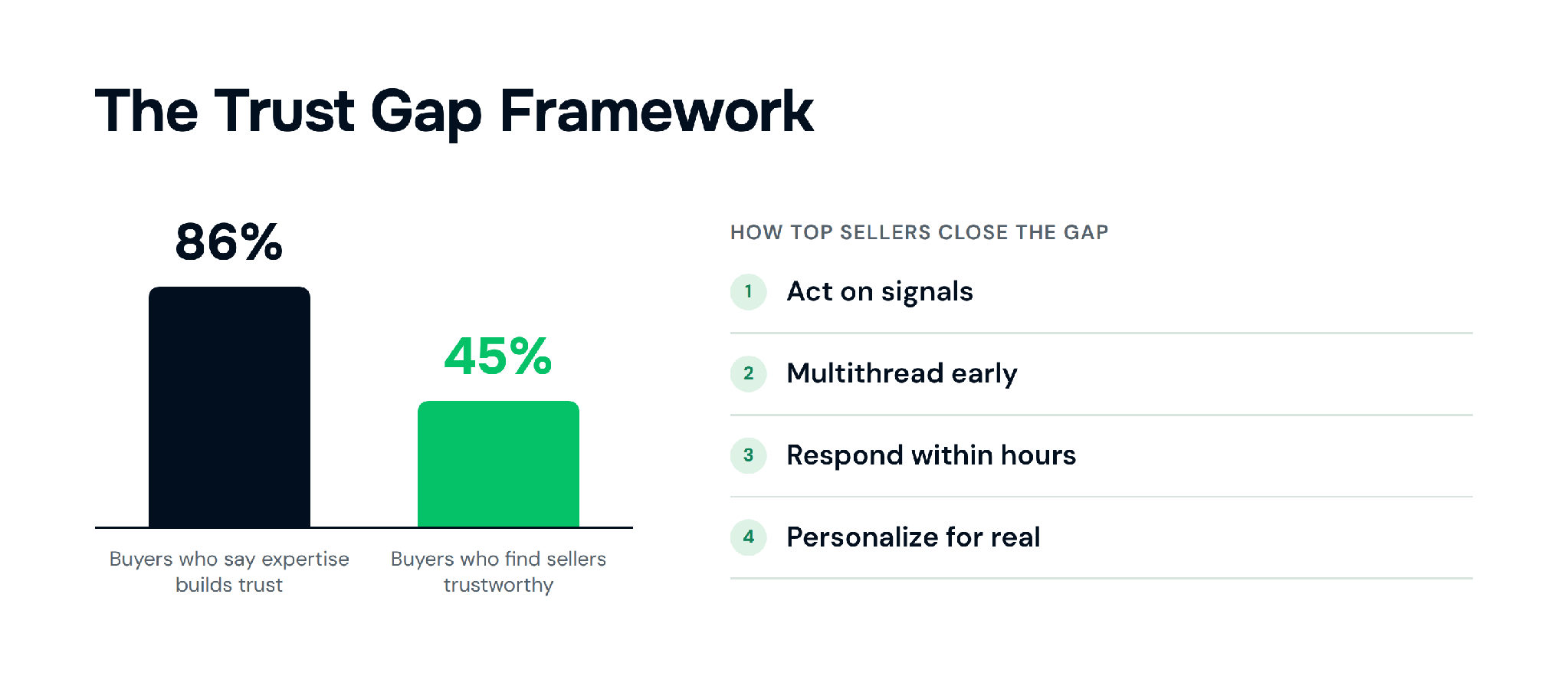
Act on signals. Start from something that just changed: a job change, company news, or a product launch. Profile views are one of the strongest signals there is, because buyers check a seller’s profile before they reply.
Multithread early. Buying groups are getting bigger and cycles are getting longer. The warmest paths are customer advocates, former customers who’ve moved to new companies, and mutual connections, which get nearly 3x the InMail response of cold outreach. Top sellers are also almost 50% more likely to bring in their own executives as sponsors.
Act insanely quickly. Signals decay fast. For example, the value of a job change is highest the day it happens.
Deeply personalize. Not “Hi {first name}.” The first conversation is about their problem and your point of view on it. The product comes later.
“The top sellers are reaching out within hours, not days or weeks, of a job change.”
– Catherine Flynn, LinkedIn
3. The 5-Star Sales Experience Framework
Chris Lee, Head of Sales, Americas, Deel
Everyone talks about customer experience. Almost nobody talks about sales experience.
Chris got the idea for this framework from hotels. At a 3-star hotel, you travel for hours, wait 20 minutes in line, get your key and go to your room. Nothing is wrong, but nothing is memorable either.
At a 5-star hotel, they know who you are and what time you’re arriving. Someone opens the car door, takes your bags and books your dinner. Every moment of that experience is work done before you walk in.
So Chris asks a simple question of every deal: what would the 5-star version of this sales process feel like?
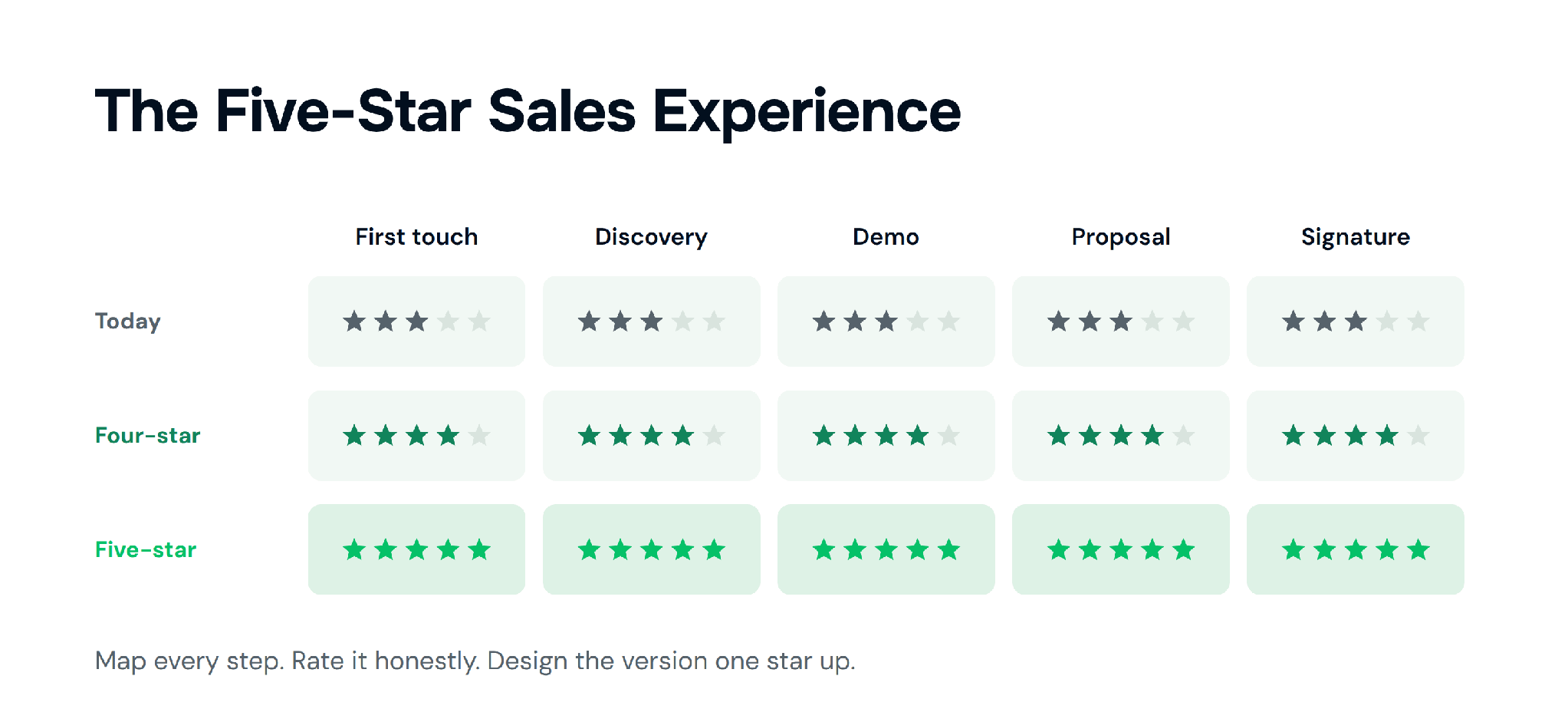
Map every step. Write down every moment the buyer experiences, from the first inbound touch to signature. Not your internal pipeline stages. Their experience of you.
Rate it honestly. Give each step a star rating. Most land at three stars: functional, predictable and forgettable.
Design one star up. For each step, write what four-star looks like, then five. Chris pushes further and imagines a ten-star, just to break out of what’s normal for your category. Make your own scale.
Invest where it counts. Some upgrades cost nothing. Others cost money, and AI is making many of them cheap. The personalization and ABM that used to be reserved for enterprise deals can now reach SMB buyers too. Decide step by step, based on your product, your persona and your industry.
“What is a 4-star sales experience if today is a 3-star, if today is mediocre, what is a 5-star?” – Chris Lee, Deel
Here’s what a 5-star looks like at Deel. A founder who wants to meet on a Saturday gets a meeting on Saturday. After a demo, the senior leadership team introduces themselves to the buyer. Chris has given his cell number to thousands of prospects, and all he asks for in return is honest feedback on the sales process.
He also keeps an internal leaderboard of prospect sentiment about the sales experience itself (most of his reps don’t know it exists – maybe they will now though!).
4. The No-Ask Note Framework
Ross Rich, Co-founder and CEO, Accord
Every rep wants the CRO meeting. Most of them ask for it too early.
Ross’s view is that CROs delegate. They own the revenue strategy and the forecast, and they lean on RevOps, enablement and their VPs to evaluate tools. Show up in their inbox too early and you’re wasting their time, but ignore them and you’re invisible to the person who signs.
The no-ask note framework solves both problems. Ross picked it up from Skip Miller during his years in GTM at Stripe.
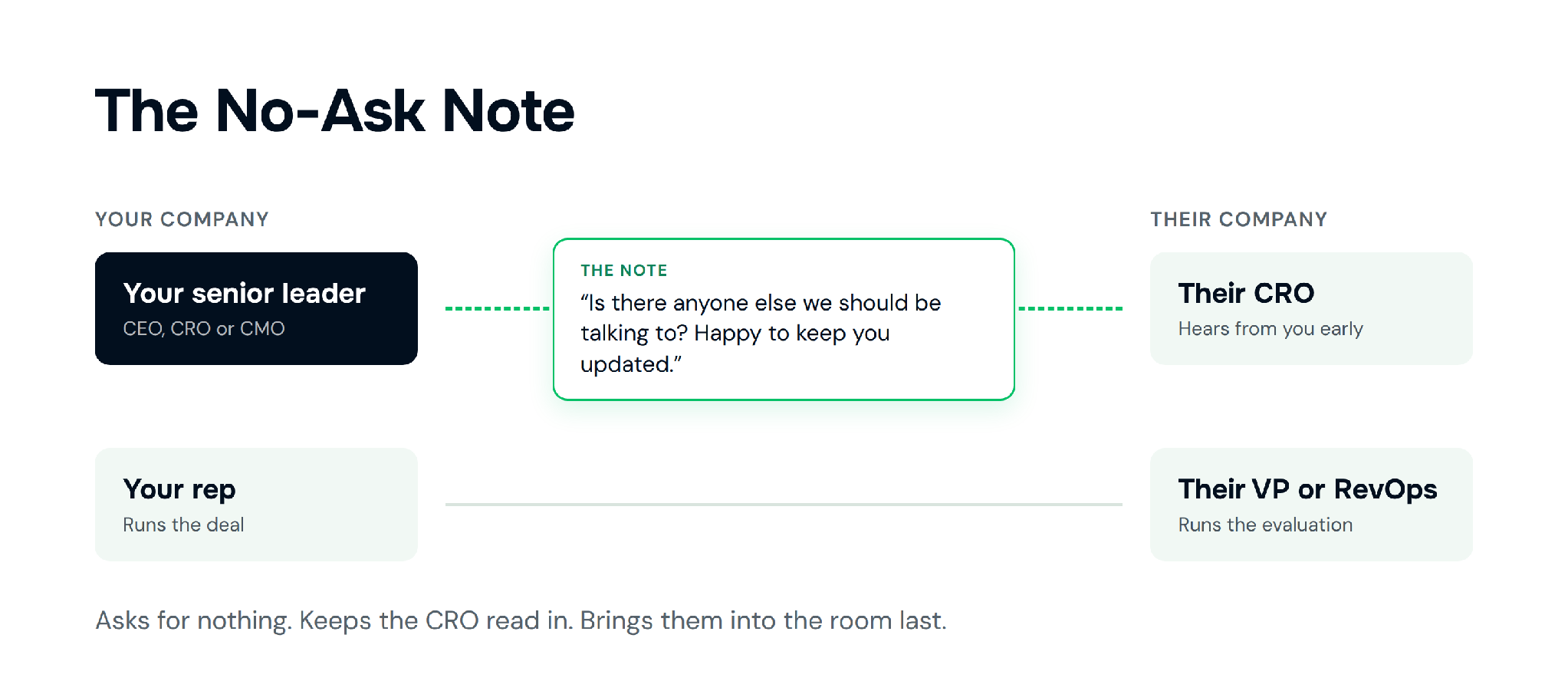
Earn it first. Start with a strong discovery conversation with someone on the CRO’s team: RevOps, enablement or a VP. The note needs something real to reference.
Match the sender. The note doesn’t come from the rep. It comes from the right senior leader at your company, matched to their seniority: your CEO, CRO or CMO.
Ask for nothing. The whole note fits in four lines. It sounds like you’re focused on this priority this year. We’re excited to explore it with your team. Is there anyone else we should be talking to? Happy to keep you updated. The only ask is the light one in the middle.
Stay async, and bring them in last. Through a long deal, keep sending short updates in their language. By the time the CRO joins a call, every answer is ready and every stakeholder is aligned.
“You’re not asking for anything. And the big problem is that everyone usually starts with, hey, can I get 15 minutes?” – Ross Rich, Accord
5. The 3-Input Comp Plan Framework
Brian Le, Global Sales Compensation, Notion
Sales comp is an operating system for go-to-market: whatever the plan rewards is what reps will do, regardless of what the strategy deck says.
At Notion, Brian scaled the commissioned team from 80-90 people to 400+ in about 2.5 years. Every plan he builds comes down to three inputs, and the three have to agree with each other.
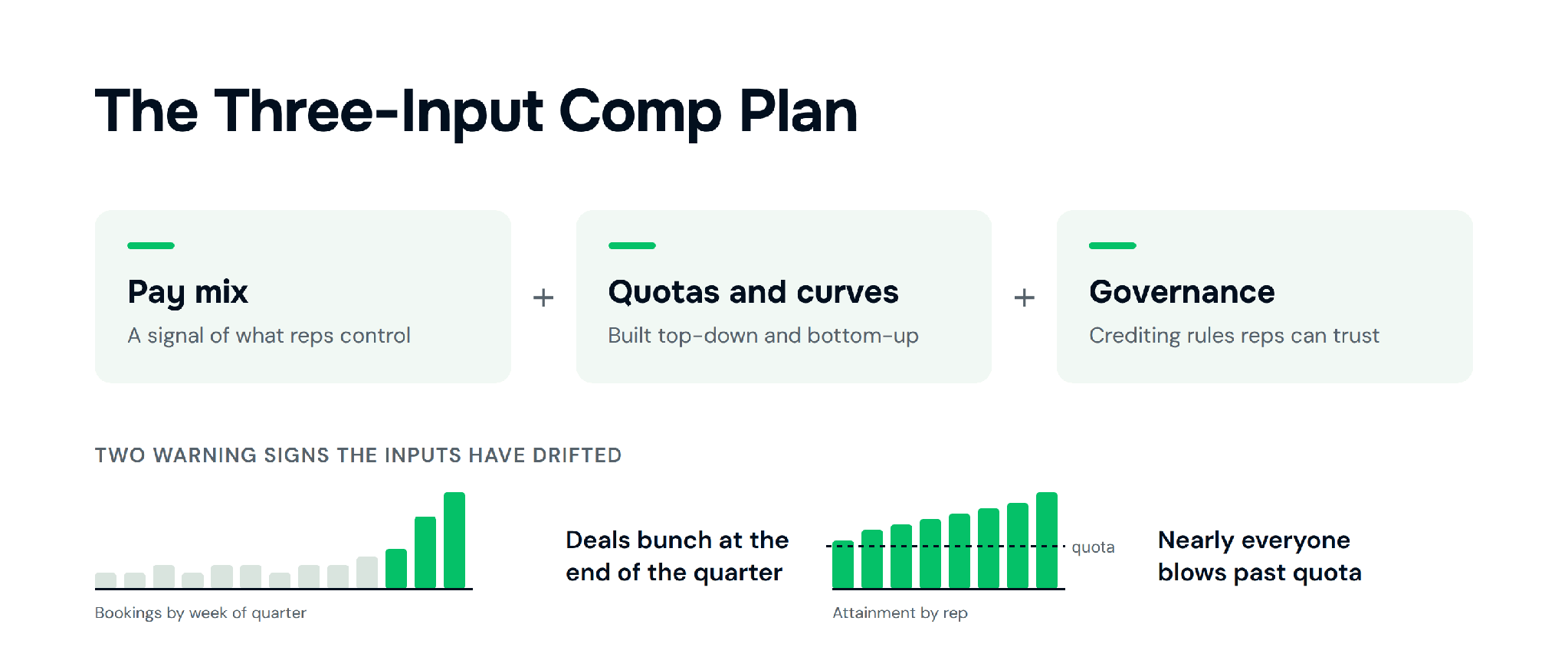
Pay mix. Most teams treat the base and variable split as a number that adds up to 100. Brian treats it as a signal to sellers about what they actually control. The more a rep can influence the outcome, the more of their pay should ride on it.
Quotas and pay curves. Build quotas top-down from the plan and bottom-up from real capacity, then backtest them against actual pipeline conversion rates. Dividing the number by headcount is not a quota.
Governance. Policies, crediting rules, leaves and holdovers. It’s the least glamorous input and the one where trust is won or lost. Break one crediting promise and you lose capacity and the ramp investment you made in that rep.
“When one doesn’t speak to the other, that’s when you start to see the degradation of comp plans.” – Brian Le, Notion
Brian watches for two early signs that the inputs have drifted apart.
Deals bunch at the end of the quarter. If bookings spike in the final weeks, the plan may be shaping when reps close, or the sales cycle is longer than the plan assumes.
Nearly everyone blows past the quota. A good quarter feels great. A distribution where almost every rep beats their number usually means the quota is wrong.
Tag @GTMnow so we can see your takeaways and help amplify them.

CertifID acquired Closinglock (GTMfund company) to build end-to-end fraud prevention for real estate transactions. The combined platform covers identity verification, secure payments, and closing workflows in one place for the real estate industry.
Databricks acquired Row Zero (GTMfund company), a cloud spreadsheet that scales beyond 1 million live rows, after its own finance team fell in love with it. Combined with Databricks’ AI agent Genie, enterprise data stays secure while analysts interact with it in the format they already know. At $7B ARR and five acquisitions this year, Databricks says it’s just getting started.
Salesforce is acquiring Listen Labs, the AI-powered market research platform that replaced slow, expensive studies with continuous customer interviews. Within a year of launch, Listen was serving 20% of the Fortune 500. As AI makes building easier, knowing what to build becomes the hard part – Listen helps companies answer that by actually talking to their customers.

GTM: How a $2B company’s CMO trained half her org to build agents (in 2.5 weeks) | Meagen Eisenberg
Listen through the links in the page above or by searching wherever you get your podcasts “The GTMnow Podcast.”

EliseAI – raised $350M at a $4B valuation, led by a16z and Bessemer, for AI agents that run apartment buildings’ day-to-day work. It handles renter questions, tours, maintenance requests, and renewals across 6.5M units, about 1 in 5 US apartments, and has passed $200M in ARR.
Ascerta – raised an $18M Series A, led by Dell Technologies Capital, to show companies whether their AI spending actually pays off. It tracks the cost, usage, and business results of AI tools like Copilot and Agentforce in one place. One customer caught an AI agent whose cost per run had jumped from $0.40 to $70. The AI boom has created a second market: proving the ROI.
Modulate – raised a $25M Series B, led by Future Ventures, for voice AI that understands how something is said, not just what’s said. It analyzes tone, emotion, and intent in live calls, and flags deepfake voices and fraud. It started by moderating voice chat in Call of Duty and has analyzed 600M+ hours of audio.

Growth Marketer at Tavus (San Francsico, CA)
Customer Success Manager – Pooled Accounts at Nectar (Hybrid – Lehi, UT)
Sr. Partner Marketing Manager at Capchase (Hybrid – Dallas, TX)
Account Manager, Commercial at Gorgias (Hybrid – Belgrade)
Director, Business Development at Owner (Remote – USA)
See more top GTM jobs on the GTMfund Job Board.

Upcoming events you won’t want to miss:
Moment 2026: October 6, 2026 (NYC, NY)
GTM On the Edge: Live Session: October 7, 2026 (San Francisco, CA)
Customer Success Week: October 5-9, 2026 (NYC, NY)
TechCrunch DISRUPT: October 13–15, 2026 (San Francisco, CA)
GTMfund AGM/Retreat: October 15-17, 2026 (San Francisco & Napa, CA)
Net 30 (AI x Finance Summit): October 21, 2026 (NYC, NY)

Some GTMnow Network love to close it out – we appreciate you.