Companies are increasingly hiring for this new role.
xAI is hiring a Head of GTM, Systems and Agents.
Notion is hiring a GTM AI and Innovation Manager.
Zapier brought on a Director of GTM Innovation.
While the titles themselves vary from company to company, If you read the job descriptions what they’re all hiring is an Agent Operator.
Every GTM team is about to need one. Most teams already have a shadow version, usually a high-agency RevOps lead, a curious AE, or the marketer who turned their personal Claude workflow into the team’s. They’re doing the job without the title, the budget, or the tools to do it well. That’s changing, with more companies hiring for Agent Operators.
Why this role, why now
The Agent Operator is a role increasingly being hired for because six things happened at the same time, and any one of them on its own would’ve been a footnote. Together, they reshape the org chart.

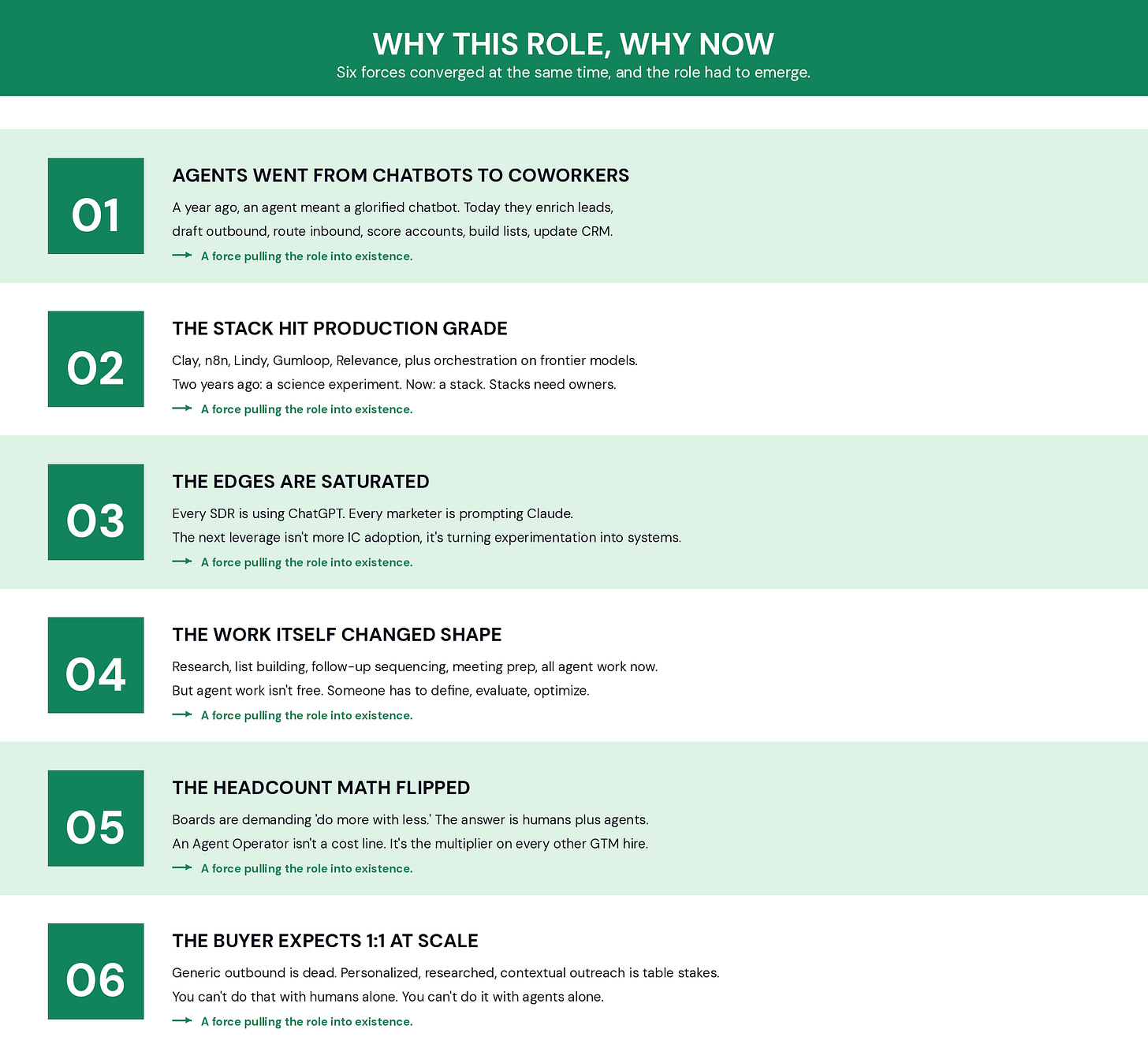
Six forces converged at the same time, and the role had to emerge
1. Agents went from chatbots to coworkers
A year ago, “AI agent” looked very different than it does now. The work agents can do has expanded roughly 10x in 18 months. The work humans need to do to deploy them has expanded with it. Defining the task, evaluating the output, handling the edge cases, optimizing the prompts: none of that goes away when you swap a human for an agent, it just moves to whoever’s running the agent.
2. The tooling stack hit production grade
Today, there’s a real stack behind agentic GTM. Clay for data and orchestration, n8n and Gumloop for workflow plumbing, Lindy for vertical agents, internal orchestration on top of Claude, GPT, and Gemini. The tools graduated from “interesting” to “production.” Production stacks need owners, the same way every other production system in the company has one. Nobody runs a Salesforce instance without an admin. Nobody runs a marketing automation platform without an ops lead. And yet most GTM teams are running a fleet of agents with nobody whose actual job is to make sure they keep working.
3. The edges are saturated
The next layer of leverage is the move from a thousand private experiments to a handful of deployed, measured, repeatable systems that the whole team runs on. That requires somebody whose actual job is to make that translation happen, taking the IC’s clever prompt and turning it into infrastructure the entire team benefits from. Without that person, you don’t have an AI strategy.
4. The work itself changed shape
Work that used to be fulfilled by employees is now agent work. But agent work isn’t free. Someone has to define the task in writing, evaluate whether the output is good, handle the cases the agent can’t, and optimize the system over time. Without that person, you have a fleet of agents and no one watching the road. The work didn’t disappear. It moved upstream, and it concentrated. Which means the leverage of the person doing it concentrated too.
5. The headcount math flipped
“Do more with less” has been a common line for years. Most teams have heard that as a hiring freeze. It isn’t, exactly though because it’s more like a hiring freeze for the old org chart.
The new math is humans plus agents, and the math only works if someone knows how to deploy and supervise the agents. An Agent Operator isn’t a cost line, it’s the multiplier on every other GTM hire you make. Without one, your three-person SDR team has three people. With one, your three-person SDR team has three people and a fleet of agents doing the research, list building, and first-touch outreach behind them. The Operator’s value is measured by how much they can improve everyone else’s output.
6. The buyer expects 1:1 at scale
Generic outbound is dead. Buyers can spot a templated sequence from a hundred yards, and reply rates have collapsed for anyone still trying to scale the old way. The bar is now personalized, researched, contextual outreach, at volume.
You can’t hit that bar with humans alone. The unit economics don’t work. You can’t hit it with agents alone either. They miss nuance, hallucinate context, and produce output that’s confident but wrong if nobody’s watching. The only path through is humans plus agents, stitched together cleanly, with an Agent Operator running the seam. The seam is the role.
Agent work, then and now
If the role still feels abstract, the easiest way to ground it is to look at how the underlying work changed. Two years ago, an “AI agent” was a feature. Today it’s a coworker. That shift is what makes the Agent Operator role load-bearing.

What ‘AI agent’ meant 18 months ago vs what it means today, and why that shift demands a new kind of supervision
The 18-months-ago column isn’t a strawman. We’ve all sat through demos of single-turn chatbots that deflected an FAQ, got celebrated as innovation, and got abandoned six months later when nobody wanted to maintain them. They were features, not systems, and they didn’t need an owner because they didn’t really do anything.
The 2026 column is structurally different. Multi-step autonomous workflows that live inside the system of record, run continuously, and produce output that downstream humans depend on, are systems. Systems have failure modes. Systems drift. Systems degrade silently if nobody’s watching them. The reason most agent deployments quietly fail in month three isn’t that the technology stopped working. It’s that the technology kept working while the world around it changed, and there was nobody whose job was to notice.
What the Agent Operator actually does
Strip the title politics out of the conversation and the work breaks down into four stages, run on a loop. Every Agent Operator job description should map to these four.

Four stages, run on a loop. Each one feeds the next. Without the loop, you have agents and no one watching the road.
Define
The Agent Operator writes the job description for every agent on the team. Not the prompt, the JD. What’s the task, in writing? What’s a successful output look like? What inputs does the agent get? What does it escalate? What does it never do, ever, even if asked?
Loose task definition produces loose output, the same way a loose hiring brief produces a loose hire. The Agent Operator’s first move on any new agent is forcing the precision that prompts alone never demand.
Deploy
The Agent Operator picks the stack. The decision is “which tool is best for this specific job, given our data, our team, and the half-life of the technology.” It’s super nuanced to each company.
The pic isn’t permanent.. Stacks have a 6-9 month half-life right now. The Agent Operator’s job is making the next swap painless when the better tool shows up, which it will.
Evaluate
The Agent Operator builds the evals: a sample set of inputs, a defined rubric for what “correct” looks like, a way to score outputs at scale, and a baseline performance number that gets tracked over time.
When the underlying model gets updated, evals catch the regression before customers do. When a new prompt gets pushed, evals tell you whether it’s actually better or just feels better. Without evals, you’re managing on vibes. With evals, you’re managing the way a sales manager manages a rep ramping up: against a measurable bar that doesn’t move based on whose turn it was to demo the tool that week.
Optimize
Agents don’t stay the same, models update, tools deprecate features, buyers change behavior, internal priorities shift. The Agent Operator iterates on prompts, context, data sources, and guardrails on a regular cadence (weekly for high-volume agents, monthly for lower-volume ones), not when something breaks.
This is the part that compounds. A team running iteration cycles every week for six months has a fleet of agents that’s measurably better than a team running the same agents on autopilot. The agents on autopilot degrade because the world around them changed and nobody adjusted.
The three things an Agent Operator does not own: the strategy itself (that’s the GTM lead’s job), the customer relationships (still humans), and the budget (RevOps or finance). They’re a force multiplier on those functions, not a replacement for them.
The market’s already pricing this in
If you think this thesis sounds early, the labor market disagrees. The role exists, it’s already being hired, and the only thing the market hasn’t done yet is settle on what to call it. The titles are inconsistent, but the work is the same. We believe the best name for this new role is the Agent Operator.

The labor market is moving faster than the org charts. The role exists. The titles are still being figured out.
According to Apollo, GTM engineering postings grew roughly 205% across 2025, from around 1,400 in mid-2025 to over 3,000 by January 2026. That’s two consecutive years of doubling, and the curve is still steepening. Across the 200 fastest-growing companies tracked by GTMnow, “GTM Ops, Systems, or Engineering” titles outnumber “Marketing Engineer” titles by more than 15 to 1. The function is consolidated, and the titles haven’t caught up.
The historical analog here is RevOps in 2018. In 2017, “RevOps” was a niche title used by a handful of companies, mostly in SaaS. By 2019, it was a board-level conversation. By 2021, every Series B company had a head of RevOps. The function consolidated because the work became necessary, the headcount math demanded it, and a few high-profile hires gave the rest of the market permission to follow. The Agent Operator role is on roughly the same curve, except the cycle is happening faster because the underlying technology moves faster.
How to build this role inside your team in 30 days
The practical starting point isn’t a fancy job posting. It’s the minimum viable version of the role that gets started this quarter with someone already on your team.
Days 1 to 5: Audit what’s already deployed.
Pull a complete list of every AI tool, agent, automation, and GPT subscription anyone on the GTM team is using. The audit will surface two things: a shadow stack much bigger than the leadership team thought existed, and one or two people who are clearly already doing parts of the Agent Operator job without the title.
Days 6 to 10: Pick the person.
The best Agent Operators come from one of three places: (i) a strong RevOps background plus genuine technical curiosity; (ii) an engineering or PM background that pivoted into GTM; or (iii) a high-performing IC who turned their personal AI workflow into the team’s. The person you want is usually the one already running unofficial agents on their own time. Talk to them. Carve out 50% of their existing role for the first 90 days. Don’t make it a full role yet, earn the headcount with results.
Days 11 to 20: Pick three high-leverage agents to standardize.
Don’t try to take over everything at once. Pick the three workflows that produce the most repeated work and have the clearest measurable output. Lead research, post-call summaries, and outbound personalization are common starting points. Standardize each one: write the task definition, pick the tool, build the eval, set the exception path. Get those three running clean before adding a fourth.
Days 21 to 25: Set up the measurement.
Build the KPI dashboard before the role goes live. Agent-attributed pipeline, time-to-deploy for new agents, eval score trend, headcount equivalent saved. The Agent Operator’s own performance review at day 90 should run off this dashboard. So should be the case for converting their role to a full-time hire.
Days 26 to 30: Run the first review cycle.
Pull a sample of every agent’s output. Read it. Score it against the eval. Find one thing to fix. Fix it. Document what you changed and why. Ship the next iteration. Then do it all again next week.
By day 30, you have a person, a stack, three deployed agents, a measurement system, and one full iteration loop completed. That’s the proof of concept. From there, the role compounds. By day 90, you have the case for converting it into a permanent hire and the data to back the headcount conversation.
When AI execution compresses, supervision becomes important
There’s a version of this story that sounds purely tactical. Job descriptions, eval frameworks, KPI dashboards. That framing misses the bigger move.
What GTM teams are actually building when they hire an Agent Operator is a supervision capability. When software creation compresses, distribution becomes the constraint (the Cursor lesson). When AI execution compresses, supervision becomes the constraint. The teams that own the supervision layer own the output advantage. The teams that don’t are running on stale agents, drifted prompts, and a lot of confidence about an AI strategy that’s quietly producing mediocre work.
The reason this role compounds is that every other GTM hire improves when an Agent Operator is doing the job well. The SDR’s research is better. The AE’s call prep is faster. The marketer’s campaigns ship sooner. The CSM’s renewals are warmer. The Agent Operator isn’t replacing any of those people. They’re making each of those people materially more effective, every week, on a curve that compounds because the agents themselves get better with iteration.

The Agent Operator at a glance.
Tag @GTMnow so we can see your takeaways and help amplify them.
More for your eyeballs
ElevenLabs crossed $500M ARR, up from $350M at end of 2025 in just four months. The Series D brings in BlackRock, Wellington, Nvidia, Santander, and 30+ creatives including Jamie Foxx and Eva Longoria. Voice is becoming the primary interface layer for enterprise AI, and the biggest money is starting to agree.
How top GTM leaders stay in the hiring process. Vikas Bhambri joined Andy Mowat’s Whispered Hiring podcast to break down the process he runs personally. For example, he gives candidates feedback in the last 15 minutes and watch how they take it.
More for your eardrums
GTM 189: AI Will Make 90% of Executive Decisions Within 2 Years | Steve Lucas, Boomi CEO
Listen through the links in the page above or by searching wherever you get your podcasts “The GTMnow Podcast.”
Startups to watch
Village – raised $9.5M led by Upfront Ventures, with participation from GTMfund, to fix specialty pediatric care. Nearly 1 in 5 U.S. kids face developmental, behavioral, or mental health needs and most families are left quarterbacking fragmented providers alone. Village brings the care team together in one place.
Hightouch – raised $150M at a $2.75B valuation to build the agentic marketing platform: AI agents that run on your actual customer data to research audiences, generate creative, and execute campaigns 24/7.
Hottest GTM jobs of the week
- Account Success Manager, SMB at Crossbeam (Remote – Boston / New York / Philadelphia)
- Founding Account Executive at Atrix (Hybrid – New York, NY)
- Principal Sales Engineer at Vividly (Remote – US)
- Director of Customer Success at Fastbreak AI (Charlotte, NC)
- VP, Customer Success (EMEA) at Writer (Hybrid – London, UK)
See more top GTM jobs on the GTMfund Job Board.
GTM industry events
Upcoming events you won’t want to miss:
- SaaStr Annual: May 12–14, 2026 (San Mateo, CA)
- GTMfund Dinner: May 14, 2026 (San Francisco, CA)
- RevStar Summit: June 3, 2026 (Toronto, Canada)
- GTMfund Dinner: June 9, 2026 (London, UK)
- Dreamforce 2026: September 15–17, 2026 (San Francisco, CA)
- INBOUND: September 16–18, 2026 (Boston, MA)
- Pavilion GTM2026: September 28–October 1, 2026 (NYC, NY)
- CVC Week by Counterpart Ventures: September 29, 2026 (San Francisco, CA)
- Customer Success Week: October 5-9, 2026 (NYC, NY)
- TechCrunch DISRUPT: October 13–15, 2026 (San Francisco, CA)
GTMnow community love
Some GTMnow Network love to close it out – we appreciate you.