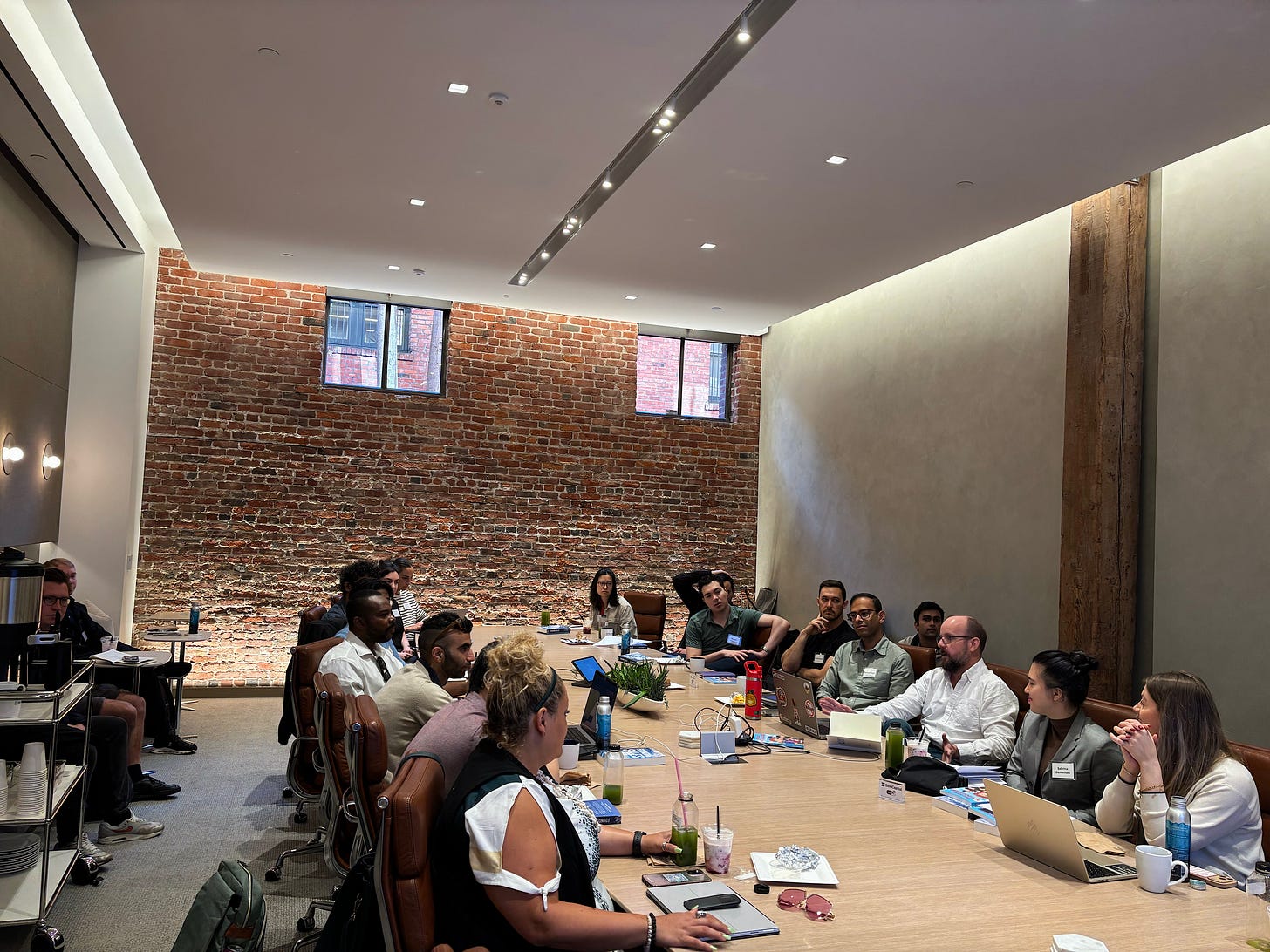
Most early-stage founders know their product better than anyone alive. But selling is a different nuanced beast. We recently hosted a private workshop on founder-led sales for 20 founders, and the feedback was incredible.


We partnered with Pete Kazanjy on the event – author of Founding Sales, co-founder of TalentBin (acquired by Monster), Atrium, and Modern Sales Pros.
These are a few of the notes from the session, and that serve as a guide to founder-led sales.


HockeyStack is the AI platform for modern GTM teams. It unifies all your sales and marketing data into a single system of action. Built-in AI agents help teams prospect the right accounts, improve conversions, close and expand deals, and scale what works.
That’s why teams like RingCentral, Outreach, ActiveCampaign, and Fortune 100 companies rely on HockeyStack to eliminate wasted spend, take better decisions, and make space to think. Learn more at hockeystack.com

Outbound sales today is still built around manual work: writing emails, building lists, and managing sequences across disconnected tools.
Nooks is breaking the mold. With their new AI Sequencing product, Nooks is an agent workspace where AI works alongside reps, helping them understand accounts, prioritize the right prospects, and generate context-rich outreach based on actual first-party interactions.
No more wasting time in multiple tools – it’s one unified workspace for all your outbound channels. Arm your sales team with intelligent outbound. Learn more at nooks.ai.
First, Calibrate What Sales Is
Pete Kazanjy’s definition is simple: Modern sales is consulting where the consultant has a particular predilection to one solution – theirs.
If your job as a salesperson is to consult – to genuinely help a prospect understand their problem, believe in its importance, and evaluate whether your solution is the right fit – then founders are uniquely equipped for it.
Nobody understands the problem you solve better than you do. Nobody has had more conversations with people who have that problem. Nobody can speak with more credibility about the category, the alternatives, the failure modes of the existing approaches.
“Sales is a transfer of enthusiasm.” The founder’s enthusiasm for the problem they’re solving is the single most powerful selling asset in existence. Use it.
The other thing worth internalizing early: companies do not buy things, people do. When you are selling to a business, you are persuading a collection of individuals, each with their own awareness of the problem, their own career incentives, and their own threshold for conviction. The organizational buying decision emerges from the sum of those individual journeys. Understanding this is the foundation of everything that follows.
The Journey Every Buyer Takes
Before you can sell anything, you need a map of where you are taking people. Every buyer, regardless of industry or deal size, moves through a predictable progression of belief. Pete frames it as five stages: Problem Awareness, Problem Prioritization, Solution Preference, Commercial Agreement, and Championship.
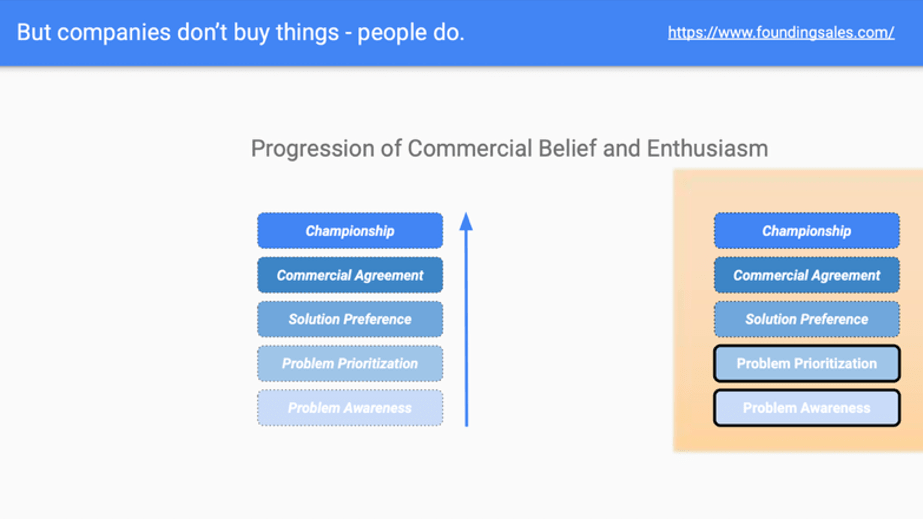
Problem Awareness is the starting point — the buyer knows, at some level, that a problem exists. Problem Prioritization is when they decide it is important enough to actually address. Solution Preference is when they conclude that your approach is the right one. Commercial Agreement is the signed contract. Championship is when they become an active internal advocate, willing to fight for the budget, navigate the procurement process, and bring others along.
Your job as a founder-seller is to advance people along this journey. The tools you use — email, phone, a well-run demo, a dinner, a reference call — are the vehicles. But the destination is always the same: a person who started with vague awareness of a problem and ended up a champion of your solution, ready to build org-wide conviction around it.
The most common mistake founders make is pitching solution preference to someone who has not yet prioritized the problem. You can have the most compelling demo in the world, but if the person on the other side of the call does not believe this problem is in their top three priorities right now, nothing is going to happen. Qualifying where someone is on this journey — and meeting them there — is one of the highest-leverage skills in early-stage sales.
The job is not to convince people to buy something they don’t want. The job is to advance people who already have the problem along a journey toward conviction. Start with the right people.
Stage 1: Figuring It Out
The first mode of founder-led sales is the hardest to be honest about, because it requires admitting that you do not yet know things you might assume you already know. You do not know who exactly will buy your product. You do not know what sequence of conversations converts them. You do not know what objections are real versus noise. Stage One is the process of finding out.
The goal of Stage One is not to close as many deals as possible. The goal is to develop a repeatable, transferable understanding of how your product gets sold. Pete calls this the minimum viable sales motion — a small-scale, high-quality proof that you can reliably move a meaningful sample of right-fit prospects from first contact to paying customer at a win rate that starts to feel statistically meaningful. The target is somewhere in the range of 30 to 50 qualified prospects run through your process, with 10 to 20 converting. Once you have that, you have something to build on.
Define your ICP with precision
Everything in Stage 1 starts with Ideal Customer Profile (ICP). Pete breaks ICP down into three nested questions, each more specific than the last.
The first question is what companies: Which organizations have the problem you solve, in an acute enough form that they would pay money to address it? This is where you think about firmographics — industry, company size, growth stage, tech stack, revenue range — but also about structural conditions. What has to be true about a company’s situation for your problem to feel urgent?
The second question is who inside those companies: Which specific individuals feel this problem most acutely and have the standing to do something about it? Title matters, but job function matters more. You are looking for the person whose day-to-day is materially affected by the problem you solve — and who has enough organizational standing to either buy or champion a purchase. That person is your entry point.
The third question is the one most founders skip entirely: when. Is there a specific trigger — a funding event, a new hire, a product launch, a missed quota, a compliance deadline, a tool contract renewal — that makes a company’s need for your solution an urgent priority? Timing is everything in B2B sales. A company that is a perfect ICP fit but is mid-budget-freeze is not a real prospect right now. The companies that are perfect ICP fits and are experiencing a trigger event are your hottest targets. Find those.
Most founders define their ICP too broadly. The single most leveraged thing you can do in Stage 1 is narrow it. The more precisely you can define who has your problem and why, the less time you waste on conversations that were never going to convert.
Build your sales narrative before you build anything else
Before you send a single prospecting email, you need a narrative. This is a clear, coherent story about the problem in the world, why it matters, why it is hard to solve with existing approaches, and why your solution addresses it in a way that nothing else does.
This narrative needs to exist in multiple forms: a spoken version for the first discovery call, a deck for the formal presentation, email sequences for prospecting, a one-pager for the prospect to share internally. The words and framing should be consistent across all of them. When they are not, buyers sense it — and the inconsistency creates doubt about whether you actually understand the problem as deeply as you claim.
The discipline here is writing things down and testing them explicitly. Most founders have a great spoken narrative but have never written it out, which means it lives entirely in their heads and cannot be transferred to a rep, evaluated for weaknesses, or improved systematically. Write down your sales story. Read it out loud. Run it past people who know nothing about your space and see if they understand it. Then run it past people who are in your ICP and see if it resonates. Treat the narrative as a product.
Prospect
Stage 1 prospecting is a deliberate, structured activity. The starting point is a list: a spreadsheet of 75 to 100 target accounts that match your ICP hypothesis, with specific people identified at each — name, title, LinkedIn profile. Building this list is itself a forcing function. If you cannot identify 75 to 100 real companies that fit your ICP, your ICP is either too narrow or too theoretical.
The outreach itself should be human and personal at this stage. This means actual personalized messages that demonstrate you did your homework: you read their LinkedIn, you noticed a relevant trigger event, you understand something specific about their situation. At this stage, the conversion rate on truly personalized outreach dwarfs anything a sequence tool can produce. You are not trying to generate volume yet.
Different buyers respond to different channels. Some will respond to a thoughtful cold email, others will engage on LinkedIn, others need a warm introduction, a few will only meet you at an industry event over a drink. Part of Stage 1 is figuring out which engagement modes work best for your specific ICP, and building that knowledge into the motion you eventually systematize.
The Buying Group Problem
In B2B, there is often no single “decision maker.” In almost every sale, the purchase decision emerges from a group of people who each need to reach a sufficient level of conviction. The executive sponsor, the day-to-day champion, the technical evaluator, the procurement lead, the skeptic who asks the hardest questions in the demo — each of them is on their own journey. Your job is to bring them along together.
Pete calls this dynamic the buying group, and the challenge it creates is one of the most common reasons founder-led deals die in late stages. The founder has done brilliant work building conviction with one person — the champion — but has not gotten adequate access to the other stakeholders who need to be convinced. Then procurement comes in with hard questions nobody has prepared for, or the executive who controls the budget has never heard a real case for the product, or the skeptic surfaces objections that derail three weeks of momentum.
The antidote is deliberate multi-threading. From the first conversation, you should be thinking about who else in the organization needs to be part of this process. Mapping the buying group is the core work of enterprise sales. In simpler sales (lower ACV, smaller buyer organizations), you might have one or two people to convince. In more complex deals, you can have five, seven, ten stakeholders across multiple teams, each needing a different conversation. Understanding which kind of sale you are in — and having a plan for each stakeholder — is necessary.
The deal does not close when one person is convinced. It closes when org-wide conviction reaches a threshold. Your job is to run a coordinated campaign across the entire buying group, not a single sales call with a single champion.
One practical implication: your champion cannot do all this work for you. A champion who loves your product but cannot get internal access or does not have organizational standing is a limited asset. Part of your qualification work in Stage 1 should be assessing the champion’s ability to build internal conviction — their seniority, their political capital, their access to the people who control the budget. A great champion inside a broken buying structure will not close.
Stage 2: Scaling It
The transition from Stage 1 to Stage 2 happens when something specific is true: you have a documented, repeatable sales motion. You can describe exactly what you do from first contact to close, in enough detail that someone else could attempt to follow it. You know which ICP companies to target, which persona to contact, which trigger events to look for, which outreach approach gets responses, how to run the discovery call, what the demo should cover, how you handle the top five objections, what the proof point looks like that moves people from solution preference to commercial agreement.
If you cannot describe all of that, you are not in Stage 2 yet. You are still in Stage 1, and hiring a sales rep right now will cost you time, money, and probably the person’s career momentum. The most common mistake founders make in sales is entering Scale mode before they have actually finished Figure It Out mode.
What needs to be documented before you hire
The handoff from founder to first rep is like a product launch. The product is the sales process itself. Before you bring anyone in to run it, you need a written record of how it works.
That means: a written ICP definition with enough specificity to be operationalizable (not just “mid-market SaaS companies” but the actual firmographic and trigger-event criteria you have validated). A prospecting playbook that specifies the list-building approach, the outreach sequence, and the personalization methodology. A discovery call guide that maps out the questions you ask and what good versus bad answers look like. A demo script that has been tested and refined. An objection guide. A competitive positioning sheet. A typical deal flow with stage definitions that actually reflect how deals progress, not just what a CRM template suggests.
This sounds like a lot. It is. That is the point. If you have not done enough deals to produce all of this from lived experience, you have not done enough deals. The documentation is a forcing function for the self-assessment: do I actually have a repeatable motion, or do I have a collection of things I did that worked for various reasons I do not fully understand? The former can be taught. The latter cannot.
Who to hire first (and who not to)
The first sales hire is one of the highest-stakes decisions in a company’s trajectory. The instinct many founders have is to hire a senior, experienced salesperson — someone who has “been there, done that” and can come in and build something. That instinct is usually wrong.
Here is why: an experienced sales leader hired before the motion is proven will bring their own playbook, which may or may not match your product, your market, or your buyer. They will be frustrated when the infrastructure they expect (clean CRM data, marketing-generated pipeline, refined comp plans) does not exist. They will make assumptions that should still be hypotheses. And when things do not work, it will be genuinely unclear whether the sales motion is broken or the person is the wrong fit.
The right first hire is a high-ceiling, somewhat experienced seller who is analytically rigorous and eager to get into the weeds of a new problem — someone who does not need a polished system handed to them but can follow a documented process and help make it better. Their job is not to invent the sales motion. It is to execute the one you have already proven, generate enough signal to validate that it transfers, and work with you to refine it. Once you have two or three reps running a consistent motion, you have earned the right to bring in sales leadership.
Hire to execute the motion, not to discover it. The founder’s job is to discover and document. The first rep’s job is to validate that it transfers. Leadership’s job is to scale what’s been proven.
For more guidance, check out The First Sales Hire Playbook.
Running the motion efficiently
Stage 2 is about operational discipline. The deals you are closing now need to look like the deals you plan to close at 10x the volume. That means consistent qualification criteria (so you are not wasting time on prospects who were never going to buy). It means a pipeline hygiene standard (so leadership has real visibility into what is actually moving, not what reps are optimistically stage-advancing). It means a deal review cadence that surfaces risk early. And it means a continuous improvement loop — a mechanism for learning from every lost deal and integrating those lessons back into the playbook.
One dimension of Stage 2 that founders consistently underinvest in is the feedback loop between sales and product. In Stage 1, the founder is getting that feedback organically — they hear objections on every call, they see what feature gaps are losing deals, they know what the market wants because they are in the market every day. In Stage 2, as the founder steps back from direct selling, that feedback loop can break. Build mechanisms to keep it alive: regular deal review sessions with reps, close analysis on every lost opportunity, and a formal channel for surfacing product gaps that surface repeatedly in sales conversations.
The Maturity Stages at a Glance
Pete’s framework identifies several distinct maturity stages across the founder-led sales journey. Here is how they map to the activities and questions each stage demands:
Stage 0 — Zero Customers, Zero Motion
You have a product and a hypothesis. The work is: do any of your assumptions about who has this problem and how much they care about it survive contact with actual buyers? Spend 100% of your sales time talking to prospects — not building a deck, not refining the pitch, not setting up a CRM. Get on the phone. Run discovery calls. Listen more than you talk. The goal is validated ICP and problem-pain calibration, not revenue.
Stage 1 — First Customers, No Playbook
You have early customers — maybe five to ten — but you closed them through force of personality, domain credibility, and network effects. You cannot describe exactly how you closed them in a way someone else could replicate. The work is: run 30 to 50 qualified prospects through your process, document every step, track your conversion rates at each stage, and produce a version of the sales motion on paper. By the end of this stage, you should be able to hand a new hire a document that tells them what to do.
Stage 2 — Proven Motion, First Hire
You have a documented motion with statistically meaningful conversion data. A win rate of 15 to 25% on qualified pipeline, a defined sales cycle, and a clear map of the buying group. Now you hire someone to execute it. The early hires are executors, not builders. The critical success metric here is not total ARR — it is whether the rep’s conversion metrics track close to yours. If they do, you have a transferable motion. If they do not, you have more work to do in Stage 1.
Stage 3 — Repeatable Motion, Building Team
Two to four reps are running the motion consistently. Pipeline is flowing from a mix of outbound, inbound, and partner channels. You have enough data to know which deal profiles close and which do not. Now is when you bring in sales leadership — someone who can manage the team, run deal reviews, refine the comp plan, and own the operational infrastructure of the sales org. The founder’s role in sales shifts from doing to enabling.
Final Thought
The most important thing you can take from this edition is the distinction between figuring it out and scaling it.
Nothing happens until someone sells something. That someone, in the beginning, is you. There is no shortcut past it — and there should not be. The founder who has sold is a fundamentally different, more capable leader than the one who never did.
Tag @GTMnow so we can see your takeaways and help amplify them.

Granola raises $125M at a $1.5B valuation, up from $250M less than a year ago. Meeting notes are a commodity at this point, and Granola knows it — the real bet is on becoming the enterprise context layer, with new APIs that let teams pull meeting intelligence into AI workflows. The valuation jump says investors believe whoever owns the context wins.
Apollo.io acquired Pocus, bringing signal intelligence directly into its GTM platform alongside 230M+ contacts and agentic workflows. The bet: revenue teams shouldn’t need a separate tool to know where to focus. Worth watching how this plays out upmarket, where Apollo has seen 400%+ growth in enterprise accounts over the past year.

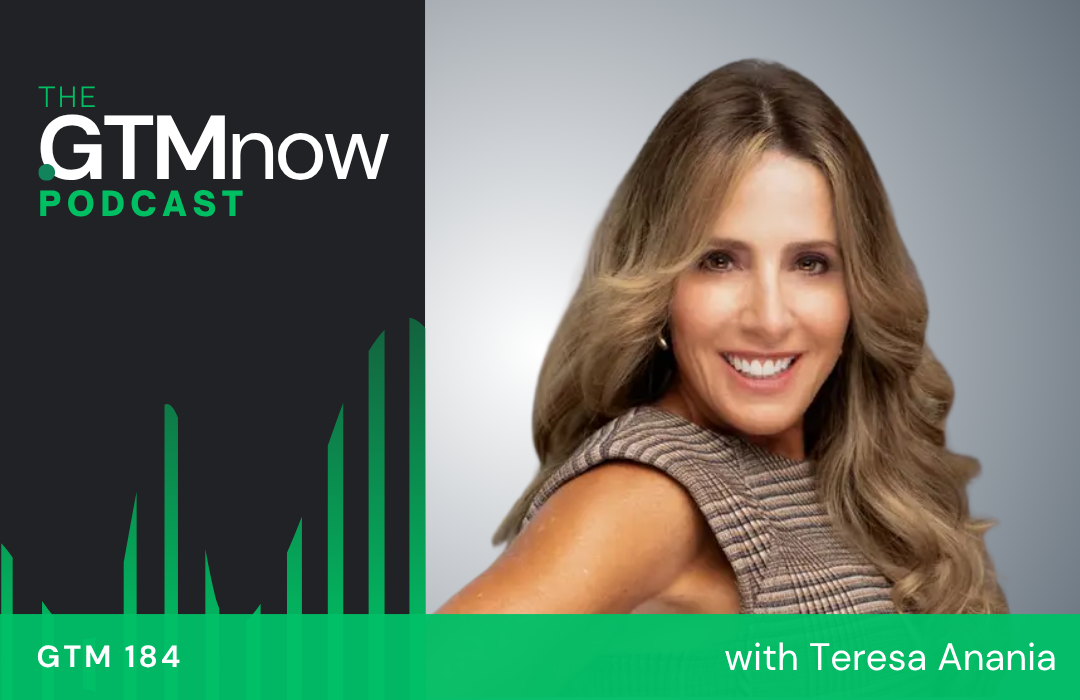
GTM 184: How Sophos Scales Customer Success for 600,000 Customers with Teresa Anania
Listen and subscribe wherever you get your podcasts by searching “The GTMnow Podcast.”

Armada – named among Fast Company’s Most Innovative Companies in computing, alongside NVIDIA and Google. The real story is what they’re building: distributed AI infrastructure for the environments most platforms ignore. Worth watching as enterprises and governments push AI into the field, not just the cloud.
Examen – raised $4.3M in total funding and launched. Examen is building an autonomous analyst for commercial real estate. GTMfund is proud to have led the Seed round.
Wyllo – the newly combined NoFraud and Yofi, is reframing fraud prevention as an intent problem rather than a binary approve-or-decline decision. If the thesis lands, risk stops being a cost center and starts informing growth. One to watch for ecommerce teams tired of black-box tools that block as much revenue as they protect.

-
Enterprise Account Executive at SEMrush (US)
-
Founding Growth Lead at Casium (Hybrid – Bellevue, WA)
-
Enterprise Customer Success Manager (Named Accounts) at Gorgias (Hybrid – San Francisco, CA)
-
Growth Marketing Manager – Demand Generation at CaptivateIQ (Hybrid – Austin, TX | Remote – Raleigh, NC / Nashville, TN / Toronto, Canada)
-
Enterprise Solutions Engineer (Post-Sales) at Noibu (Remote – Canada)
-
Senior Manager, Strategic Partner Marketing at Vanta (Remote – US)
See more top GTM jobs on the GTMfund Job Board.

Upcoming events you won’t want to miss:
-
MicroConf 2026: April 12–14, 2026 (Portland, OR)
-
GTMfund Dinner: April 14, 2026 (Austin, TX)
-
SaaStock USA: April 15–16, 2026 (Austin, TX)
-
Forrester B2B Summit: April 26–29, 2026 (Phoenix, AZ)
-
SaaStr Annual: May 12–14, 2026 (San Mateo, CA)
-
GTMfund Dinner: May 14, 2026 (San Francisco, CA)
-
GTMfund Dinner: June 9, 2026 (London, UK)
-
Dreamforce 2026: September 15–17, 2026 (San Francisco, CA)
-
INBOUND: September 16–18, 2026 (Boston, MA)
-
Pavilion GTM2026: September 28–October 1, 2026 (NYC, NY)
-
Customer Success Week: October 5-9, 2026 (NYC, NY)
-
TechCrunch DISRUPT: October 13–15, 2026 (San Francisco, CA)

Some GTMnow community (founder, operator, investor) love to close it out – we appreciate you.