
This is a special edition of The GTM Newsletter by GTMnow – read by over 52,000 revenue professionals weekly to stay up-to-date on go-to-market and scale their companies and careers. GTMnow is the media brand of GTMfund – sharing go-to-market advice from the top 1% of revenue operators including the 350 executives behind the fund, news, and our viewpoints from working with hundreds of portfolio companies.
The State of Sales Jobs
From week to week, it can feel like sales roles are up, and the next down.
Understanding what’s truly happening in the SaaS startup jobs space can be challenging, so a closer look at the data offers valuable insights.
A huge thank you to Jason Saltzman and Live Data Technologies for generously allowing us to tap into their data to help surface the latest trends in go-to-market teams at startups. This data is typically safeguarded behind paid offerings, as the company leverages prompt engineering of major search engines to capture real-time job change data, tracking over 88 million professionals.
The TL;DR (data reflects Q3 2024, the period this report originally covered):
- Sales role hiring rebounded in 2024 after a difficult 2023.
- Mid-level roles like Managers, Directors, and Leadership positions tend to have the longest tenures (2.5 to 3 years), while both senior roles (CROs) and individual contributors (AEs and SDRs) have shorter tenures (1.5 to 2 years).
- SDR hiring was declining while AE hiring remained steady and showed gradual growth.
- Companies were increasingly prioritizing senior-level hires, favoring more experienced talent who could take on broader responsibilities.
Sales role growth
Sales roles were broken out by seniority and accompanying title variations.
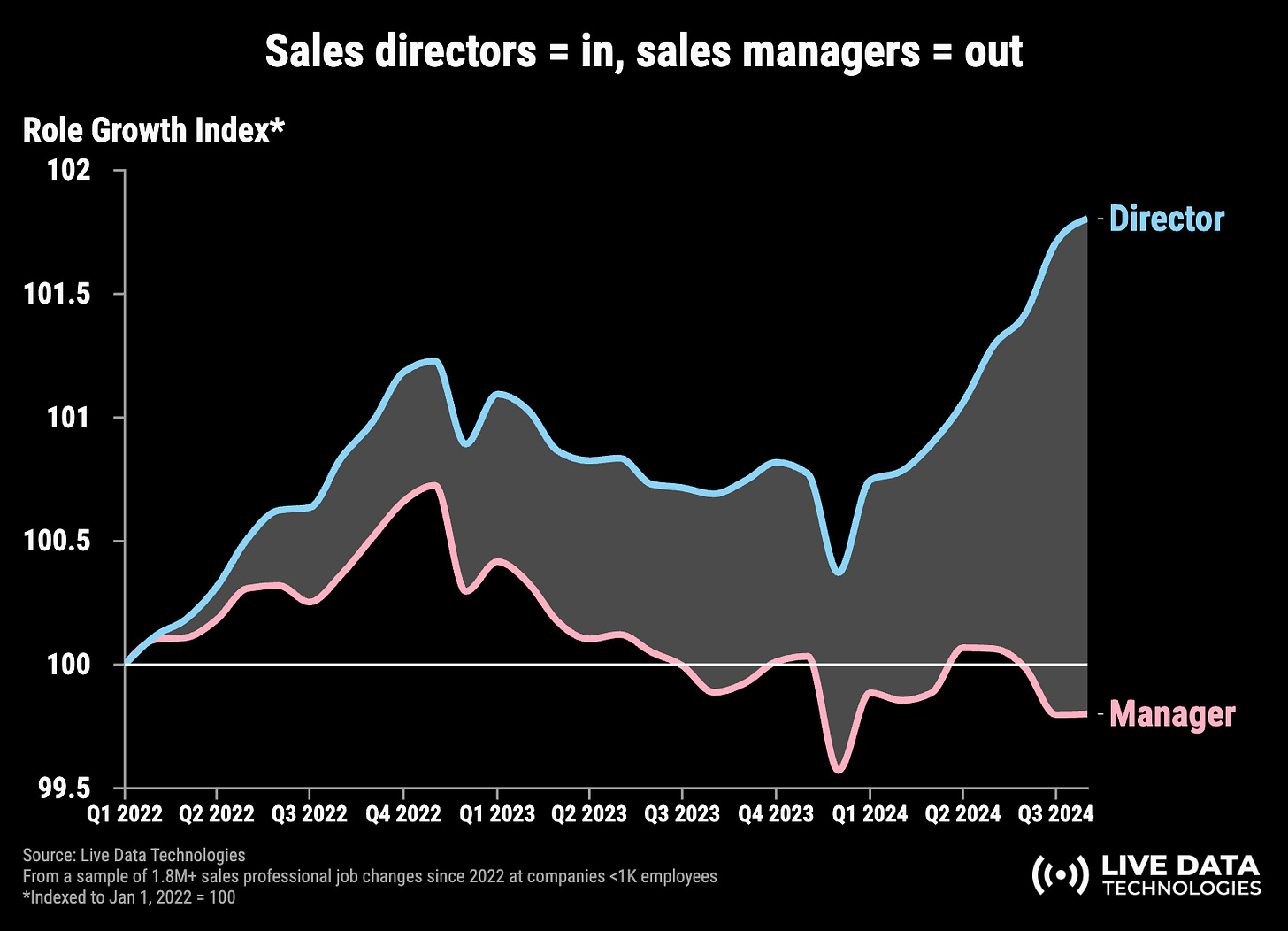
To interpret these charts, if the growth index on the y-axis is 110, this means there are 10% more roles compared to 2022 when the base index of 100 was set.
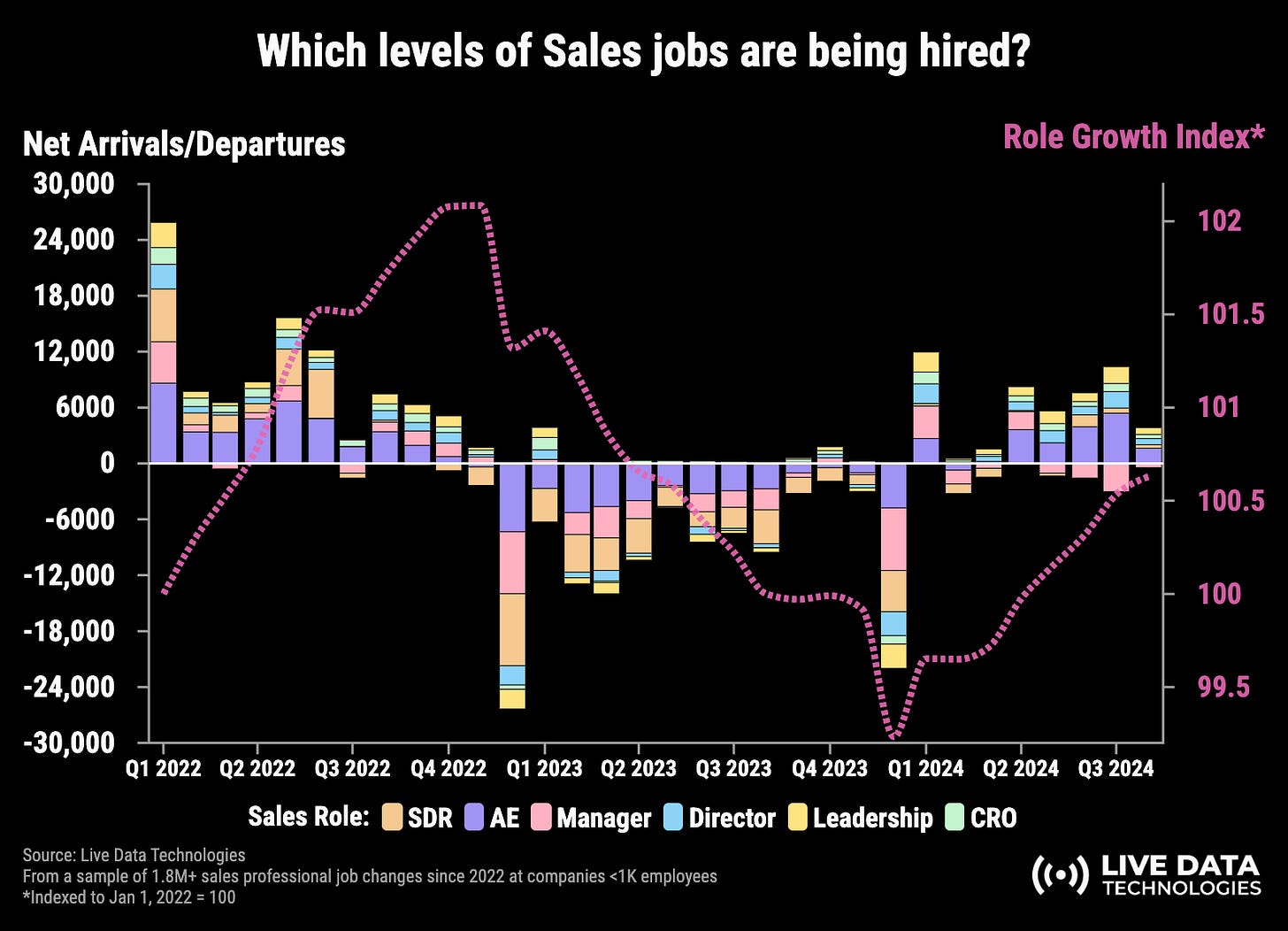
Last year through to March of that year saw negative growth in sales roles, with more companies shedding employees than adding.
There’s a clear dip in Q1 2023 with substantial negative net departures. During this period, there seems to have been a large-scale reduction in sales teams, likely due to market conditions, monetary policy, or growth strategy shifts. This dip continues through the year, though there’s a gradual recovery from mid-2023 onward.
By 2024, there was a general resurgence of hiring after a difficult 2023.
Tenure of sales roles
Average tenure for all was less than 4 years, with most falling between 2-3 years.
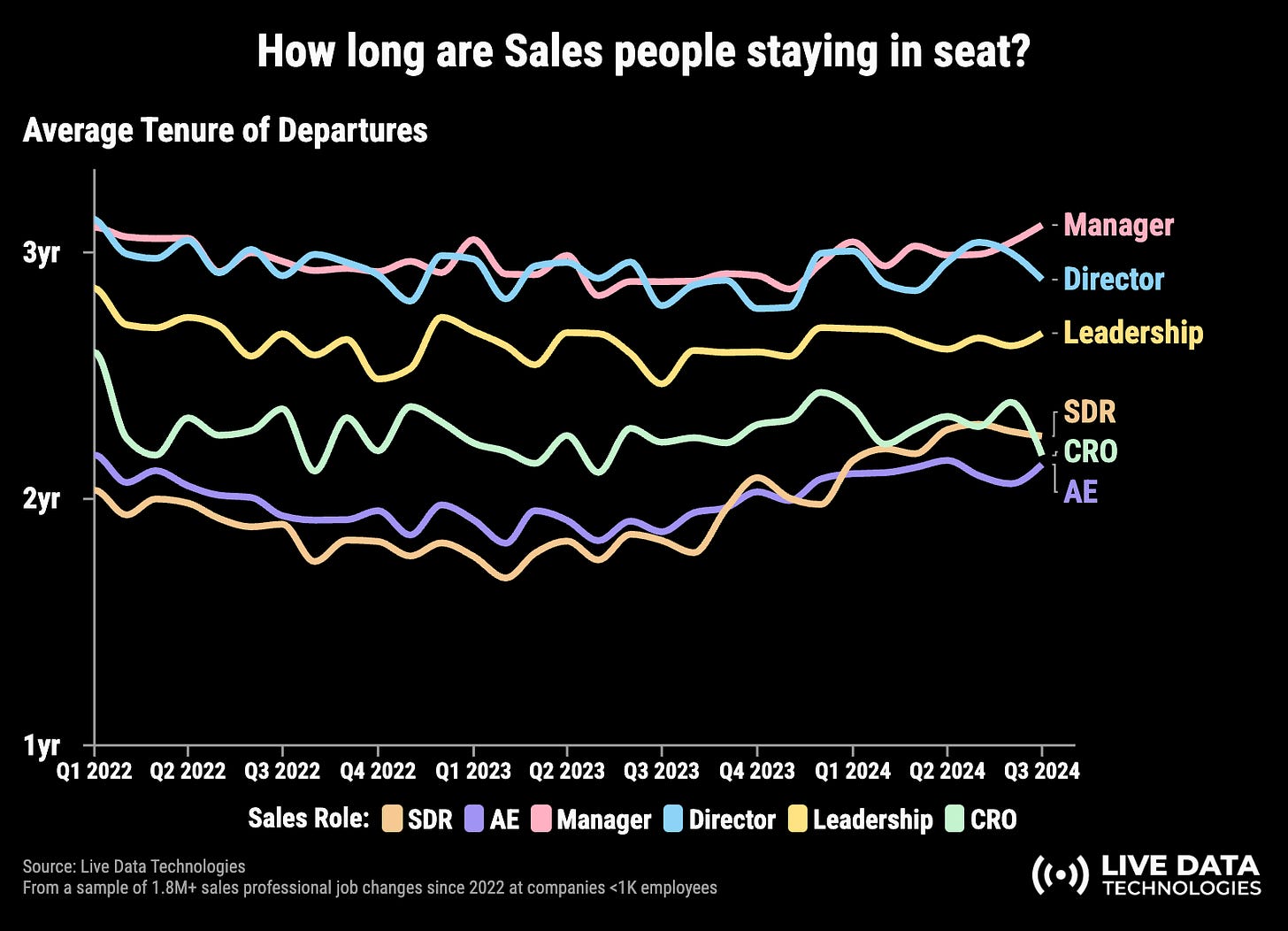
However, tenure varied significantly depending on the role.
Higher-level roles like Managers, Directors, and Leadership positions tended to have longer tenures, generally hovering around 2.5 to 3 years. This aligns with expectations, as these roles often come with more responsibility, require longer ramp-up times, and are typically more stable.
In contrast, individual contributor roles such as SDRs and AEs exhibited significantly shorter tenures, averaging closer to 1.5 to 2 years. SDRs and AEs, in particular, tend to be early-career roles, which often experience higher turnover as people move to other positions or advance up the career ladder.
CROs (green line) showed one of the shortest tenures, with most staying in the role for less than 2 years on average. This may reflect the high-pressure nature of the CRO role, where frequent leadership changes are common due to performance expectations or strategic shifts.
Growth of roles
While SDR and AE roles had similar hiring trends in 2022, their trajectories drastically diverged from there. SDR hiring plunged, whereas AE hiring stayed relatively stable.
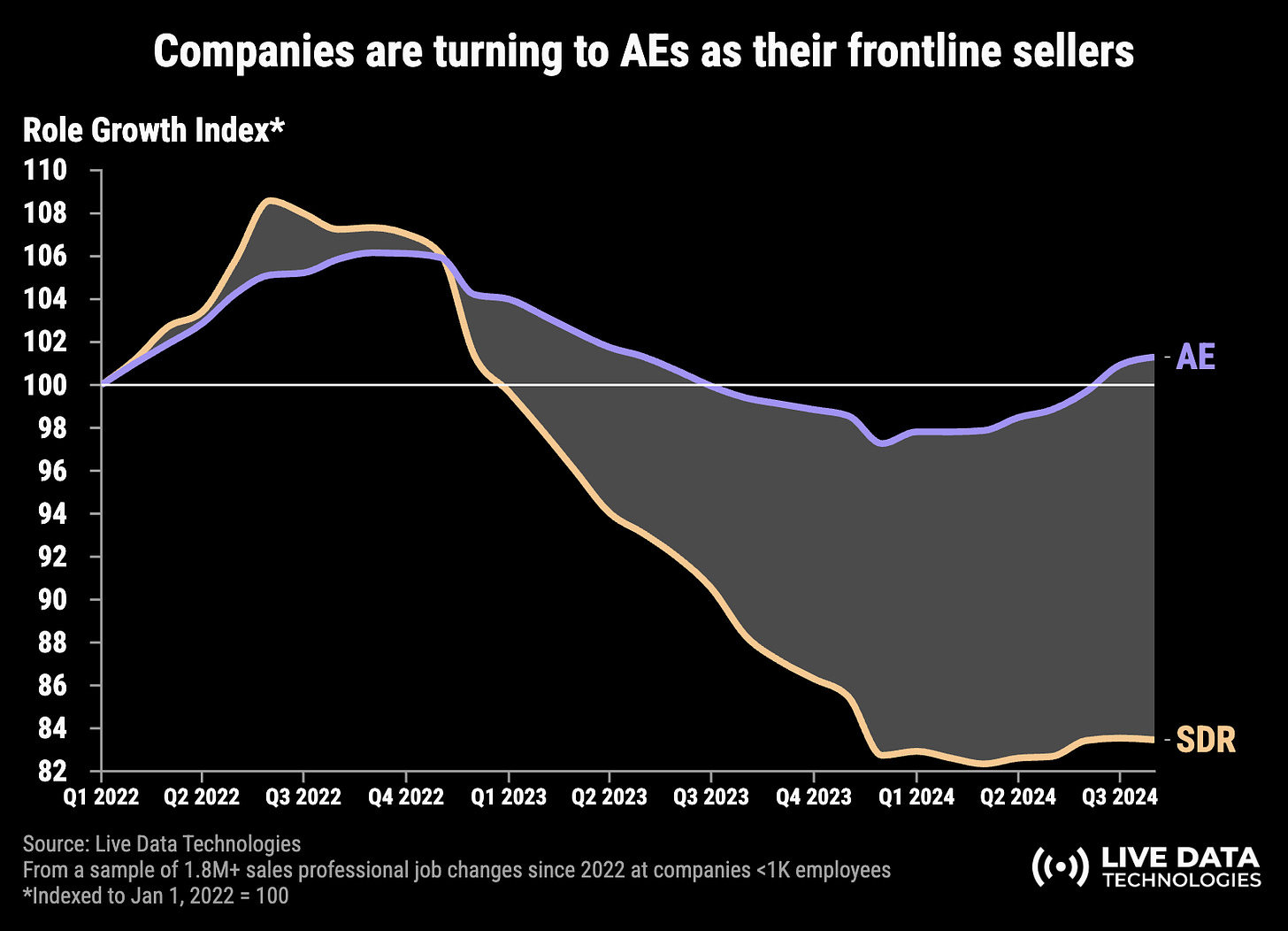
Sales teams underwent a notable shift, with AEs increasingly taking on the role of primary sellers, while SDR positions became leaner.
In Q1 2022, the Role Growth Index for SDRs was high, peaking around 108. By Q1 2023, SDR hiring began a steep decline, falling below 90 by Q4 2023. This suggests companies were significantly reducing their reliance on SDRs, possibly due to strategic changes, evolving go-to-market models, or the automation of tasks typically handled by SDRs.
In Q3 2023, there were approximately 35,000 SDR roles at companies under 1,000 employees. One year later in Q3 2024, there were approximately 32,000 SDR roles at the same companies — a reduction of nearly 6%.
In contrast, the Role Growth Index for AEs stayed fairly stable, hovering around 102 between Q1 2022 and Q3 2023. By Q3 2024, it showed a slight upward trend, indicating companies were leaning more heavily on AEs. This trend suggested AEs were taking on more direct selling responsibilities, possibly consolidating roles once shared between SDRs and AEs.
Companies were increasingly relying on AEs for both lead qualification and direct selling, while SDR roles declined. Some of that shift traces back to automation and AI tools handling more of the repetitive work SDRs used to own — a trend that’s only accelerated since this data was pulled. Platforms like Airspeed are a good example: they turn call notes and CRM updates into something reps don’t have to do by hand anymore.
As a result, AEs were operating more frequently in a full-cycle capacity. Feedback from GTM leaders echoed this notion.
“We’ve made a number of changes and realigned our business model in 2024 to make our AEs full cycle. For a startup, I believe full cycle is the only way to go. While many argue AEs should focus on new logos, for us, signing big companies like Intuit means that upselling and expanding those accounts are more valuable than most of our regular customers.” – James Kaikis (Head of GTM at TestBox at the time this newsletter was released)
Continuing the trend of senior roles taking on broader responsibilities, Director-level roles saw a significant increase, while Manager-level roles steadily declined.
The same effect showed up between the Chief Revenue Officer (CRO) and leadership roles.
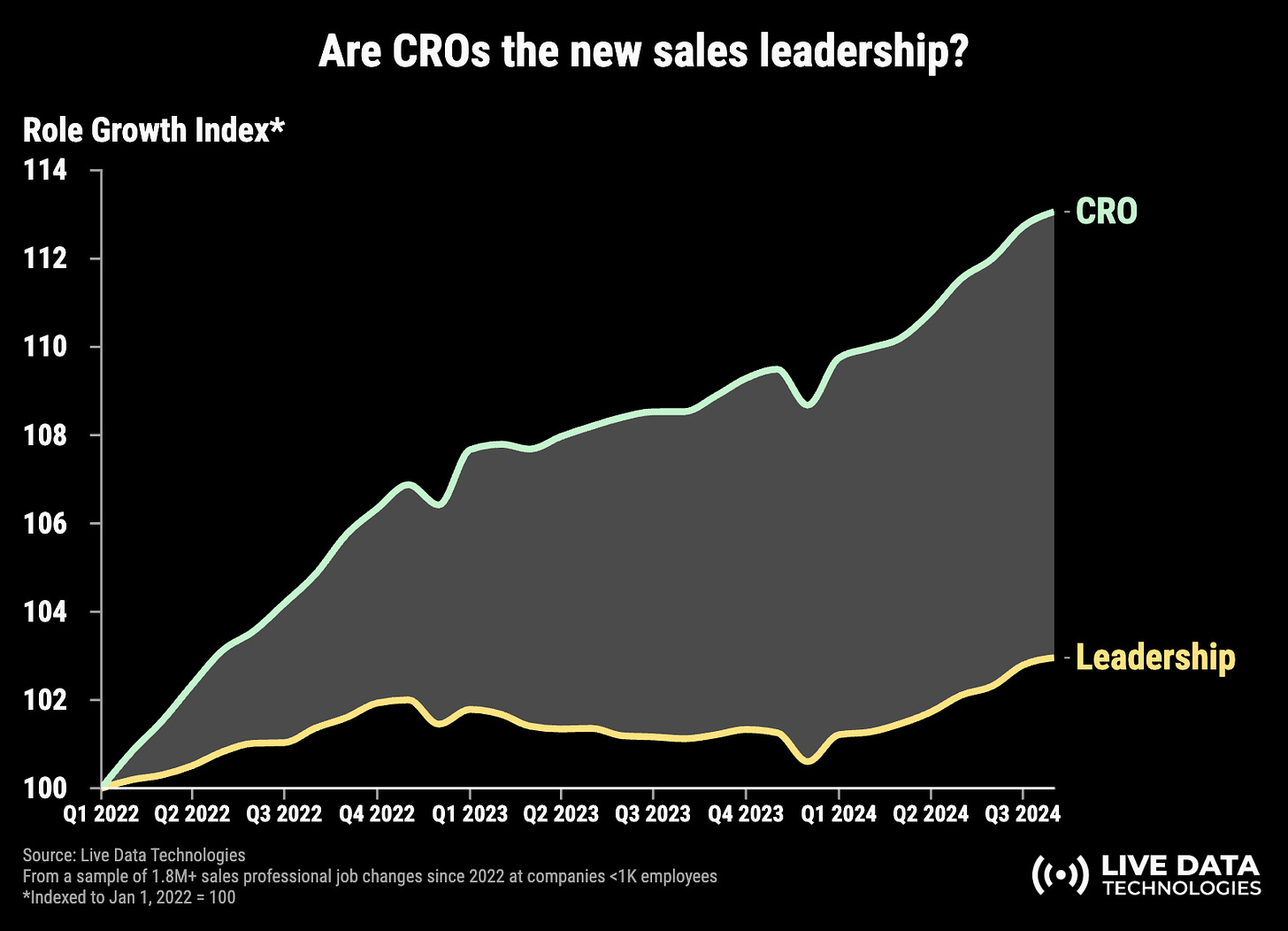
Companies were investing in more senior employees. In startups, speed is currency. Having more senior people who have “been there, done that” can expedite growth. It may come at a price, but that price is often worth it in the long run.
It may also reflect changing organizational structures where senior leaders take on more responsibilities, potentially reducing the need for multiple layers of management.
It could also be that teams found greater agility with leaner headcounts, in line with Price’s Law: “the square root of the number of employees in a company do about half the work.” In a 400-person company, that’s just 20 people. Full breakdown of Price’s Law here.
Looking for a sales role right now?
Head straight to the GTMfund Job Board. That’s where we keep the real, current openings across our portfolio, from CRO down to SDR, at companies built by some of the best operators in the game. If you’re looking to level up, that’s the place to start.
This was part one of a two-part series on The State of GTM Jobs. Part two, on Customer Success hiring trends, came out that December.