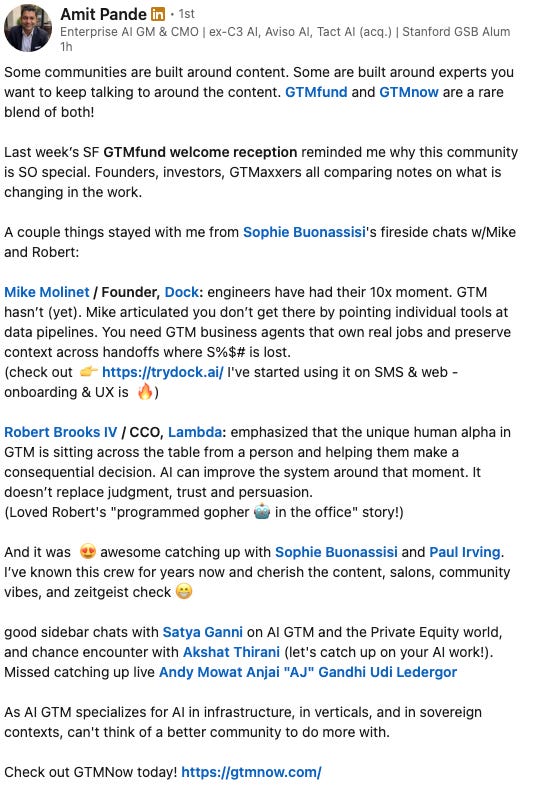

We just got back from the annual GTMfund event (GTMnow is a media brand owned and operated by VC firm, GTMfund) – and wow! So special to see many of you in person. You can check out pictures here: PT1 – welcome reception / PT 2 – AGM / PT 3 – Retreat.


Your top 20% know how to win deals, while the other 80% are guessing.
Your strongest performers carry your KPIs by running the same playbook on every deal, while you’re spending years (and money) trying to clone them. Meanwhile, across the rest of the team, deals stall, single-threaded with thin business cases and mutual action plans that don’t get actioned.
Accord makes your top performers’ playbook the whole team’s standard. Shaped by your unique sales process and real-time buyer conversations, Accord Agents handle the work between calls to move deals forward, so reps can focus on their buyers, and the conversations that close deals.
Accord brings agentic execution and the buyer experience together in one platform, turning how your best reps sell into how your entire team executes. Accord customers see an average 40% increase in deal size and 20% faster sales cycles.
Ready to be next? Visit inaccord.com
3 Charts on Where Venture Money Is Going
Every month, we send our LPs a short list of “quality reads”: the charts, Substacks and podcasts that best capture what’s happening in venture. At the GTMfund AGM this past week, we picked our favorite charts of the year and walked everyone through them.
Here are three of them. These are the ones that matter most if you’re building, joining or advising an early-stage company right now.
1. The top 20 deals took 44% of software VC funding
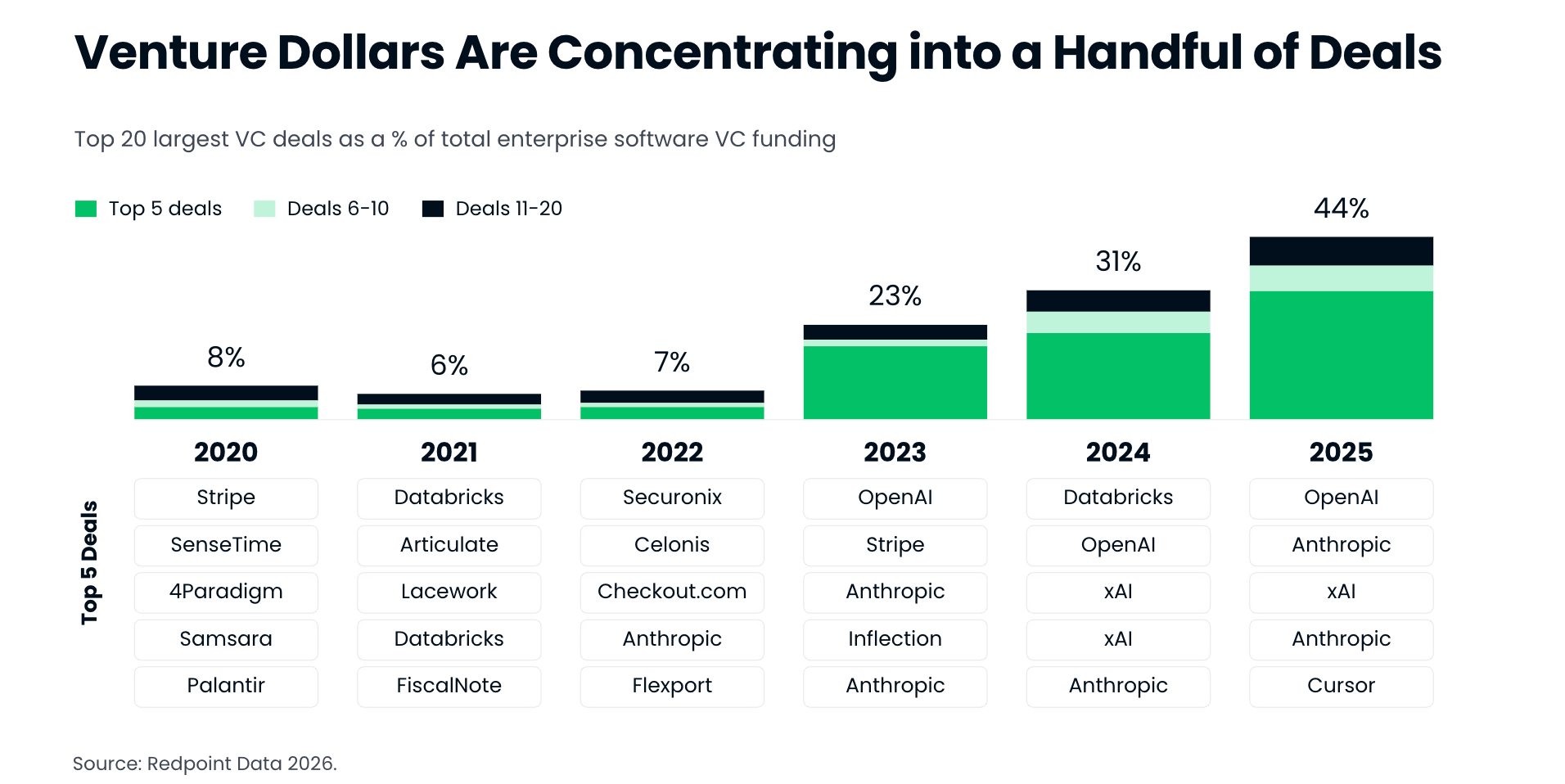
From 2020 to 2022, the 20 largest software deals took single digits of the year’s funding. In 2025 they took 44%. OpenAI, Anthropic and xAI took most of the top spots, with Cursor among them.
Part of that is how capital-intensive frontier labs are. And it doesn’t stop there – this is happening down the entire stack.
Carta’s data shows the same thing at every stage. Capital going in is close to a local high, while the number of deals is near its lowest in five or six years. More money is going to fewer companies.
The bar for the next round has moved. Fewer companies get funded at each stage, so graduating from seed to A, or A to B, is harder than the headline funding numbers suggest.
2. Top quartile isn’t enough anymore
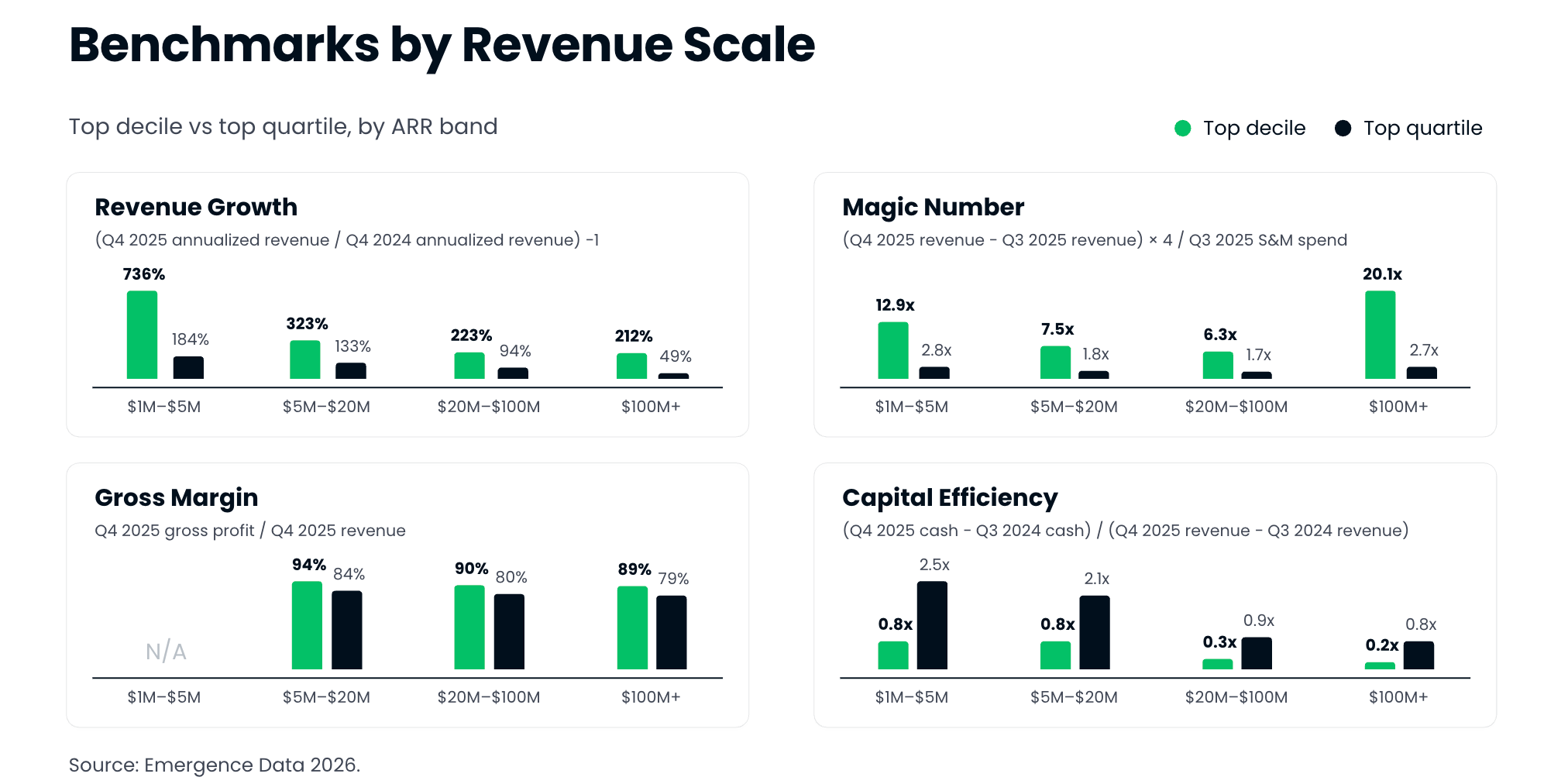
Top decile vs top quartile, by ARR band (Emergence, 2026):
$1M-$5M: revenue growth 736% vs 184%, magic number 12.9x vs 2.8x, burn per new dollar 0.8x vs 2.5x
$5M-$20M: 323% vs 133%, 7.5x vs 1.8x, 0.8x vs 2.1x
$20M-$100M: 223% vs 94%, 6.3x vs 1.7x, 0.3x vs 0.9x
$100M+: 212% vs 49%, 20.1x vs 2.7x, 0.2x vs 0.8x
Venture has always been a power law, so money has always gone to the top quartile. Emergence’s benchmarks show it now goes past that, to the top 10%. The gap between top decile and top quartile has never felt farther apart.
The magic number shows it most clearly. Take net new revenue in a quarter, annualize it, and divide by the previous quarter’s sales and marketing spend. Top-decile companies at $1M-$5M ARR come in at 12.9x. Top-quartile companies, still a strong group, come in at 2.8x.
Burn tells the same story from the other side. At $1M-$5M ARR, top-decile companies burn $0.80 for every new dollar of revenue. That means they add more revenue than they burn. Top-quartile companies burn $2.5
How Emergence calculates them:
Magic number = (this quarter’s revenue − last quarter’s revenue) × 4 ÷ last quarter’s S&M spend. Higher is better.
Burn per new dollar = cash burned ÷ net new revenue over the same period. Lower is better.
3. Years 4 to 6 are when the biggest companies get founded
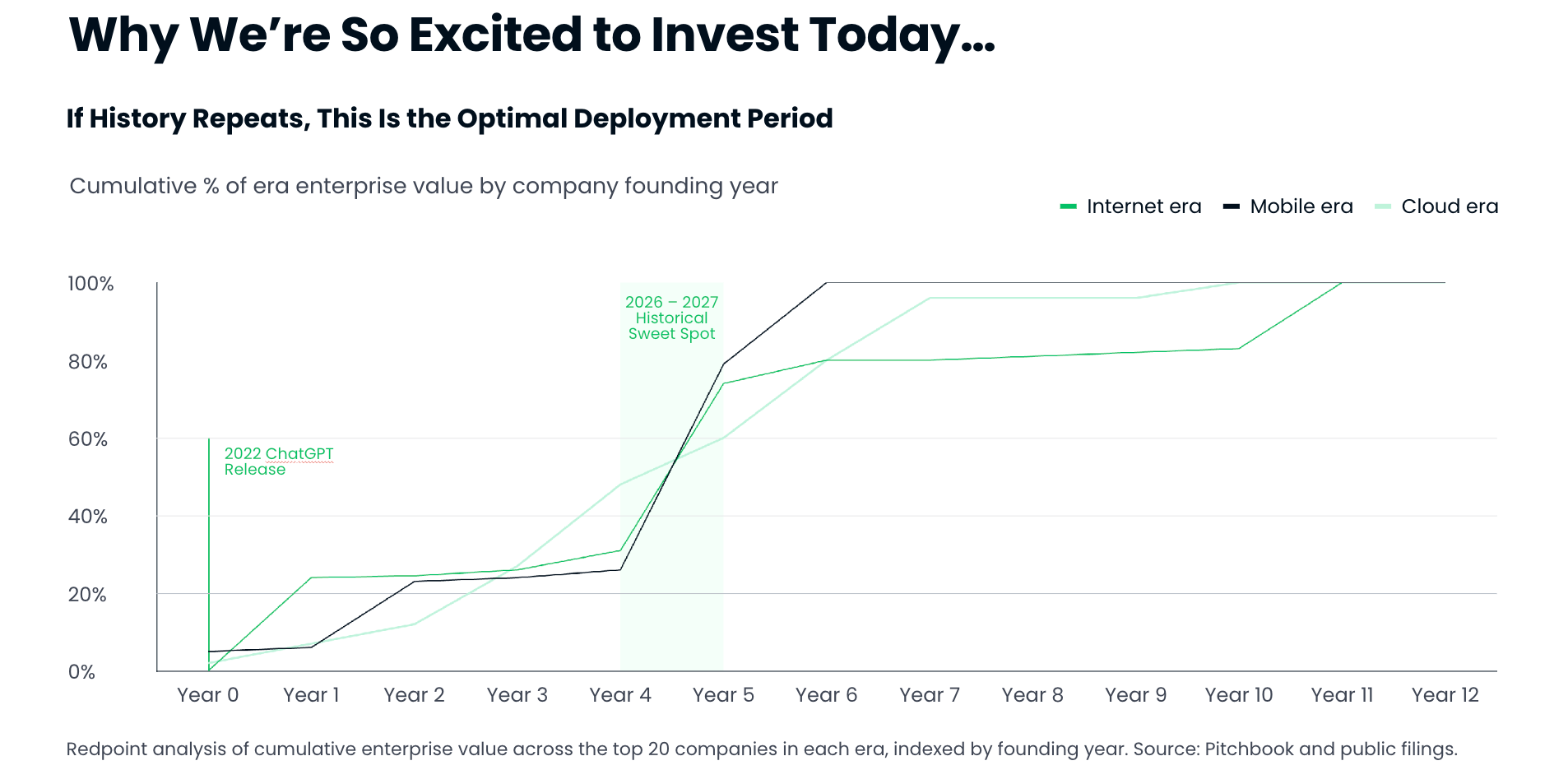
Redpoint looked at the three most recent platform shifts: internet, mobile and cloud. For each one, they tracked which founding years produced the most enterprise value among the era’s top 20 companies.
The answer was the same all three times: years four, five and six.
If ChatGPT’s launch in late 2022 was the starting gun, we’re in year four now. Some of the biggest and most important companies of the AI era have not been founded yet.
The bottom line
Money is going into fewer, better companies, and “better” now means top decile on efficiency as well as growth. At the same time, history says the companies that define this era are still being started. Both are true at once: the bar is higher, and the opportunity is earlier than it looks.
Next week, Part 2: what’s happening inside the AI economy. Token demand is up 27x in a year, and frontier labs take about 70% of spend on 35% of tokens. Plus $700B in hyperscaler capex, and whether any of it looks like 2000.
Which of these surprised you most? Let us know in the comments.
Tag @GTMnow so we can see your takeaways and help amplify them.

Legal AI startup Legora raised $550M in Series E funding at an $8.8B valuation, less than a month after its biggest competitor Harvey raised the same amount at a $15.5B valuation. Atreides Management led the round, and Legora says ARR has doubled to over $200M since April. [We sat down with Legora’s CRO Patrick Forquer on the GTMnow podcast last week: here.]
Mutiny launched the Buyer Experience Guide, ten playbooks and templates for what reps should put in front of buyers. Built with Jen Allen-Knuth, April Dunford, Chris Orlob, Sam Jacobs, and six other sales leaders, it covers every key moment from the first-call pitch to the pricing proposal.
Salesforce is acquiring customer engagement platform Braze for about $5.66B, with Braze shareholders receiving $47.50 per share in cash. BRZE shares surged roughly 50% on the news, and the deal is expected to close in Salesforce’s fiscal 2028. It folds Braze’s real-time behavioral triggers across email, SMS, and WhatsApp into Marketing Cloud alongside Agentforce – the clearest signal yet that CRM giants want event-driven engagement, not scheduled campaigns and static segments.
New Seismic research found 75% of B2B leaders trust human guidance more than AI output when the two conflict. The survey of 200 senior revenue-tech decision-makers also found 46% say AI has made them more reliant on people for high-stakes decisions. The read: buyers use AI to research and humans to validate, which raises the bar for sellers rather than replacing them.
At Zoomtopia, Zoom launched a Unified Context Layer that links meeting history with docs and third-party app data so people and AI agents can act on it. ZoomMate Agent Teams and portfolio-wide MCP servers are available now, with ready-made sales and marketing workflows shipping into tools like Salesforce, and Zoom says Virtual Agent customer count is up 256%. Meeting-to-CRM-action automation is going mainstream.
Intuit agreed to acquire Sequence, an AI-native revenue management platform that automates quote-to-revenue for usage-based, milestone-based, and hybrid pricing. Terms are undisclosed, and CEO Riya Grover joins Intuit’s mid-market product org. As B2B pricing gets more complex, the quote-to-cash back office is becoming the next GTM consolidation target.

GTM: How Datarails Grew 30x in 5 Years (90% Outbound → 90% Inbound) | Aviv Canaani, Datarails
Listen through the links in the page above or by searching wherever you get your podcasts “The GTMnow Podcast.”

Different – emerged from stealth with a $48M seed round led by General Catalyst for AI that runs demand generation end to end for lean B2B marketing teams. Lightspeed also participated, and the founding team includes ThoughtSpot and Nutanix co-founder Ajeet Singh. Customer Descope says a 2-person team now runs 7-10 programs at once across ~2,800 target accounts and redirected 60% of paid spend that was going to waste – the pitch is a marketing team of 5 operating like 50, with AEO monitoring built in.
Azoma – raised an $11.2M Series A led by Puma Growth Partners for its Agentic Commerce Optimization platform, which helps consumer brands get discovered by AI shopping agents like ChatGPT and Alexa for Shopping. Revenue has grown roughly 10x over the past year, and customers include L’Oréal, Unilever, Mars, and Reckitt. One data point worth stealing: across 38M AI citations it analyzed, editorial coverage makes up 51.9% of what Gemini cites vs 7.6% on Google AI Overviews.
AuxoAI raised a $20.7M Series A led by NTTVC to build the “forward-deployed AI company” for Global 2000 enterprises. It has worked with 40+ clients across manufacturing, consumer goods, healthcare, and telecom, and is an AI-native Google Gemini Enterprise transformation partner under Google’s $750M partner program.

Chief Marketing Officer at Pavilion (Remote – US)
Account Executive, Growth – France at Vanta (Hybrid – London, UK)
Sr. Customer Success Manager at Tavus (San Francisco, CA)
Founding BDR Manager at Kick (Toronto, Canada)
Customer Support Representative – Mandarin Speaking at Owner.com
See more top GTM jobs on the GTMfund Job Board.

Upcoming events you won’t want to miss:
GTMfund Toronto Dinner: November 16, 2026 (Toronto, Canada)
GTMfund NYC GTM Leader Happy Hour: November 18, 2026 (NYC, NY)

Some GTMnow Network love to close it out – we appreciate you.