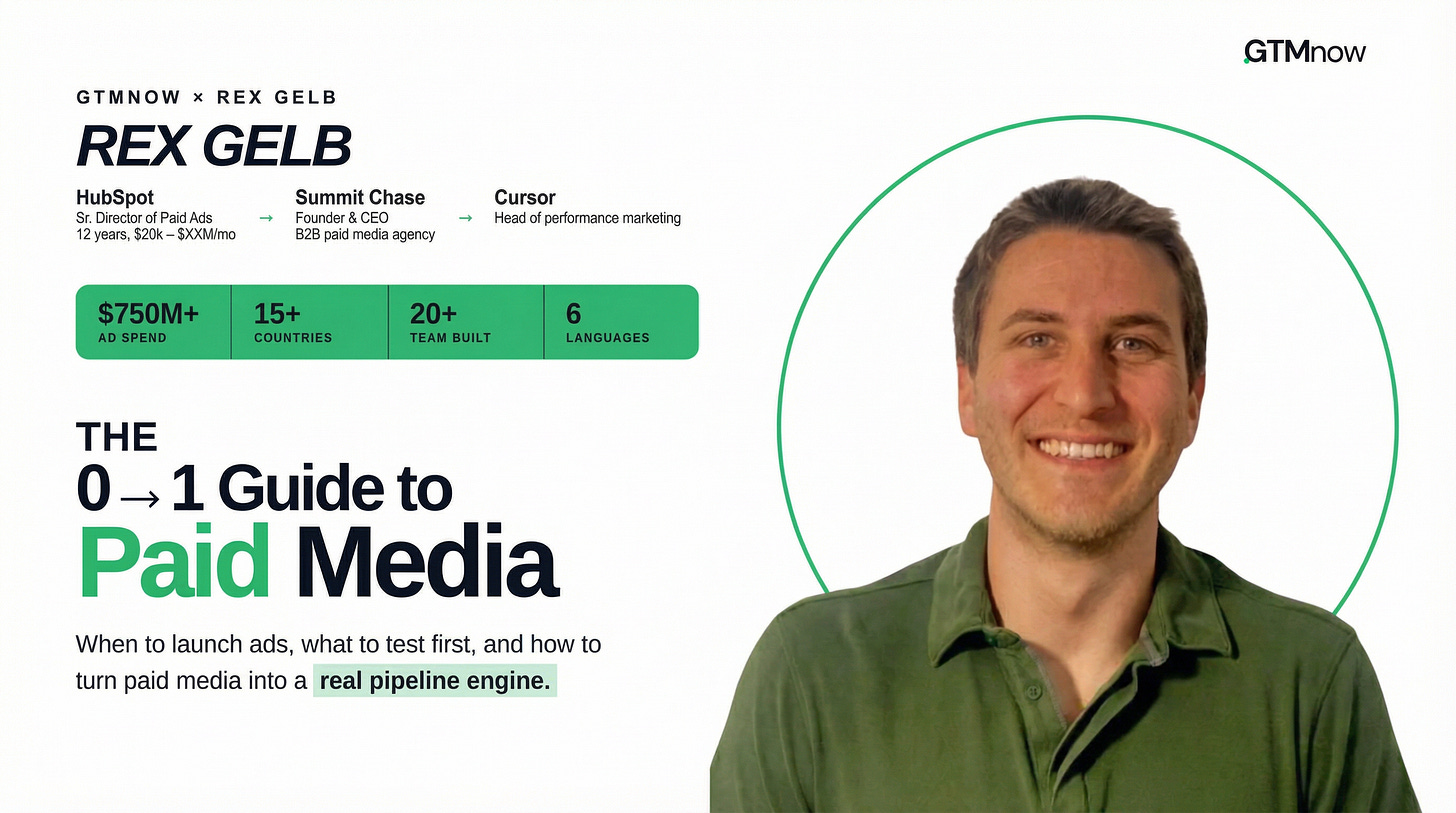
The news yesterday that OpenAI acquired TBPN truly demonstrates how valuable distribution is. As it’s increasingly more valuable but also more challenging to build, many companies and leaders have been inquiring more about paid ads. So, we teamed up Rex Gelb, Founder at Summit Chase and Head of Paid Media at Cursor, to bring you this edition.
Rex spent over a decade leading paid media at HubSpot. He started as a team of one managing a single Chrome extension on a $20k/month budget. By the time he left, he had built and led a global team of 20+ operators running campaigns across dozens of products, 15+ countries, and 6 languages.
Over 12+ years, he has managed roughly $750M in spend across Google, Meta, LinkedIn, and other major platforms. Now, he’s leading performance marketing at Cursor.
This guide walks through the 0 to 1 playbook. When to start, how much to spend, what to test first, and how to scale once something finally works. Let us get into it.


Sales today still relies on manual work: stitching together “Frankenstacks” and toggling between a dozen tabs just to log a single call.
Reevo is breaking the mold. As a vertically integrated Revenue Operating System, Reevo replaces the fragmented maze with a single, AI-native workspace. It captures 100% of your first-party data, from emails to meeting recordings, to help reps find high-intent buyers, automate administrative “garbage,” and generate context-rich outreach that actually sounds human.
No more wasting time on data entry or disconnected tools. It’s one unified engine for the entire revenue cycle. Go Stackless. Learn more at reevo.ai.
Step 1: Know When Not to Run Ads
The biggest mistake founders make with paid media is starting too early.
Ads are not the tool that creates product-market fit. They amplify it.
If you haven’t reached basic traction yet, paid media usually just accelerates the learning that something isn’t working. Rex has seen this pattern hundreds of times: founders pour $30K-50K into ads before retention exists, then conclude paid media does not work for them. The reality is the product was not ready. The ads just made that visible faster. Without product-market fit, you are paying to acquire users who churn immediately, and the platform learns to find more users who look like your churning users. It becomes a negative feedback loop.
If retention is not there yet, you are probably too early. Paid media works best when it pours gasoline on a fire that already exists.
Before investing in ads, you should already see signs that the product works:
Users are sticking around. Not just signing up, but coming back. If your week-4 retention is below 20%, ads will amplify a leaky bucket.
Customers are renewing. If customers are not staying, spending more to acquire new ones is a losing formula.
Word of mouth exists. People recommending your product without being asked.
Early deals are happening organically. Revenue coming in through inbound, referrals, or outreach that converts without heavy discounting. If you can’t close deals at all, paid media will not fix your sales motion.
Paid media works best when it pours gasoline on a fire that already exists.
The exception is early product testing. Some startups will run small paid campaigns to quickly recruit beta users or gather feedback. In that case the goal isn’t revenue – it’s learning. Small campaigns ($2K-5K) to recruit beta users, test messaging, or validate positioning are fine. But large-scale pipeline generation should wait until traction exists.

Step 2: When You Have Traction, It’s Almost Always Worth Testing
Once you have product-market fit and some capital to deploy, paid media becomes a very asymmetric bet.
The downside of testing is relatively small. You spend $20K-50K over a few months and learn what does not work. The upside is a repeatable pipeline engine that compounds for years. That risk-reward profile is why most Series A companies should be testing paid.
Most B2B companies start testing paid media around Series A, when they have both traction and budget.
Typical starting ranges look something like this:
Seed / Pre-PMF ($0-20K/month)
Mostly small tests and signal gathering. At this stage, paid media is a research tool, not a growth engine. Rex started at this level at HubSpot: one person, one product, $20K/month budget. The goal was to figure out whether paid could work at all.
Series A ($20-50K/month, ramping to $100K+)
Aggressive teams may ramp toward $100K+ if tests work. This is the inflection point. Test 3-4 campaign types simultaneously; measure pipeline, not just leads. Two to three months is typical before something works consistently. Resist the urge to quit after four weeks.
Series B+ (often $200K/month and up)
This is common depending on growth targets. At this stage you are scaling what works: new channels, geos, audience segments. Key: CPC has risen for 87% of industries (WordStream). If a channel produces ROI today, scale aggressively now, not next quarter.
These are not rules, they are just patterns.
Step 3: Expect It Not to Work at First
The first few months of paid media are usually messy. Rex shared at HubSpot’s INBOUND conference that roughly 90% of Facebook ad campaigns fail when they launch. The bar is not “get it right the first time.” Rather, it’s to “build a system that finds what works faster than competitors do.”
The goal early is not efficiency. The goal is finding signal.
Campaigns miss targets, messaging feels off, targeting is wrong. This is normal. Remember, the goal is finding signal and learning.
Winning ad programs come from testing combinations across five variables. Think of it as a five-dimensional matrix. Each combination you test narrows the space of what works.
The five variables to test:
Platforms. Which channels does your audience actually respond on? LinkedIn might seem obvious for B2B, but Rex has seen Google competitor campaigns outperform LinkedIn for certain products. Do not assume. Test.
Audiences. Job titles, seniority levels, company sizes, industries. Rex consistently finds that the buyer you think will convert best is not always the one who actually does.
Creative. Long copy vs. short copy. Video vs. static. In 2026, authentic native-style content increasingly outperforms polished production, especially on Meta.
Offers. Demo request vs. free trial vs. gated content. A demo request typically converts to pipeline at 3-5x the rate of a whitepaper download.
Landing pages. On LinkedIn specifically, Lead Gen Forms increase completion rates dramatically by auto-filling user data.
Eventually something starts to click. Then you double down.
The Core Three: Platform-by-Platform Playbook
Below is a practical starting framework for the three platforms most B2B companies should test first. These cover the three primary buying modalities: professional targeting (LinkedIn), active search intent (Google), and broad reach at scale (Meta). Most B2B companies should master these three before expanding to YouTube, Reddit, Twitter/X, or CTV.

LinkedIn Ads
LinkedIn is usually the first paid channel B2B teams test. It offers the cleanest targeting for professional audiences. You can target by job title, seniority, company size, industry, and even specific companies. No other platform comes close to this level of professional precision.
But the biggest mistake companies make on LinkedIn is adding unnecessary friction. Driving traffic to a landing page sounds logical, but it often kills conversion rates. The user has to leave LinkedIn, wait for the page to load, manually fill out a form, and submit. Each step loses people.
Instead, start with LinkedIn Lead Gen Forms. These keep the user inside LinkedIn and auto-fill their information (name, email, company, title) from their LinkedIn profile, which dramatically increases completion rates.
What to test on LinkedIn:
Thought leadership ads. Short insights from founders, operators, or subject matter experts consistently outperform polished marketing copy. LinkedIn now supports Thought Leader Ads that run from personal profiles rather than company pages. Early data shows CPCs of $5-$15 with meaningfully higher engagement rates.
Document Ads. These are an underused format that deserves more attention. You upload a PDF (whitepaper, guide, data report) and users can preview it directly in their feed without leaving LinkedIn. The download interaction pre-qualifies the lead. Document Ads deliver the lowest average CPL on the platform: $256, compared to $317 for single image ads.
In-feed ads. Simple posts that appear naturally in the feed. These work well for demo requests, product announcements, and event promotions.
Message or conversation ads. Direct outreach style ads that mimic a sales conversation.
Content offers or demo requests. Test both gated content and demo CTAs.
Also test multiple personas. sometimes the buyer you think converts best is not the one who actually does. Run the same offer to 3-4 different persona segments and let the data tell you who your real buyer is. You might discover that mid-level managers convert better than VPs, or that a specific industry segment responds at 3x the rate of your assumed ICP.
LinkedIn success comes from systematic testing. 2026 benchmarks: Avg B2B CPC $5.50-$8.50. CTR 0.44-0.65%. B2B ROAS 4.1-8.3x. LinkedIn now captures ~39% of all B2B paid media budgets globally.
Google Ads
Google is often the highest-intent paid channel. But many companies launch Google campaigns incorrectly. Always start with Search ads, not display or YouTube.
There are three core campaign types to test:
1. Brand Campaigns
If competitors are bidding on your company name, they can capture demand you created. Brand campaigns protect that traffic.
It may feel strange paying for clicks on your own name. After all, your organic listing is right there. But in practice, competitor ads push your organic result further down the page, and even a small percentage of clicks going to competitors represents real pipeline leakage. Brand campaigns are usually very cheap (low CPC, high CTR, high conversion rate) because the user already has intent to find you.
2. Competitor Campaigns
Competitor terms are often one of the highest ROI tests in early Google programs.
The conversion rates on competitor campaigns tend to be lower than brand campaigns (they are looking for someone else, after all), but the lead quality is often exceptional because these are buyers deep in an active evaluation. The key is having a compelling reason for them to consider you: a clear differentiator, a comparison page, or a case study from a customer who switched.
3. Non-Brand Search
These are category keywords like “HR compliance software,” “B2B lead generation platform,” or “marketing attribution tool.”
These can be competitive and expensive, but they help you capture new demand. Other Google formats like Performance Max, Display, and YouTube can work well later. But for 0 to 1, Search should always come first.
Meta (Facebook and Instagram)
Meta ads behave very differently than LinkedIn and Google.
The platform relies (even more) heavily on machine learning. The ad system learns from massive volumes of behavioral data and makes targeting decisions that often outperform manual audience selections. Trying to micromanage campaigns or over-segment audiences usually makes performance worse, not better.
Instead, take a consolidated approach. This means running a small number of campaigns with broad targeting and letting the algorithm optimize. Specifically:
Do not separate Facebook from Instagram. Let Meta decide where your ad performs best for each user. The platform has more data about user behavior across its properties than you do.
Do not split mobile from desktop. Again, the algorithm handles this better than manual segmentation.
Do not create tiny audience slices. A campaign targeting 5,000 people gives the algorithm nothing to work with. Broader targeting (50K-500K+) lets the machine learning system find your buyers within a larger pool.
Avoid using lead forms unless you include strong qualification questions. Meta lead forms often produce high volume but low quality because the auto-fill makes it too easy. Driving traffic to your website with a clear conversion action (demo request form, free trial signup) usually produces better-qualified leads.
The 2026 creative shift: Meta’s algorithm increasingly favors authentic, native-style content over polished production. Short-form video with CPVs as low as $0.01-$0.02 is becoming the default. A founder recording a quick take on their phone may outperform a two-week agency production.
Always measure pipeline contribution, not just top-of-funnel volume.
After the Core Three, Expand Carefully
Once you have data from LinkedIn, Google, and Meta, additional channels may be worth testing.
Common next experiments include:
YouTube for video education and retargeting
Reddit for niche technical communities
Twitter/X for startup and developer audiences
CTV for brand awareness at scale
But most B2B companies should focus on the core three first.
Spreading budget across too many channels early slows learning. The math: $30K/month across three platforms gives you $10K per platform. $30K across six gives you $5K each – often below the threshold for statistically meaningful results on any of them.
The Most Important Step: Set Up Your Tracking First
Before launching any ads, you must set up proper conversion tracking.
Without it, the platforms cannot learn who to target. This is the section Rex feels most strongly about – it is arguably the single biggest determinant of whether your paid media program succeeds or fails. If your tracking only captures 40% of actual conversions (blocked by ad blockers, iOS privacy changes, or broken pixels), the algorithm is working with a distorted picture of reality.
Modern paid media relies heavily on machine learning. Google’s Smart Bidding, Meta’s Advantage+, and LinkedIn’s ad delivery systems all optimize based on the signals you send back to the platform. When a user clicks your ad and then converts (fills out a form, starts a trial, books a demo), that conversion event tells the platform: “this is the kind of person I want more of.” The platform then uses that signal to find more users who look similar.

The modern tracking stack:
Server-side tracking with Conversions API (CAPI). Browser-side pixels are increasingly blocked by ad blockers, iOS privacy changes, and cookie restrictions. Server-side tracking bypasses all of these limitations by sending conversion data directly from your server to the ad platform’s server. This is no longer optional. It is the foundation of effective paid media in 2026. Google calls it Enhanced Conversions. Meta calls it Conversions API. LinkedIn calls it the Conversions API as well. The implementation is technical, but the impact is dramatic: companies that implement server-side tracking typically see a 15-30% improvement in attributed conversions, which in turn gives the algorithms significantly more data to optimize with.
Advanced Matching. This sends hashed customer data (email addresses, phone numbers) to the ad platforms to improve attribution accuracy. When a user converts, the platform can match that conversion back to the specific ad click more reliably, even across devices and sessions. This is especially important for B2B where buying cycles span weeks or months: the person who clicked your LinkedIn ad on their phone two weeks ago might convert on their desktop today. Without Advanced Matching, that conversion is invisible to the platform.
Consent Mode. With GDPR, CCPA, and evolving privacy regulations, you need tracking that works within consent frameworks. Google’s Consent Mode adjusts data collection based on user consent preferences, allowing the algorithms to still learn from aggregated, anonymized signals even when users decline full tracking. This is especially important if you are running campaigns in Europe or targeting privacy-sensitive enterprise buyers.
Think of it like training a machine learning model. The better the data you provide, the better the outcomes. Without clean tracking, the algorithm is essentially flying blind.
One more critical point: by 2026, platforms like Google (Performance Max, AI Max for Search) and Meta (Advantage+) no longer offer automation as an optional feature. They assume it. The AI handles bidding, audience targeting, creative assembly, and placement. The role of the human operator has shifted from managing campaign settings to ensuring the quality of inputs. Your tracking data, creative assets, product feed, and landing page structure are now the primary levers you control. Everything else is delegated to the machine.
Think of it like training a machine learning model. The better the data you provide, the better the outcomes. Without clean tracking, the algorithm is essentially flying blind.
Step 4: When Something Works, Hit the Gas
Eventually you will find a campaign that produces real pipeline. When that happens, many companies often make another mistake.
They scale too cautiously. The risk of scaling too slowly is often larger than the risk of scaling too fast. CPC has risen for 87% of industries over the past year (WordStream). B2B SaaS CPCs specifically rose ~9% YoY. The window to scale a winning channel at favorable economics is always narrowing.
If a channel produces positive ROI, the best time to invest is now.
Ad inventory rarely gets cheaper over time. Competition increases, prices rise. Winning companies move quickly once a channel proves itself.
Paid media works best when you:
Test aggressively
Identify winners
Scale quickly
Speed matters. Follow this rhythm: test aggressively in months 1-3, identify winning combinations, then shift to scaling mode where 70-80% of budget goes to proven winners and 20-30% stays in testing to find the next breakthrough. Never stop testing entirely.
The 2026 Shift: AI Is Rewriting the Paid Media Playbook
One more dimension worth addressing, because it changes how every founder should think about this channel going forward. The role of AI in paid media has shifted from “nice-to-have optimization” to “the entire operating system.” Understanding this shift is critical for anyone building a paid media program in 2026.
Creative is now the primary lever
When the platform controls bidding and targeting (which it increasingly does, by default), the variable that separates a strong campaign from a weak one is the quality of what you feed the machine.
Platforms are becoming more opaque
Google’s Performance Max and Meta’s Advantage+ give advertisers less control over individual campaign settings. You can not manually set bids for specific keywords in Performance Max. You can not control which placements your Advantage+ ads appear on. The tradeoff is often better aggregate performance at the cost of visibility.
The operator’s role is shifting
Less hands-on-keyboard campaign management. More strategic oversight, creative direction, first-party data management, and measurement architecture. The skill set that matters in 2026 is not bid management. It is understanding what signals to feed the system, how to build a creative testing pipeline, how to own first-party data strategy, and how to interpret why the AI made the decisions it did.
For more on how AI is reshaping software broadly, see our edition on “The “SAASpocalpse.”
Final Thought
Paid media is not magic. But it is one of the most powerful growth engines available to B2B companies when the timing is right and the execution is systematic.
The opportunity is still massive. The best time to build your paid media muscle is before your competitors figure it out. Start now. Start small. But start.
Tag @GTMnow so we can see your takeaways and help amplify them.
More for your eyeballs
Trimble is acquiring Document Crunch, bringing AI-powered contract risk analysis into its construction project management ecosystem. Construction is one of the last industries to modernize around document compliance, and purpose-built AI that catches payment disputes and notification failures before they escalate is a real wedge. Vertical AI finding its way into incumbent platforms is the pattern to watch.
Granola raises $125M at a $1.5B valuation, up from $250M less than a year ago. Meeting notes are a commodity at this point, and Granola knows it — the real bet is on becoming the enterprise context layer, with new APIs that let teams pull meeting intelligence into AI workflows. The valuation jump says investors believe whoever owns the context wins.
More for your eardrums
VC: Investing at Inception in the Age of AI Agents with Ed Sim
For the full thing, listen on Apple, Spotify, YouTube or wherever you get your podcasts by searching “The GTMnow Podcast.”
Startups to watch
Armada – named among Fast Company’s Most Innovative Companies in computing, alongside NVIDIA and Google. They’re building distributed AI infrastructure for the environments most platforms ignore. Worth watching as enterprises and governments push AI into the field, not just the cloud. To learn more you can also check out the GTMnow episode with CEO Dan Wright.
Examen – raised $4.3M in total funding and launched. Examen is building an autonomous analyst for commercial real estate.
Hottest GTM jobs of the week
- Enterprise Account Executive, US & Canada (Dallas, TX)
- Customer Success Manager at Esper (Austin, TX)
- Customer Success Manager at gaiia (Remote – Canada)
- Associate Account Executive (Sports Cards) at Alt (Remote – US/Canada)
- AVP, customer success (West) at Writer (Hybrid – San Francisco, CA)
- Growth Marketing Manager (PALs/Consumer) at Tavus (San Francisco, CA)
See more top GTM jobs on the GTMfund Job Board.
GTM industry events
Upcoming events you won’t want to miss:
- MicroConf 2026: April 12–14, 2026 (Portland, OR)
- GTMfund Dinner: April 14, 2026 (Austin, TX)
- HockeyStack’s Top Secret Launch Party: April 16, 2026 (San Francisco, CA)
- SaaStock USA: April 15–16, 2026 (Austin, TX)
- Forrester B2B Summit: April 26–29, 2026 (Phoenix, AZ)
- SaaStr Annual: May 12–14, 2026 (San Mateo, CA)
- GTMfund Dinner: May 14, 2026 (San Francisco, CA)
- GTMfund Dinner: June 9, 2026 (London, UK)
- Dreamforce 2026: September 15–17, 2026 (San Francisco, CA)
- INBOUND: September 16–18, 2026 (Boston, MA)
- Pavilion GTM2026: September 28–October 1, 2026 (NYC, NY)
- CVC Week by Counterpart Ventures: September 29, 2026 (San Francisco, CA)
- Customer Success Week: October 5-9, 2026 (NYC, NY)
- TechCrunch DISRUPT: October 13–15, 2026 (San Francisco, CA)
GTMnow community love
Some GTMnow community (founder, operator, investor) love to close it out – we appreciate you.