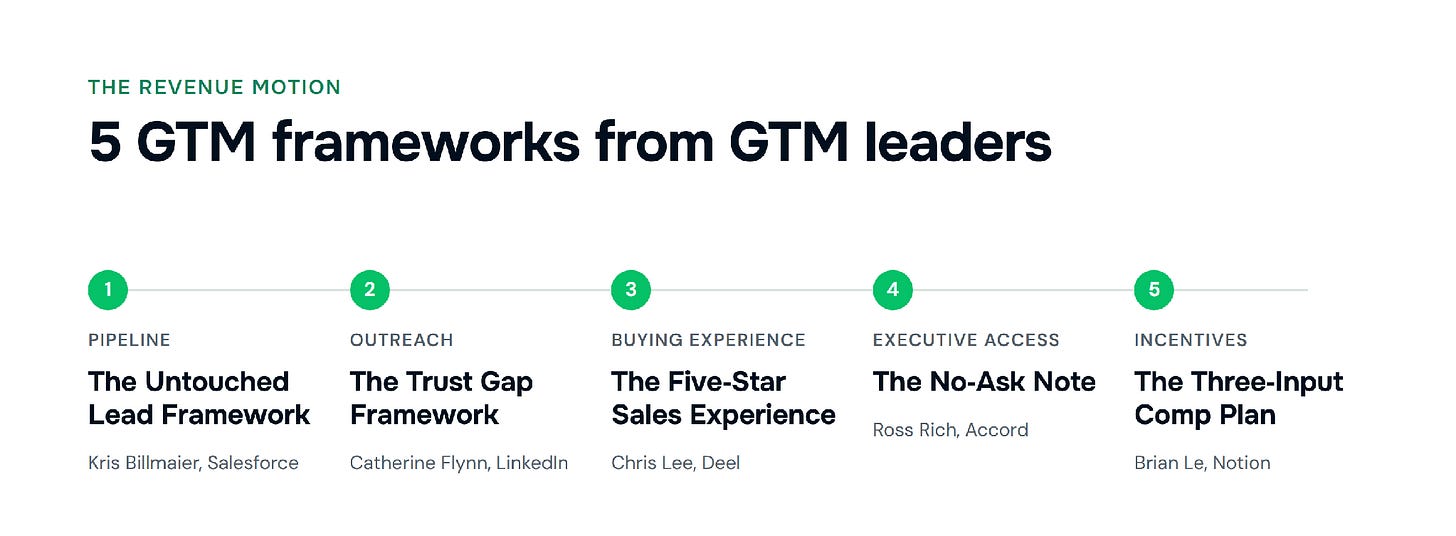


The biggest lever on revenue is rep performance. The biggest lever on rep performance is compensation.
Most compensation programs don’t reflect how the company actually wants to grow. They’re inherited, patched, and running in spreadsheets – until a top rep leaves over a disputed payout, or a down quarter exposes that the plan was rewarding the wrong behavior all along.
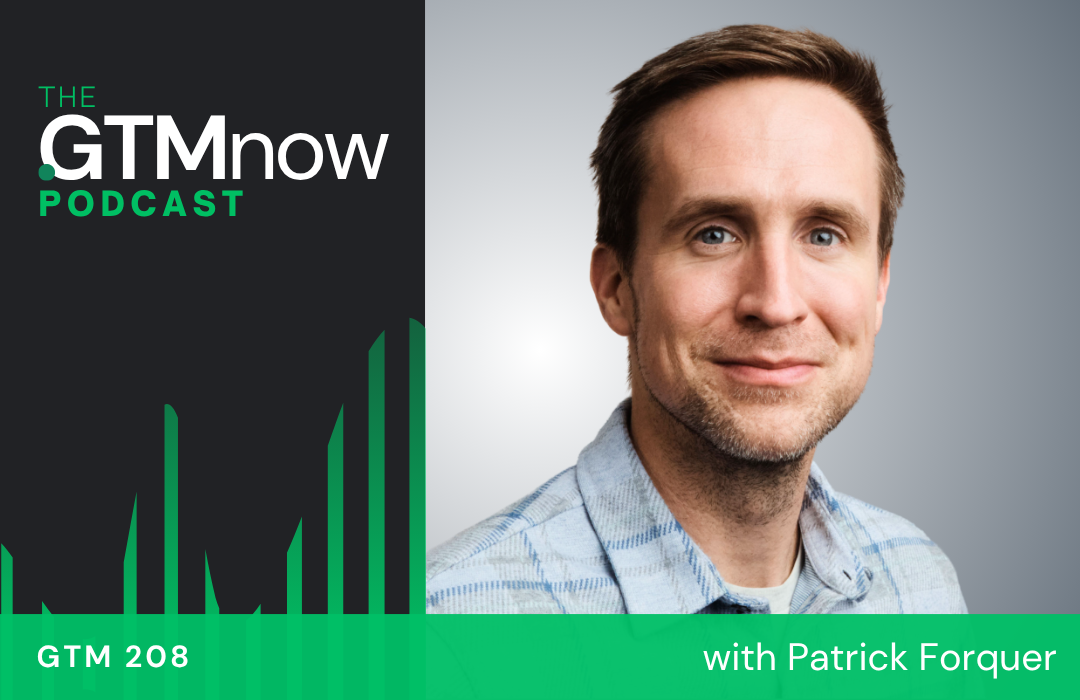
GTMnow’s upcoming episode series on sales compensation features Siva, founder of Everstage (the #1 rated incentive management platform on G2), alongside leaders who rebuilt compensation from scratch as their sales teams scaled 10x.
Episode 1 drops June 9th! Subscribe to The GTMnow Podcast (YouTube / Apple / Spotify) wherever you listen and stay tuned 👀
Anthropic and OpenAI are hiring GTM roles
If you think the best AI products in the world don’t need GTM, look at who’s hiring.
The companies building the AI that’s supposed to replace your sales team are the ones hiring sales reps the fastest.
Go-to-market is the largest hiring category at OpenAI. Roughly one in five open roles sit across sales, partnerships, and revenue functions, with enterprise account executives among the company’s most aggressively recruited positions.

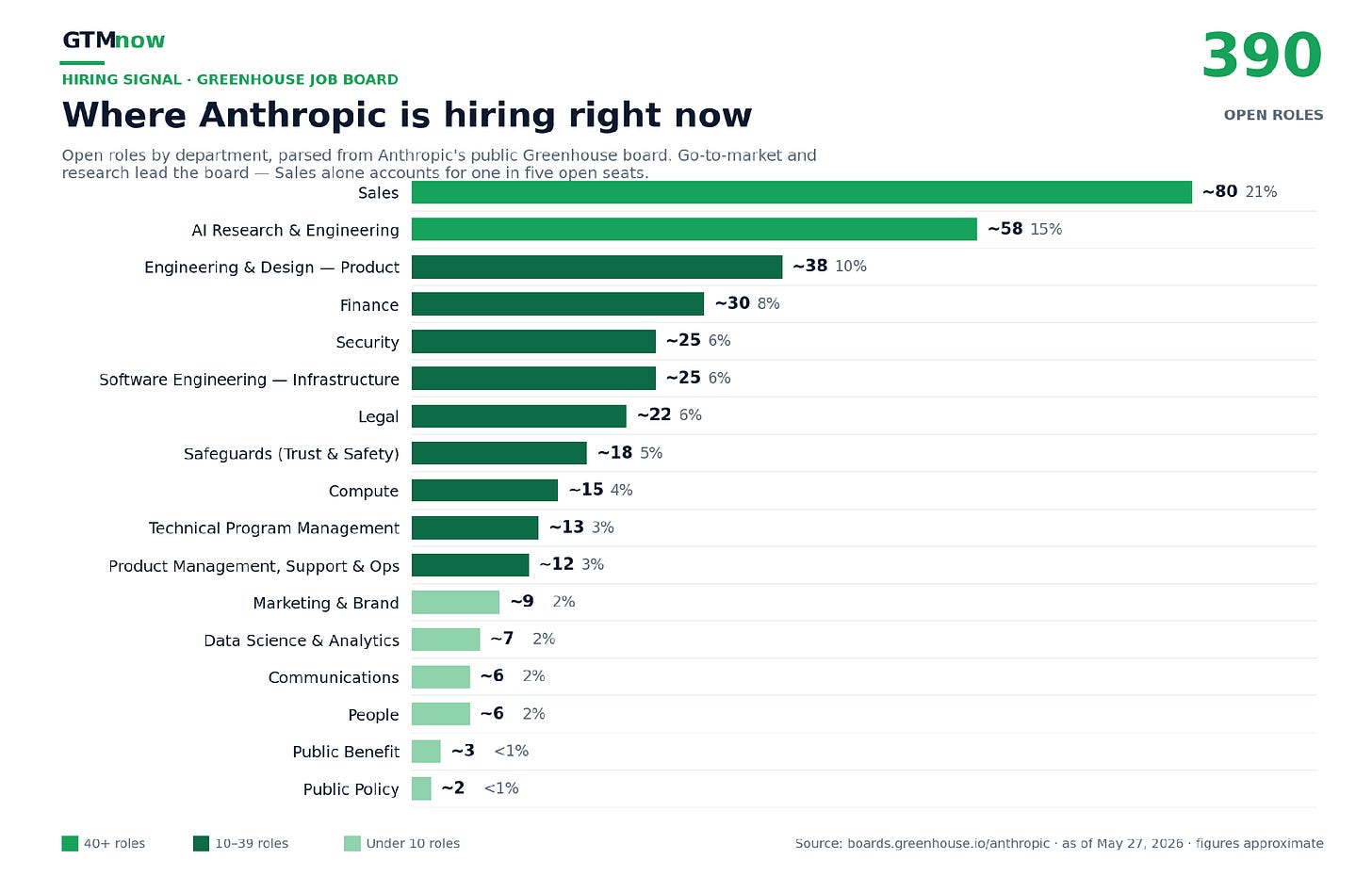
Anthropic shows the same pattern. Sales represents approximately 20% of all open roles, more than any other department.

These are arguably the two strongest product organizations in AI. They’re also investing heavily in distribution.
OpenAI is reportedly planning to nearly double headcount this year, growing from roughly 4,500 employees toward 8,000. Anthropic continues to expand across enterprise sales, partnerships, and customer-facing teams. The companies with the strongest product positions in the world are hiring knowing distribution is the force multiplier.
On June 1, Anthropic confidentially filed for a U.S. IPO, days after a $65 billion round pushed its valuation to $965 billion. A company that still leads with AI safety and research is walking into public markets on the back of an enterprise sales engine it has been quietly building for months.Deal size is a driving factor
PLG gets you to the door and humans close the room
The driver isn’t a vanity org chart. It’s the shape of the revenue. Anthropic’s annualized run-rate recently crossed roughly $47 billion, up from about $9 billion at the end of 2025, and reported sources note that enterprise customers account for roughly 80% of it. The customer base tells the same story from a different angle: more than 1,000 businesses now spend over $1 million a year with Anthropic, double the count from two months earlier, and up from about a dozen two years ago.
Self-serve scales beautifully, right up to a ceiling. A $1 million-plus annual contract doesn’t get won in a Stripe checkout. It gets won by an account executive who can build relationships across a multi-division buying committee, a solutions architect who can map the model to a customer’s actual technical stack, and a customer success manager whose job is protecting the renewal.
Once your average contract value crosses the threshold where a single deal involves multiple stakeholders and a procurement cycle, you need a human GTM layer.

The revenue is enterprise-led and concentrated. That mix is what pulls hiring toward sales.
Lessons from their org shapes
Decode which roles they’re hiring and you’ve got the 2026 enterprise-AI playbook in miniature. Three roles are prominent:
Forward-deployed engineers and solutions architects
These are technical sellers who embed inside the customer’s environment and ship the integration, not pitch-deck sellers who present and leave. Anthropic runs this as an applied AI / forward-deployed engineering function; OpenAI is building its own deployment-engineering muscle for the same reason.
Enterprise account executives
Land and expand. Long cycles, many stakeholders, executive sponsorship. This is the role Anthropic has been hiring most aggressively, and it exists to win and grow the accounts that PLG surfaces but can’t close on its own.
Technical ambassadors
OpenAI’s own framing for a class of specialists who help businesses actually use the tools, essentially productized customer success. As one analysis put it, these aren’t salespeople; they’re the people who turn an impressive pilot into production usage. The same function MIT’s research keeps flagging as the missing link, given how many enterprise AI deployments stall before they show ROI.

Three roles, one playbook: sell technically, expand deliberately, drive adoption.
Why this is the Palantir motion, finally going mainstream
The forward-deployed engineer wasn’t invented by an AI lab. Palantir built it in the early 2010s out of necessity, when intelligence-agency customers couldn’t fully explain what they needed, so Palantir put its own engineers inside the customer’s walls to build alongside them.
For a decade, the model was treated as a curiosity, services dressed up as software, too high-touch to scale, the thing serious SaaS investors warned founders away from. Palantir’s stock slid to around $6 in 2022 and the skeptics felt vindicated. Then it returned roughly 640% over the following five years, and became the one the most valuable software companies on earth.
The fringe motion became the default
The reason it fits AI orgs so well is that the knowledge gap sits in the middle of every enterprise deployment. The lab’s engineers know how to make the model work, the customer’s engineers know the data schemas, the compliance rules, and the internal politics of which team owns which system. Someone has to stand in that gap and build. That’s the FDE, and the broader pattern is now called “the Palantirization of everything”.

The classic handoff assumed the product spoke for itself. AI revenue assumes someone has to make it work in production.
The future of enterprise software
The AI vendors selling automation of the entire GTM function are, without exception, building human GTM functions of their own. Watch what they do, not what they market.

When the product gets copyable, the moat moves up the stack to distribution.
The labs that build the models told us, in the one language that can’t be spun, where they think the next five years of enterprise software live.
Tag @GTMnow so we can see your takeaways and help amplify them.
More for your eyeballs
Sam Altman, Palmer Luckey, Dylan Field, and a room full of tech legends played Mafia — and it’s exactly as chaotic as it sounds. Founders Fund hosted the game, featuring founders, investors, a pro poker player, and a biohacker trying to out-deceive each other.
Anthropic has confidentially submitted its S-1 to the SEC. The IPO isn’t confirmed yet – timing and pricing depend on market conditions – but the filing gives them the option to go public once the SEC completes its review. The AI infrastructure race is heading to public markets.
Sierra hit $200M ARR. Seven quarters to reach $100M, two more to double it. The compounding is accelerating.
More for your eardrums
GTM 193: How Esper Is Building the Operating System for Government Policy | Maleka Momand
Listen through the links in the page above or by searching wherever you get your podcasts “The GTMnow Podcast.”
Startups to watch
Pace – raised $46M Series B co-led by Thrive Capital and Sequoia to bring AI-native operations to insurance. Their agents have completed 250,000+ critical insurance operations, growing 3x every quarter. 60% of the world’s losses go uninsured – Pace is attacking the $9 trillion protection gap starting with back-office automation.
Default – raised $20M Series A led by 8VC to launch a unified, real-time data layer for revenue agents. Everyone is trying to deploy agents, and Default solves the bottleneck: siloed data and legacy systems that aren’t ready for them.
Noble – partnering with Profound to close the loop on AI search visibility. Profound customers can now identify citation gaps and fill them with Noble’s offsite network, getting their brand into the third-party sources AI platforms actually cite.
Hottest GTM jobs of the week
- Director of Product Management – Product Platform at CaptivateIQ (Remote)
- Senior Manager of Customer Success (Enterprise) at Owner (Remote – US)
- Business Development Representative at Atlan (Remote – India)
- Director, Commercial Customer Success at Vanta (Remote – US)
- Growth Marketing Campaigns Manager at Armada (Remote – US)
See more top GTM jobs on the GTMfund Job Board.
GTM industry events
Upcoming events you won’t want to miss:
- GTMfund Dinner: June 9, 2026 (London, UK)
- Lenny & Friends Summit: September 10, 2026 (San Francisco, CA)
- Dreamforce 2026: September 15–17, 2026 (San Francisco, CA)
- INBOUND: September 16–18, 2026 (Boston, MA)
- Pavilion GTM2026: September 28–October 1, 2026 (NYC, NY)
- CVC Week by Counterpart Ventures: September 29, 2026 (San Francisco, CA)
- Customer Success Week: October 5-9, 2026 (NYC, NY)
- TechCrunch DISRUPT: October 13–15, 2026 (San Francisco, CA)
GTMnow community love
Some GTMnow Network love to close it out – we appreciate you.