Through GTMfund, we’ve invested in 120+ startups. Individually, the team has angel invested in many more.
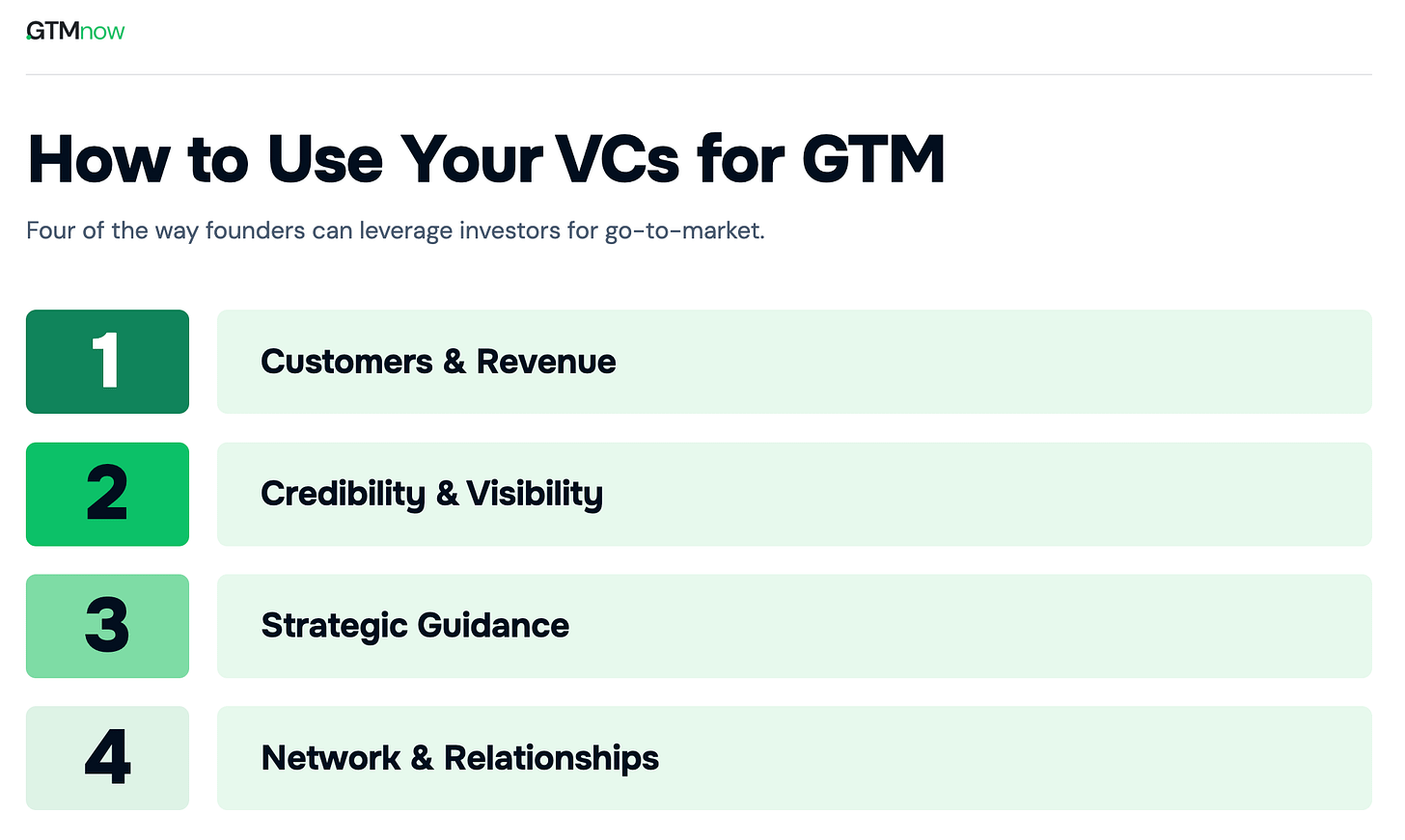
Founders and startup teams often lean on their investors for core support like fundraising and operational guidance. “GTM” is literally in our name (GTMfund!), so go-to-market is where we specialize, on top of those usual areas. Still, we’ve found that not enough founders tap their investors for GTM help, so this edition breaks down how to do exactly that. Below are four core areas that any investor may be able to support with, and how to successfully approach each.

Customers and Revenue
Venture capital is greatly a network business. Don’t be afraid to ask your investors for direct introductions. Their networks are vast, and if they can’t make one, they’ll simply say so. An easy starting point: scan the rest of the portfolio for companies that could be a fit as customers. This can be done by an SDR, someone else on your team, or yourself depending on your team composition. If it’s someone on your team, have them map target accounts to investor portfolio companies by referencing investors’ websites, where they typically list all of the companies they’ve invested in. Then, have them ghostwrite emails that come from the CEO, so the outreach is CEO to CEO of the portfolio company. Your investor will be able to forward the email along to the target company, if they’re able to accommodate the request.
The easiest way to get help is to do the work for your investor up front. They’re fielding asks from dozens of portfolio companies at any given time. A specific ask, like an introduction to one named company, is easy to act on. A vague one, “can you connect me with anyone who might be a fit,” isn’t.
For example, a unique way of easing the lift that we’ve seen founders do is have their top target accounts built out into a custom dashboard – with ones in funnel and cold ones they want to break into – and have a way for investors to easily click in, visualize it, and then click a button if they can provide an introduction.
The easier you make it for people to help, the more they will help. They want to help, but there’s natural inertia working against you. Make intros easy.
The conversion on warm intros vs. cold outbound is worth the effort.

Credibility and Visibility
Many investors have platforms that highlight portfolio companies, some form of owned distribution. A few go further and lean into media entirely, the way we do at GTMfund with GTMnow, our own media arm. Tell your investors directly that you’re open to these opportunities. That’s what keeps you top of mind when one comes up.
Regardless of a firm’s distribution, every fund runs an annual general meeting (AGM). That’s another venue to raise your hand for a speaking slot. They might not be able to make it happen, but now they know you want it if the chance comes up – it’s worth a shot.
Strategic Guidance
Every firm structures this differently, but most have some function built for strategic guidance. At GTMfund, this includes a community of 350+ go-to-market operators, plus an extended network that we plug into portfolio companies for strategic guidance and even hands-on GTM support.
Other firms run it through an Operating Partner, someone dedicated to getting hands-on with portfolio companies. You can get a sense of that role from this interview with Bill Binch, Operating Partner at Battery Ventures.
Network & Relationships
Nearly every fund runs an offer program. This is a standing offers list – discounts, free credits, preferred pricing – that a VC firm negotiates with vendors and makes available to every company in its portfolio.
Ask your investors if they have a portfolio offer portal/program. If they do, it can be beneficial to provide some form of standing discount for portfolio companies. That will help you get included in the portal available to fellow portfolio companies. It’s passive, it’s evergreen, and it puts you in front of every company the fund touches without another ask.
Don’t limit this to the names already on your cap table. VC friendlies, investors who passed or haven’t invested yet, still have portfolios that they are looking to support with access to the best products. If your product meaningfully solves a need for them, they may be happy to also add you to their portfolio offer portal/program.
Your investors want to help you be successful, and they believe you will be – they invested for a reason! Think of them as a partner, not only on the finance side but in all aspects of how to make you successful. That includes go-to-market.
It can be helpful to celebrate the wins across these four areas, along with any other areas. It will make others want to jump in and help too. One light-lift effective way of doing this is by having a shoutout section at the bottom of investor update emails. Here’s an example:

Be strategic in how you approach it. The best founders don’t look at their VCs as a volume driver, because that’s not what relationship networks are. However, it can be one of your most strategic channels for conversion and value creation if leveraged correctly.
Tag @GTMnow so we can see your takeaways and help amplify them.
More for your eyeballs
AI Benchmarks and Beyond – Emergence Capital’s new report on how B2B software performance is being redefined in the AI era, built from data across 560+ companies. AI-native companies are growing ~4x faster with 21% higher retention, proof that treating AI as a core competency instead of a feature is now the dividing line.
Zoom is acquiring Common Room – the video company is buying the AI-native sales intelligence platform to move upstream of the call into go-to-market buyer intelligence. Common Room turns scattered customer signals into person-level buyer intel for teams at Anthropic, Notion, and Snowflake, and folds into Zoom Revenue Accelerator as Zoom pushes to be an AI “system of action,” not just a video app.
The Death of the Three-Act Playbook – Mike Vernal (Sequoia) argues the classic enterprise SaaS path of wedge, then suite, then platform is dead because the world now moves too fast for it. With companies like Cursor, Clay, and Harvey racing $0 to $100M ARR, he says founders should skip the protective wedge and go straight for the whole thing, valuing unrelenting ambition above all.
More for your eardrums
GTM: Inside Merge – How They Went Enterprise-First, Then Reversed to PLG
Listen through the links in the page above or by searching wherever you get your podcasts “The GTMnow Podcast.”
Startups to watch
Humanoid – raised a $152M Series A at a $1.35B valuation to build AI-powered industrial humanoid robots. Backed by Bosch and Schaeffler, it’s Europe’s first pure-play humanoid unicorn, and it’s starting with wheeled robots because capital rewards whatever deploys fastest.
Neo – raised $100M out of stealth to rebuild enterprise security for a world of AI agents. Founded by ex-SentinelOne execs, backed by a16z, Bessemer, and Craft, the bet is that identity and permissions all get rebuilt once software acts on its own.
Natural – raised a $30M Series A led by Forerunner to build the payments rails that let AI agents spend money. Agentic commerce is easy to demo and brutally hard to operationalize, and AI that safely moves a dollar is a lot harder to rip out.
AegisAI – raised a $36M Series A led by Battery Ventures to stop AI-generated spear-phishing. Built by the Google team behind reCAPTCHA, the bet is that once fake emails are free to produce, signature filters die and cyber budgets keep growing.
CuspAI – raised a $450M Series B at a $2.6B valuation to use AI for materials discovery. Backed by Kleiner Perkins, NEA, and Bezos Expeditions, its work sits upstream of chips, batteries, and energy, so investors fund the whole stack.
Etched – raised a $300M Series C at a $10.3B valuation to build chips purpose-designed for AI inference. Led by Sequoia with $1B already booked in orders, it’s going straight at Nvidia’s economics, betting the real money is in inference, not training.
Hottest jobs of the week
- Senior GTM Strategy & Operations Manager at Vanta (Remote – US)
- Senior Brand Manager at WRITER (Hybrid – New York, NY)
- Customer Support Representative at Closinglock (Austin, TX)
- YouTube Manager at Owner.com (San Francisco, CA)
- Vibe Growth Marketer at Tavus (San Francisco, CA)
See more top GTM jobs on the GTMfund Job Board.
GTM industry events
Upcoming events you won’t want to miss:
- Lenny & Friends Summit: September 10, 2026 (San Francisco, CA)
- Dreamforce 2026: September 15–17, 2026 (San Francisco, CA)
- INBOUND: September 16–18, 2026 (Boston, MA)
- Pavilion GTM2026: September 28–October 1, 2026 (NYC, NY)
- Moment 2026: October 6, 2026 (NYC, NY)
- CVC Week by Counterpart Ventures: September 29, 2026 (San Francisco, CA)
- Customer Success Week: October 5-9, 2026 (NYC, NY)
- TechCrunch DISRUPT: October 13–15, 2026 (San Francisco, CA)
- GTMfund AGM/Retreat: October 15-17, 2026 (San Francisco & Napa, CA)
GTMnow community love
Some GTMnow Network love to close it out – we appreciate you.