

Quick one for the ABM folks: Influ2 built an MCP connector that lets Claude or ChatGPT read your contact-level ABM data and act on it.
That means your AI tool now knows who your buyers are, so you can build programs, check performance, gather Sales intel, and more – right from the chat.
Influ2 also put together 30+ ready-to-use AI prompts, organized by what you’re trying to get done. Get them for free here!
Product-market fit (PMF) is the most used and least defined term in venture. It serves a purpose, but the way it gets used sometimes implies something that has never been true: that fit is a thing you search for, find once, and then own. Now in the AI era, PMF is often being referred to as continuous or as a treadmill.
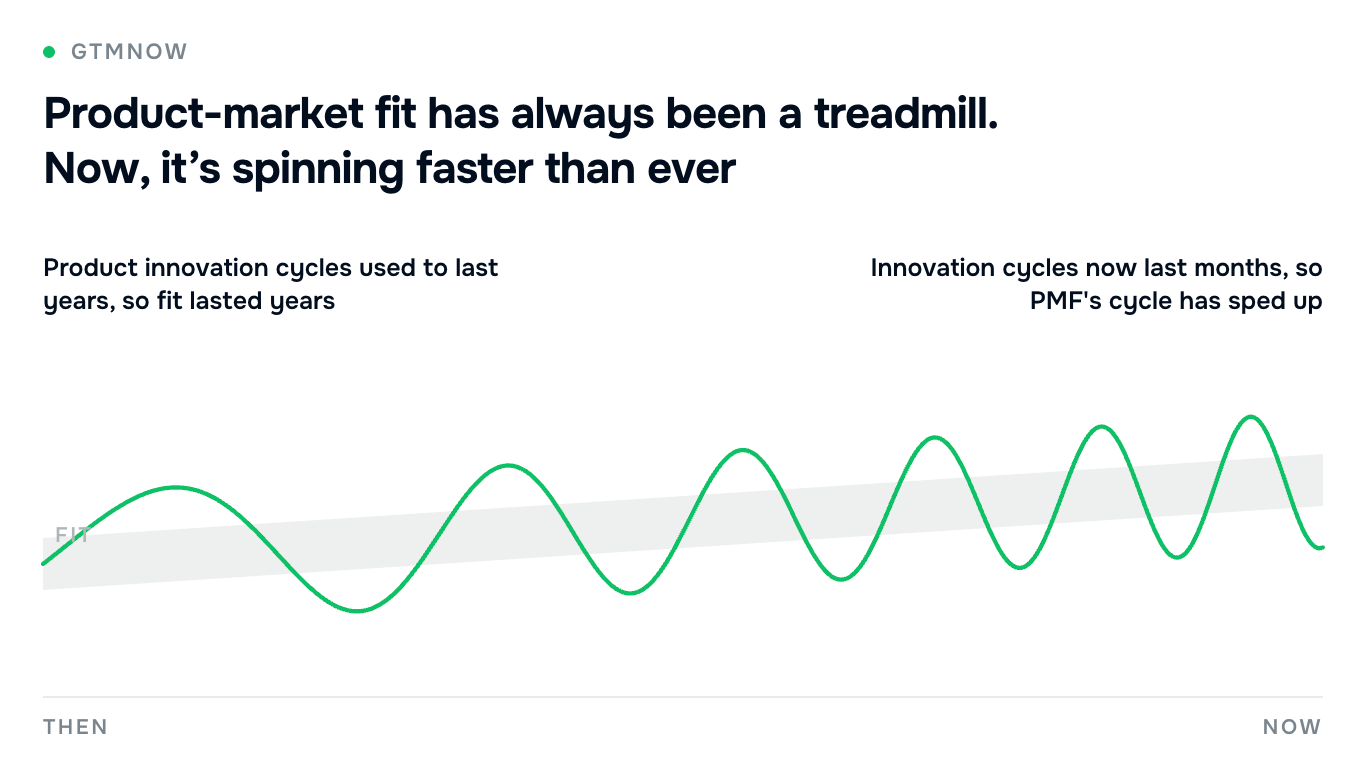
But the reality is that PMF has always been a treadmill. You’ve always had to consistently earn it. It isn’t an off switch, and nobody actually building a company would describe it as static.
It just feels like it’s a treadmill now because you can really feel its movement. It was always moving, but just at a much slower pace.
What has changed is the cadence of the treadmill – how fast it’s going. When the underlying technology iterated every few years, you re-earned fit every few years. The technology now iterates monthly, and teams are re-establishing fit every quarter, and often every month. This cadence shift is the product of the AI innovation cycle.

So now the big question for founders and GTM operators is twofold: whether you have PMF, and most importantly now whether you’re compounding fast enough to keep it.
What is product-market fit
Product-market fit is the most used and least defined phrase in software. Here are a few different ways to think about it:
Andy Rachleff coined the term. His definition is still the tightest: a value proposition that resonates with a set of customers who then buy the product repeatedly.
Marc Andreessen made it famous. In his 2007 essay “The Only Thing That Matters,” he defined it as being in a good market with a product that can satisfy that market. His test isn’t a metric, it’s a feeling, and it runs in both directions. You know you don’t have it when customers aren’t quite getting value, word of mouth isn’t spreading, usage isn’t growing, deals take too long to close, and reviews come back “meh.” You know you have it when customers buy as fast as you can make the product, usage grows faster than you can add servers, and money is piling up in your account.
YC anchors it in retention. Michael Seibel’s version is the most unforgiving of the set: look at your cohort retention curve. If it flattens, you have a real product with real fit. If it decays toward zero, you have interest. Signups measure your marketing, retention measures your product.
Justice Potter Stewart’s line about pornography – “you know it when you see it” – is probably the most honest definition of PMF anyone has offered. Talk to a founder who has it and that’s close to exactly what they’ll tell you. One of the GTMfund portfolio company founders thought he had it several times over his operating career. It wasn’t until he founded his current company and product that he told us he realized he’d never actually seen product market fit before. What it feels like, in his words: you legitimately can’t keep up. Not with what customers want, not with the ideas they have for your roadmap, not with the partners reaching out proactively wanting to work with you. All of it coalescing at once around demand for the thing you’re building.
Revenue may arrive faster
Companies are reaching revenue sooner than any previous generation.
Stripe’s analysis of the top 100 AI companies on its platform found a median of 11.5 months to $1 million in annualized revenue, against roughly 15.5 months for the fastest-growing SaaS companies before them.
Other research puts it twice as fast. Now, most of these companies have continued to grow and excel. For those that have, the timeline for scaling to $100M (and beyond) has also compressed.

Overwhelmingly it must be noted that early revenue as a signal has changed. Early revenue used to be reasonably strong evidence that you’d found something. Now the market has shifted, and it’s easier to build and scale to $1 million, but it’s much harder to continue growing and build an enduring company. In order to do so, you need to continuously keep PMF – you need to be sprinting on the treadmill.
How to keep product-market fit
Two things separate the teams that stay ahead of the treadmill from the teams it throws off the back:
1. What you do with customer usage once you have it
The most underrated thing about PMF in the AI era is that customer usage now improves the product directly. Every customer you get onto the platform, and every workflow they run on it, gives you the data to fine-tune models, route the right model to the right workflow, and build a better harness around what you’ve already shipped. That wasn’t true in the previous generation of software, where usage told you what to build next but didn’t build any of it for you. Which is why speed matters more than it used to. Getting people onto the product early, and staying open to the data and to the direction it points you, is now part of building the product rather than something that happens after it’s built. The treadmill still runs, but it has inertia to it. The teams that compound customer usage into model performance get carried forward. The teams that don’t are running at the same speed as everyone else.
2. How far ahead of the models you’re willing to build.
The second difference is a posture toward the model roadmap. The teams pulling ahead aren’t building for the intelligence they can use today. Rather, they’re building for the intelligence they expect to have in 6-9 months. Take these examples:
- ElevenLabs. Jennifer Li (GP, a16z) described: the team forecasts where frontier intelligence and model capabilities will be in 6-9 months, then starts building as though that’s already true. By the time the intelligence catches up, they’re on the front edge of using it and everyone else is playing catch up.
- Legora. Chetan Puttagunta (GP, Benchmark) explained that when Max Junestrand pitched Benchmark in February 2024, the company was five people and hadn’t been through YC Demo Day yet. One of the things that particularly resonated was a technical view: the intelligence layer was going to get a lot smarter, and the right way to build an application for lawyers was to ride that curve. The consensus at the time was the opposite. Models weren’t capable of agentic work yet, so nearly everyone was training custom models and stacking custom frameworks on top of them. The Legora founders bet the foundation models would simply get really good. Benchmark invested in March 2024, the product went GA that October against a direct competitor already valued at $3 billion, and by the end of March 2026 Legora had gone from $1 million to $100 million in ARR.
A common misconception is that product-market fit comes before go-to-market. But go-to-market is actually how you get product-market fit, and also how you maintain it.
Tag @GTMnow so we can see your takeaways and help amplify them.
More for your eyeballs
Stripe is acquiring OpenRouter — the AI model gateway that routes requests across 400+ models from 80+ providers. Stripe already optimizes payment infrastructure; now it’s doing the same for tokens.
Gamma acquired Lica, the Accel-backed design startup, to build an in-house research lab focused on the future of visual communication. Gamma is already at 100M+ users and $100M ARR – now it’s asking what presentations look and feel like when AI can personalize them for any audience.
Nooks acquired FullyRamped — the AI-native sales coaching platform that simulates hyper-realistic buyer conversations using fine-tuned voice agents. FullyRamped’s founder Aaron Marks joins Nooks to lead new product development. The vision: humans and agents working together across the full revenue lifecycle, not just getting recommendations after the call.
Salesforce and Anthropic announced Claudeforce — Claude’s reasoning fused directly with Salesforce’s data, workflows, and governance. Salesforce in Claude launches with 37 prebuilt sales skills, Claude is now the default model powering Slackbot, and both companies are each other’s strategic customers.
Nvidia is in talks to acquire Hugging Face at a $13B+ valuation — the open-source AI platform hosting millions of models and datasets. This would enable them to own the platform where developers live, driving more workloads onto Nvidia chips.
Yardstik raised $30M Series B led by Harbert Management Corporation to expand continuous workforce monitoring. Traditional background screening is a single point in time – Yardstik covers the full employee lifecycle, from fraud prevention and credential verification to ongoing monitoring.
More for your eardrums
GTM: How to Rebuild a Company as AI-Native and Lessons from 2 Exits
Listen through the links in the page above or by searching wherever you get your podcasts “The GTMnow Podcast.”
Startups to watch
Arintra raised $25M Series B to expand its AI-driven revenue assurance platform for health systems. This enables hospitals to get paid accurately and in full. Processing $5B+ in claims annually across inpatient, outpatient, and emergency care – and customers are seeing a 5.1% increase in compliant revenue capture and 43% fewer coding-related denials. GTMfund portfolio company.
Owner raised $240M at a $2.3B valuation and crossed $100M ARR. This year alone, restaurant owners will generate $1B+ in sales through the platform. While the world races to build AI that replaces jobs, Owner is building AI that gives small businesses the superpowers only big corporations could afford. GTMfund portfolio company.
Hottest GTM jobs of the week
- Account Executive – Enterprise at CaptivateIQ (Hybrid – Austin, TX)
- Senior Customer Success Manager at Spekit (Remote – US)
- Account Executive at Obvio (Hybrid – San Carlos, CA)
- Senior GTM Strategy & Operations Manager, Top of Funnel at Vanta (Remote – US)
- Customer Success Manager – Commercial at Gorgias (Buenos Aires)
See more top GTM jobs on the GTMfund Job Board.
GTM industry events
Upcoming events you won’t want to miss:
- GTMfund Happy Hour: September 2, 2026 (San Francisco, CA)
- Drive 2026: September 8-9, 2026 (Stowe, VT)
- Lenny & Friends Summit: September 10, 2026 (San Francisco, CA)
- Dreamforce 2026: September 15–17, 2026 (San Francisco, CA)
- INBOUND: September 16–18, 2026 (Boston, MA)
- Pavilion GTM2026: September 28–October 1, 2026 (NYC, NY)
- Moment 2026: October 6, 2026 (NYC, NY)
- CVC Week by Counterpart Ventures: September 29, 2026 (San Francisco, CA)
- Customer Success Week: October 5-9, 2026 (NYC, NY)
- TechCrunch DISRUPT: October 13–15, 2026 (San Francisco, CA)
- GTMfund AGM/Retreat: October 15-17, 2026 (San Francisco & Napa, CA)
GTMnow community love
Some GTMnow Network love to close it out – we appreciate you.