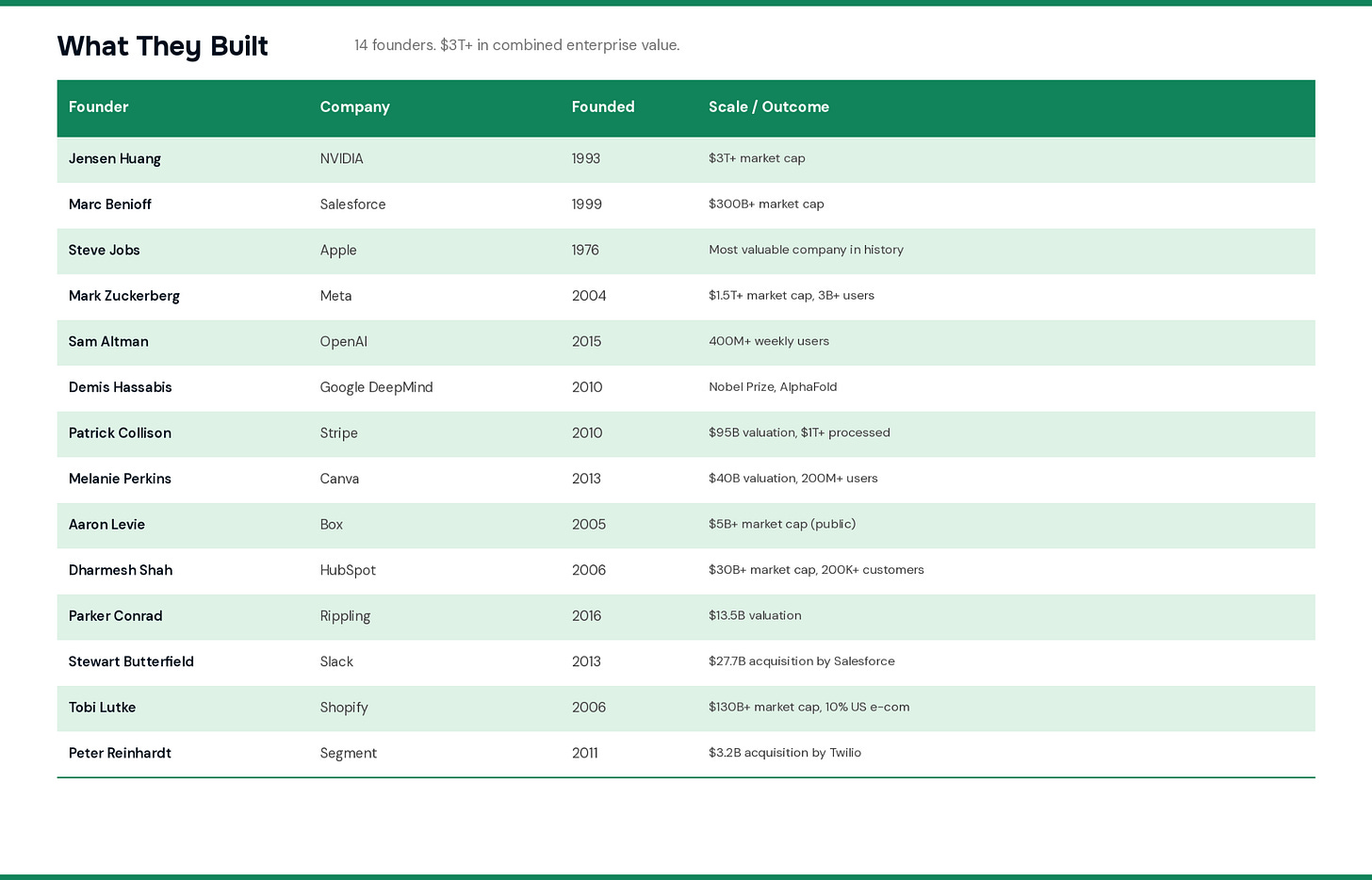
This is a collection of reflections from founders who have collectively built over $3 trillion in enterprise value.
Each quote captures a defining moment: a decision, a near-breaking point, or a belief no one else saw. What follows is what they learned, and what you can apply.


Sales today still relies on manual work: stitching together “Frankenstacks” and toggling between a dozen tabs just to log a single call.
Reevo is breaking the mold. As a vertically integrated Revenue Operating System, Reevo replaces the fragmented maze with a single, AI-native workspace. It captures 100% of your first-party data, from emails to meeting recordings, to help reps find high-intent buyers, automate administrative “garbage,” and generate context-rich outreach that actually sounds human.
No more wasting time on data entry or disconnected tools. It’s one unified engine for the entire revenue cycle. Go Stackless. Learn more at reevo.ai.

Influ2 is hosting a webinar on Tuesday, May 6th, 12–1pm ET on a problem most ABM teams struggle with, but few have solved: every buyer takes a different path to a decision, yet most programs still treat everyone at an account the same way.
Join Influ2 and guest speakers Devin Reed (CEO of The Reeder) and Ed Vander Bush (Senior Manager of ABM at LiveRamp), as they break down the failure points that erode buyer momentum and how Influ2’s newest release, built around contact-level orchestration, overcomes them.
Register here for the session – it’s time to orchestrate around how buyers actually buy.
1. Before anyone believes them
Every company on this list started as an idea most people dismissed. The common thread is not that these founders were contrarian for its own sake. They saw a specific problem with unusual clarity and refused to let consensus override conviction.
Jensen Huang · Co-founder & CEO, NVIDIA
Built NVIDIA from a graphics chip startup into a $3T+ computing platform powering the AI revolution.
“What is the problem you are trying to solve? What is the unmet need you believe will emerge? And what is it that you are going to do that is sufficiently hard that when everybody else finds out it is a good idea, they are not going to swarm it and make you obsolete?”
Huang said this, reflecting on NVIDIA’s founding in 1993, when the video game market was worth zero billion dollars. Sequoia’s Don Valentine told him startups should not invest in startups. He funded it anyway.

Melanie Perkins · Co-founder & CEO, Canva
Scaled Canva from a high school yearbook tool into a $40B design platform used by over 200 million people across 190 countries.
“Find the massive market hiding behind ‘too hard to use.’”
Perkins pitched to over 100 investors before raising her first round. The design software market was dominated by Adobe, and most investors could not see how a simplified tool could compete. She saw that the real market was not designers. It was everyone else.
Patrick Collison · Co-founder & CEO, Stripe
Built Stripe from a side project into a $95B payments infrastructure company processing over $1 trillion annually.
“For most products and most businesses, things can just be done much better. Moats are typically overrated.”
When the Collison brothers started Stripe in 2010, dozens of payment processors already existed. Everyone told them the market was solved. They saw that none of the existing products were actually good.
2. When the product finally clicks
Product-market fit is not a single moment, particularly now with AI (more on this coming soon). Despite the continuous nature of product-market fit now, there’s still usually a moment or inflection point. In the past, this would come once. Now, it comes far more frequently as products continuously adapt to evolving customer needs.
Stewart Butterfield · Co-founder & CEO, Slack
Pivoted from a failed video game into Slack, which grew to 750K+ paying organizations. Acquired by Salesforce for $27.7B.
“Sell the dream outcome. Know exactly what pain you are eliminating.”
Slack was born from the internal chat tool. Butterfield’s team built a video game called Glitch. The game failed. The chat tool became one of the fastest-growing enterprise products in history because it solved a pain point the team experienced firsthand.
Tobi Lütke · Co-founder & CEO, Shopify
Built Shopify from an online snowboard store into a $130B+ commerce platform powering over 10% of all U.S. e-commerce.
“The software I built for myself is good. Maybe other people want it too.”
Lütke wanted to sell snowboards online in 2004. Every e-commerce platform he found was, in his words, a user-hostile database editor. So he built his own. A year later, he realized the software was more valuable than the snowboard business.
Steve Jobs · Co-founder & CEO, Apple
Built Apple into the world’s most valuable company. Created the Mac, iPod, iPhone, and iPad.
“You cannot just ask customers what they want and then try to give that to them. By the time you get it built, they will want something new.”
Jobs said this in 1989, a decade before the iPod and two decades before the iPhone. His consistent thesis was that customers can describe their problems but not the solutions. The founder’s job is to close that gap.

3. Unlearning as needed
Scaling a company requires unlearning the very instincts that got you to product-market fit. The habits that work for 10 people often become liabilities at 100.

Tobi Lütke · Co-founder & CEO, Shopify
Has led Shopify through every stage, from two people in a coffee shop to over 10,000 employees.
“I did not believe in leadership. I just did not think leadership was important. I felt that if you get really good individuals, all the right things would happen. I believe those things are utterly incorrect now.”
Lütke admitted this on the Acquired podcast, reflecting on his early years as a programmer-turned-CEO. Scaling taught him that orchestrating great individuals into a team requires deliberate leadership, not just talent density.
Jensen Huang · Co-founder & CEO, NVIDIA
Retreated from the mobile phone market at its peak to bet on a then-zero-dollar AI-accelerated computing market.
“Retreating from a giant phone market to create a zero-billion-dollar market was risky, but it paid off. Strategic retreat is at the core of success.”
NVIDIA exited the mobile processor market around 2014 despite heavy investment. The decision freed resources that went into CUDA and GPU computing for AI. That strategic retreat is the foundation of NVIDIA’s current dominance.
Patrick Collison · Co-founder & CEO, Stripe
Scaled Stripe’s culture from 2 employees to 8,000+ while maintaining engineering-first principles.
“A rapidly scaling human organization is an unnatural thing. The cues and habits you learn from other human organizations are not going to be sufficient.”
Collison made this observation in an interview about culture at scale. His point: most human organizations (schools, churches, and families) do not double in size every year. Running a startup requires practices that feel contrived because the situation itself is unnatural.
4. The people who make or break it
Every founder on this list points to hiring decisions as the highest-leverage work they do. Not product. Not strategy. People.
Dharmesh Shah · Co-founder & CTO, HubSpot
Co-founded HubSpot and built the Culture Code deck, viewed over 5 million times. HubSpot now serves 200K+ customers.
“Build a movement first. The product follows the philosophy.”
Shah co-created the inbound marketing philosophy before the product fully existed. The movement attracted an audience of marketers who became the company’s first customers. Sometimes the community is the GTM strategy, and the product is what you build to serve it.
Sam Altman · CEO, OpenAI
Led Y Combinator as president, then built OpenAI into the company behind ChatGPT, reaching 400M+ weekly users.
“Mediocre engineers do not build great companies. You need to identify the people who are going to be really, really good, and go after them relentlessly.”
Altman repeated this principle across his YC lectures and Startup Playbook essays. His emphasis is on the disproportionate impact of the top 5% of talent, especially pre-product-market fit.
Marc Benioff · Founder & CEO, Salesforce
Grew Salesforce from four co-founders in a San Francisco apartment to over 70,000 employees and a $300B+ company.
“The secret to successful hiring is this: look for the people who want to change the world.”
Benioff’s hiring philosophy, outlined in Behind the Cloud, prioritized mission alignment over pedigree, which shaped the company’s early culture of customer obsession.

5. Drive growth at scale
Hypergrowth sounds like a dream until you are inside it. These founders describe the operational chaos, cultural strain, and identity crises that come with scaling faster than your infrastructure can keep up with.
Aaron Levie · Co-founder & CEO, Box
Built Box from a college dorm room into a publicly traded enterprise content platform with a $5B+ market cap.
“Compete on innovation, not features. Enterprise is won by whoever moves fastest.”
Levie started Box as a consumer product before pivoting to enterprise. The shift required rebuilding nearly everything. His takeaway was that speed of iteration matters more than feature count when competing against incumbents.
Parker Conrad · Co-founder & CEO, Rippling
After being removed as CEO of Zenefits, built Rippling into a $13.5B compound HR and IT platform from scratch.
“Compound products beat point solutions. Build the platform while others fight for features.”
Conrad’s thesis at Rippling is the opposite of conventional startup wisdom. He argues that the company that owns the system of record for employee data can build everything on top of it. Integration as moat.
6. When it feels impossible
There is a moment in every company’s history where the rational move is to stop. What separates these founders from the thousands who quit is not optimism. It is a specific kind of stubbornness backed by evidence that others could not see.
Jensen Huang · Co-founder & CEO, NVIDIA
Nearly went bankrupt in NVIDIA’s early years before the company found its path to dominance.
“I hope suffering happens to you. One of my great advantages is that I have very low expectations. People with very high expectations have very low resilience.”
Huang said this to Stanford students, explaining that NVIDIA nearly died multiple times in its first decade. Resilience is built by surviving difficulty, not by avoiding it.
Tobi Lütke · Co-founder & CEO, Shopify
Led Shopify through a near-meme-stock era during COVID, then restructured the company back to fundamentals.
“Ignorance is the single biggest driver of entrepreneurship. It was two years before it ever occurred to me that this might not work.”
Lütke says this without irony. His argument is that if you fully understood the odds, you would never start. Ignorance of the obstacles is a feature, not a bug, of the founding moment.
Demis Hassabis · Co-founder & CEO, Google DeepMind
Built DeepMind from a small London lab into the AI research organization behind AlphaFold, AlphaGo, and Gemini. Nobel Prize in Chemistry, 2024.
“I have always been interested in the biggest problems. If you are going to spend your time on something, it might as well be something that matters.”
Hassabis spent years building DeepMind before AI was commercially viable. When Google acquired the company in 2014 for over $500M, many questioned why a search company needed a fundamental AI research lab. The answer became obvious a decade later.

7. Words to remember on day 1
Hindsight compresses years of pain into clean sentences. These are the lessons these founders wish they had internalized from the start.
Jensen Huang · Co-founder & CEO, NVIDIA
33 years as CEO. Same company. Same mission. Different industry every decade.
“Strategy is not words. Strategy is action.”
Huang tracks what every employee’s top five priorities are and judges strategy by whether those priorities match the company’s direction. If the org’s daily actions do not reflect the strategy, the strategy does not exist.
Marc Benioff · Founder & CEO, Salesforce
Pioneer of the 1-1-1 philanthropic model, adopted by over 9,000 companies globally.
“The business of business is improving the state of the world.”
Benioff embedded the 1-1-1 model (1% of equity, 1% of product, 1% of employee time to philanthropy) into Salesforce from day one, before the company had revenue. Values are not something you add once you succeed. They are the architecture you build on.
Tobi Lütke · Co-founder & CEO, Shopify
Runs Shopify as a first-principles organization where every department must justify how it does things differently and better.
“The best thing founders can do is subtraction.”
Lütke’s advice to early-stage founders is counterintuitive: do less. The companies that win are not the ones that do the most things. They are the ones who identify the few things that matter and execute them with obsessive focus.

In a world where code writes itself and products can be copied overnight, the way you think is the last unfair advantage. The question is not whether you will face the same crossroads these founders faced. You will. The question is whether you will recognize it when you do.

Tag @GTMnow so we can see your takeaways and help amplify them.

AppDirect acquired PartnerStack, combining subscription commerce with partner and affiliate management in one platform. For companies running partner-led growth, it’s a meaningful consolidation — recruit, manage, and transact through partners without stitching together separate tools.
Anthropic hit a $3B revenue run rate and is doubling down on infrastructure, partnering with Google and Broadcom to build custom AI chips. The bet: owning silicon is how you control cost-per-token at scale, and at this growth rate, that math matters more every quarter.

VC: Your First VC Meeting Will Be Agent-to-Agent | Auren Hoffman (Flex Capital)
GTM 186: How One Hackathon Took Zapier’s AI Usage From 10% to 97% | CEO of Zapier
Listen by clicking the above links or by searhing wherever you get your podcasts “The GTMnow Podcast.”

Armada – named among Fast Company’s Most Innovative Companies in computing, alongside NVIDIA and Google. They’re building distributed AI infrastructure for the environments most platforms ignore. Worth watching as enterprises and governments push AI into the field, not just the cloud. To learn more you can also check out the GTMnow episode with CEO Dan Wright.
Examen – raised $4.3M in total funding and launched. Examen is building an autonomous analyst for commercial real estate.

- Director, Marketing Operations at CaptivateIQ (Hybrid – Austin, TX | Remote – Raleigh, NC / Nashville, TN / Toronto, Canada)
- Marketing & Advocacy Manager at Cube (Hybrid – New York, NY)
- Enterprise Account Executive, US & Canada at Semrush (Dallas, TX)
- Strategic Accounts at Coast (New York, NY)
- Outbound Account Executive at Owner (Remote – US)
- Enterprise Account Executive at Patch (Remote – San Francisco / New York)
See more top GTM jobs on the GTMfund Job Board.

Upcoming events you won’t want to miss:
- Forrester B2B Summit: April 26–29, 2026 (Phoenix, AZ)
- SaaStr Annual: May 12–14, 2026 (San Mateo, CA)
- GTMfund Dinner: May 14, 2026 (San Francisco, CA)
- RevStar Summit: June 3, 2026 (Toronto, Canada)
- GTMfund Dinner: June 9, 2026 (London, UK)
- Dreamforce 2026: September 15–17, 2026 (San Francisco, CA)
- INBOUND: September 16–18, 2026 (Boston, MA)
- Pavilion GTM2026: September 28–October 1, 2026 (NYC, NY)
- CVC Week by Counterpart Ventures: September 29, 2026 (San Francisco, CA)
- Customer Success Week: October 5-9, 2026 (NYC, NY)
- TechCrunch DISRUPT: October 13–15, 2026 (San Francisco, CA)

Some GTMnow Network love to close it out – we appreciate you.