

Do you always know who a buyer signal is coming from and what it actually means? For 60% of marketers, the answer is no. Without that clarity, teams review signals less often because there simply isn’t enough context to justify the effort.
Influ2 surveyed 100+ senior-level marketers and B2B experts to understand how GTM teams work with buyer signals.
“When marketers don’t have visibility into what’s actually driving an ABM score or ‘in-market’ label, it directly impacts confidence in how accounts are prioritized and where teams spend time and budget.” — Jerry Henry, Sr. Marketing Manager at Remarcable.
👉 Learn what GTM teams need to trust a signal in the full report.
The Revenue Per Employee Metric
In February, Klarna put a number in its earnings release that most weren’t used to seeing public companies report: revenue per employee. It was $1.24 million, up 3.6 times since 2022, with headcount down 49% over the same stretch.
This metric has since grown in popularity, and we believe will continue to do so.
Revenue per employee is the one number that shows whether growth came from leverage or from adding people, which is why it’s become the efficiency metric of the AI era. Every productivity claim eventually has to show up here.
So we scored nine other companies the same way, to give you a sense for where others fall also. Revenue divided by headcount, 2022 against the most recent reported fiscal year, pulled only from audited filings and earnings releases, across AI infrastructure, big tech, software, banking, and retail.

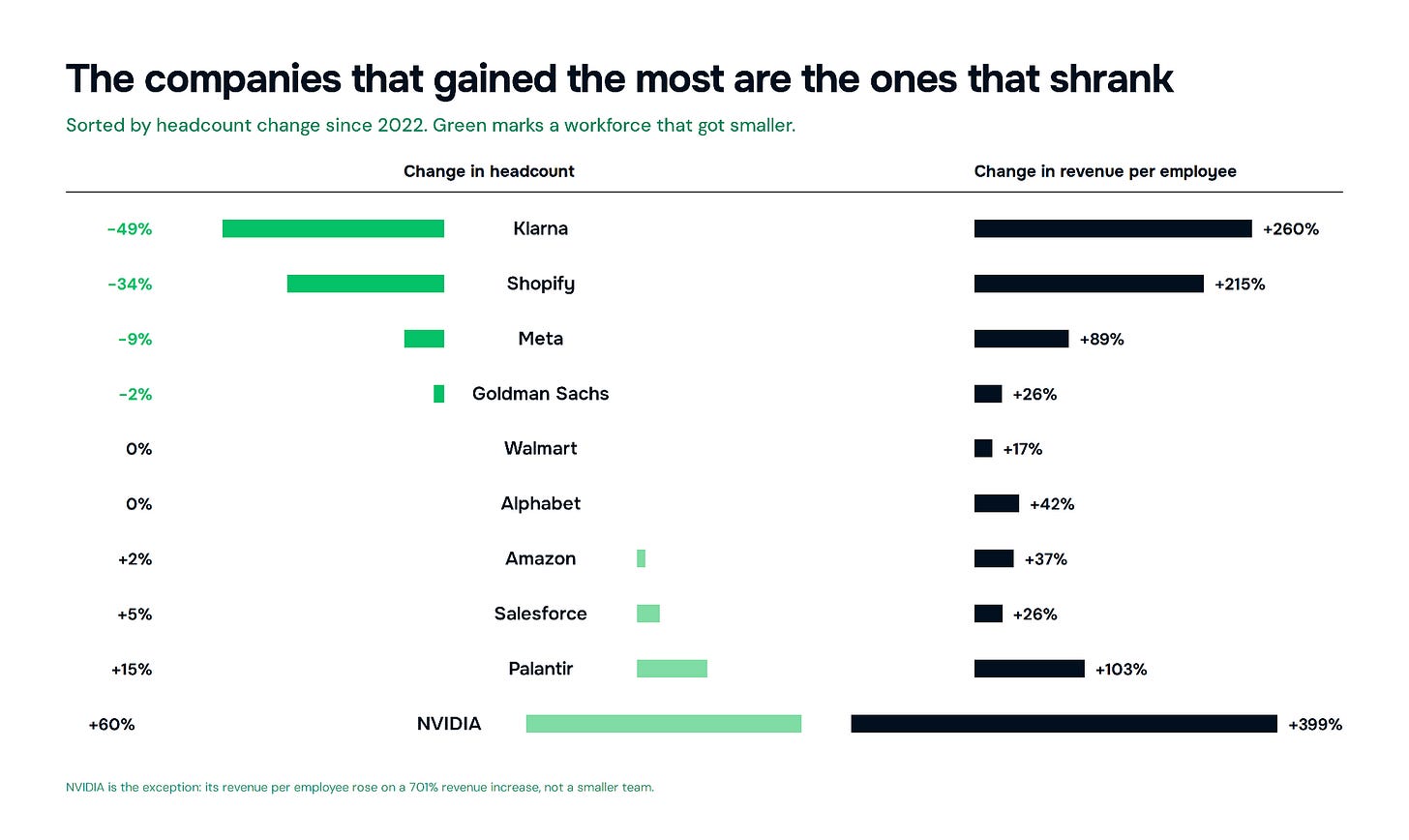
Every one of them got more efficient. The gains run from 17% at Walmart to 399% at NVIDIA. AI may be a big part of the story, but there are also other factors that go into “revenue per employee.” So, we’ll dive into these.
10 factors that impact the revenue per employee metric
Ten factors, roughly in order of how much they move the number.
1. How labor-intensive the model is
The spread across these ten is 15 to 1. NVIDIA turns roughly 42,000 people into $215.9 billion, which works out to $5.14 million each. Walmart turns 2.1 million associates into $340,000 each. Both are extraordinarily well-run companies.
The ordering has almost nothing to do with who deployed AI hardest. Amazon sells more AI compute than any company on earth and sits second from the bottom at $457,000, because 1.57 million of its people work in warehouses. Goldman Sachs, which is not an AI company by any definition, clears $1.23 million and beats Palantir, which is.
Revenue per employee is mostly a readout of how much of your cost base is software and how much is labor. Comparing across models tells you very little. Comparing the same company against itself over time is where the signal lives.
2. Product revenue versus services revenue
Licenses scale without people, services don’t. Every dollar of implementation, deployment, or managed service revenue arrives with a person attached to it, which is part of why Palantir sits at $1.09 million and lands below Goldman Sachs. Nothing about Palantir is less technical. Its revenue just includes significant forward-deployed engineers.
3. Pricing power and deal size
The same twelve reps closing $200K contracts instead of $20K ones move this number 10x without anyone becoming more productive. Revenue per employee rewards raising prices and rewards moving upmarket. If your ACV doubled this year, expect the metric to look great.
4. What counts as headcount and what doesn’t
Contractors, outsourced support, agencies, and compute all absorb work that employees used to do, and none of it lands in the denominator. A company that buys GPUs instead of hiring analysts looks efficient here by construction. It’s the easiest way to move this metric.
5. How the product gets distributed
Self-serve and sales-led carry completely different headcount per dollar. Two companies with identical ARR and identical gross margin can sit 3x apart here purely because of how the revenue gets acquired.
6. Where the workforce sits
Revenue per employee counts people, not dollars. A $60K support rep and a $600K staff engineer are the same unit here. Take a company at $100M revenue and 200 employees, so $500K per head, with 100 of those engineers sitting in a high-cost market and costing $25M. Move that team to a lower-cost country and you can keep 100 engineers and put $15M into margin, in which case the metric doesn’t budge, or spend the same $25M on 250 engineers, in which case revenue per employee falls to $286K while your capacity more than doubles.
7. Growth rate and demand shocks
When the numerator moves faster than any hiring plan can respond to, the ratio improves on its own.
NVIDIA is the honest exception, and it’s worth naming clearly. Its headcount grew 60%. The revenue-per-employee gain came from a 701% revenue increase, which is a demand shock, not a productivity story. When revenue grows sevenfold, this ratio improves no matter how you staff.
8. M&A
Acquisitions add people on close and revenue on a lag, so an acquisitive year drags this number sideways even when every deal is a good one. It’s the most common reason a well-run company’s revenue per employee stalls, and it says nothing about how the underlying business operates.
9. Hiring and backfill policy
Re-sort the same ten by headcount change instead of revenue per employee, and the list looks quite different.

The two biggest gains after NVIDIA belong to the two companies that cut the most. Klarna is down 49% and up 260%. Shopify is down 34% and up 215%. In April 2025, Tobi Lutke told Shopify teams they had to demonstrate why they couldn’t get what they wanted done with AI before asking for more headcount. Shopify went from 11,600 people to 7,600 while revenue roughly doubled.
Meta ran the same shape at bigger scale. Headcount fell from 86,482 to 78,865 across the Year of Efficiency and the years after it, and revenue per employee rose 89%.
10. Automation, including AI
This is the factor everyone wants to isolate, and it’s the hardest one to see, because it only reaches the number through the one above it.
Klarna and Salesforce both put AI agents into customer support, and both published operating numbers, which are different from one another.

Marc Benioff has said Salesforce support headcount went from around 9,000 to about 5,000 through 2025, with AI handling roughly half of all interactions and support costs down 17%. Roughly 4,000 support roles came out as Agentforce scaled. By any operational measure, that worked.
Salesforce’s total headcount still rose 9%, to 83,334. Revenue per employee moved 26%, tied for the smallest gain in the set alongside Goldman Sachs.
AI absorbing work and AI reducing headcount are two different decisions, and only the second one reaches this number.
Despite there being many factors that go into the revenue per employee metric, it’s one that we anticipate companies increasingly reporting on given AI’s impact on it.
Tag @GTMnow so we can see your takeaways and help amplify them.
More for your eyeballs
Hunt Club’s 2026 VC compensation benchmarks are out and one of the findings is that leaders who have operationalized AI are capturing 10-15% higher base pay. Meanwhile, frontier labs are pulling top talent out of every VC-backed company with TC packages most startups can’t match. If you’re benchmarking pay or planning your next executive hire, worth a read.
OpenAI just lost its second CRO in less than a year. Denise Dresser is out after 8 months, replaced by Dali Rajic from Wiz. That’s on top of the COO departing the day before.
More for your eardrums
Listen through the links in the page above or by searching wherever you get your podcasts “The GTMnow Podcast.”
Startups to watch
Clarity Systems raised a $4.4M seed to X-ray sealed return packages and catch retail fraud in about three seconds. The San Francisco startup uses X-ray imaging and computer vision to flag counterfeits, item swaps, and missing parts without opening the box, and it’s already deployed with major national retailers, a quiet fix for an expensive and invisible problem.
Axle raised a $17.5M Series A to build the AI-native clearinghouse for insurance. Led by Base10 and backed by the early team behind Plaid, the New York startup lets lenders and dealers instantly verify and monitor coverage instead of chasing paperwork, and already clears $100B+ of coverage a year for 4,000+ customers including Rocket Mortgage, Avis, and Experian.
Lindy – launched Lindy Teammate, repositioning from AI agent to AI employee. Lives in Slack, learns your business over time, and becomes the self-updating brain of the whole team. GTMfund portfolio company.
Hottest GTM jobs of the week
- Enterprise Account Executive at Crossbeam (Remote – US)
- Mid-Market Customer Success Manager at SecurityPal (Remote – California)
- Sales Development Representative, East Coast at Seso (Remote – US)
- Senior Customer Success Manager – Enterprise at Gorgias (Paris)
- Principal Product Manager at Northbeam (Remote – US)
See more top GTM jobs on the GTMfund Job Board.
GTM industry events
Upcoming events you won’t want to miss:
- Drive 2026: September 8-9, 2026 (Stowe, VT)
- Lenny & Friends Summit: September 10, 2026 (San Francisco, CA)
- Dreamforce 2026: September 15–17, 2026 (San Francisco, CA)
- INBOUND: September 16–18, 2026 (Boston, MA)
- Pavilion GTM2026: September 28–October 1, 2026 (NYC, NY)
- Moment 2026: October 6, 2026 (NYC, NY)
- CVC Week by Counterpart Ventures: September 29, 2026 (San Francisco, CA)
- Customer Success Week: October 5-9, 2026 (NYC, NY)
- TechCrunch DISRUPT: October 13–15, 2026 (San Francisco, CA)
- GTMfund AGM/Retreat: October 15-17, 2026 (San Francisco & Napa, CA)
GTMnow community love
Some GTMnow Network love to close it out – we appreciate you.