This article is a really important one to us at GTMfund. It’s the result of weeks of writing and years of compounding market perspective. It’s the belief that we founded GTMfund on, and it feels more important today than ever.
Hope you enjoy reading it as much as we enjoyed writing it. The full thing is below, and you can also read it on X.
The shifting moat of B2B software and AI
The story of enterprise software is the story of an evolving moat. Each era opens with one cost as the binding constraint – capital, deployment, distribution, or building itself – and the companies that own that era recognize and weaponize that constraint for their benefit. They deeply understand the limiting variable of the day and how to unlock it. Then a new technology collapses the binding cost, the moat moves one step further from the product, and a new set of winners emerges.
Across all four eras, two core variables have only moved in one direction: cost to deploy goes down, and time to value goes down. Every era opened with a lower floor and less friction than the one before it. The moat moves because the previous constraints collapse.
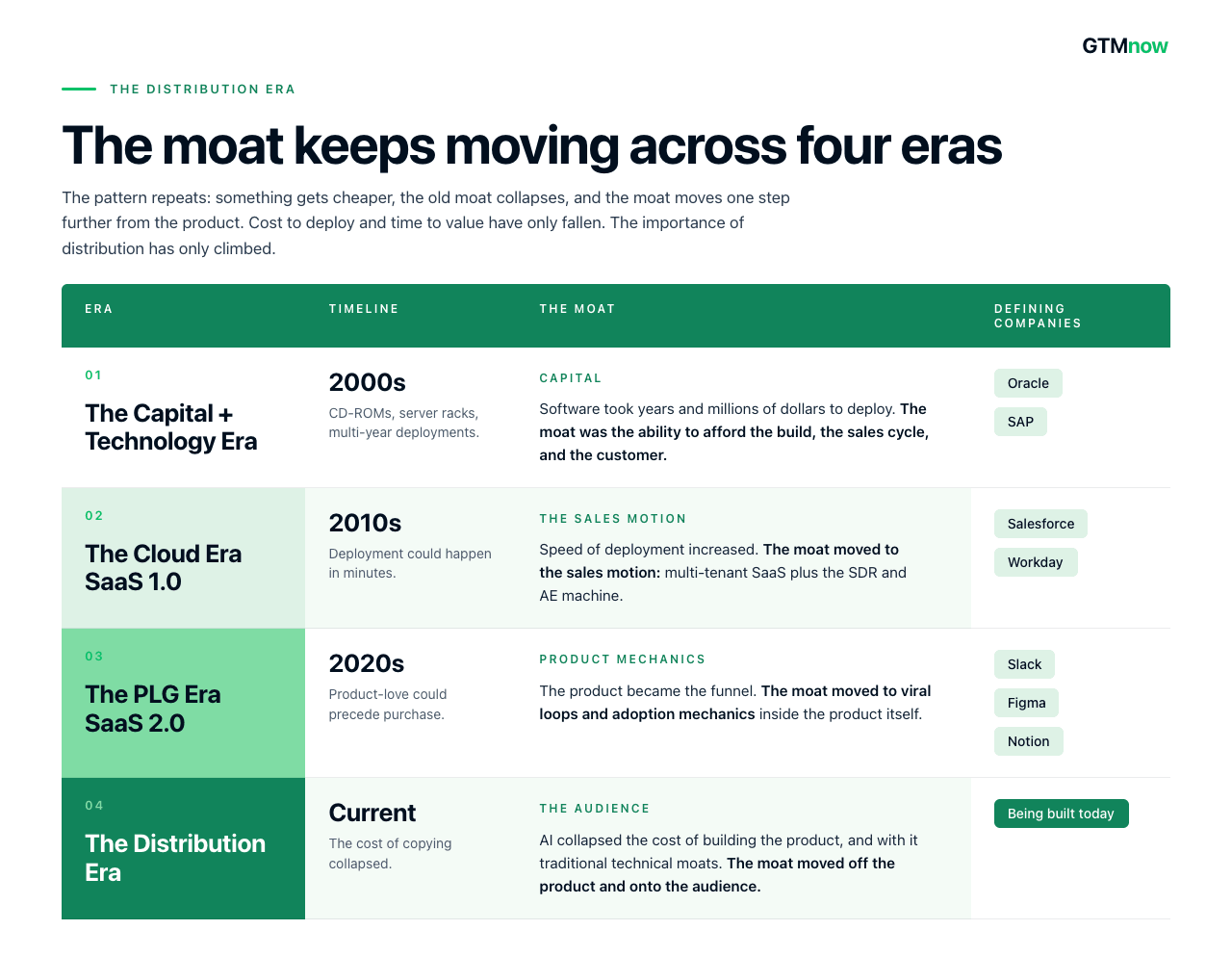
In the Capital + Technology Era, software was a physical thing. Those were the CD-ROM and server rack days, when deployments took 12-24 months and costs were high. The moat was capital itself: only the companies that could afford the multi-year build, sell, and deploy ever got into the customer’s hands.
In the Cloud Era / SaaS 1.0., software no longer required millions of dollars upfront and a multi-year deployment to get started. Instead, same-day cloud-based deployment meant companies could sign up online and start using it that day. The moat moved from capital to building product and the sales motion: multi-tenant SaaS, the SDR/AE machine, and the partner ecosystem. Even with deployment costs collapsing, building software stayed exceedingly expensive. The sheer number of engineers required to ship and scale a market-ready product meant SaaS 1.0 winners needed serious capital to build what their GTM machine was selling.
In the PLG Era / SaaS 2.0., the product became the funnel, the onboarding became frictionless, and product love could precede the eventual purchase. Slack reached a $1B valuation before hiring a sales rep. Figma followed the same playbook. The moat moved from sales to product mechanics: viral loops, collaboration-driven adoption, and evangelists. During this same period, software engineers became more productive and efficient, but it still took meaningful time and capital to build an enterprise-ready product.
Now, we’re in the Distribution Era. AI collapsed the cost of building software to near zero. More importantly, it collapsed the cost of copying it. A category leader that once had months to ship a moat-defining feature now has days before a fast-following AI-native team matches it. Product loops still work, but they no longer compound the way they did when no one could copy you. So the moat moved one final step, off the product and onto the audience.
Across all four, two core variables have only moved in one direction: cost to deploy goes down, and time to value goes down. Every era opened with a lower floor and less friction than the one before it. The moat had to move because the previous moat collapsed.
This is where we are now.

AI is the first wave that meaningfully eroded the cost of building the product itself.
Every other wave collapsed a cost adjacent to the product. None of them collapsed the cost of building the thing. Now, when you ask a CTO/CIO/CEO what percent of code is written by AI, the answer is usually “almost 100%.”
The moat of today is distribution. The pattern is the same across every Distribution Era winner we’ve seen so far: become the default brand in the category before anyone else can. Build the audience, earn the trust, and ship the product into a market that already believes in you.
Distribution beat product before AI existed
Distribution beating product isn’t a new phenomenon. It’s been hiding in the case studies of some of the best companies of the last thirty years. Let’s take a look at a few examples.
Salesforce vs. Siebel (1999–2005). Siebel had the better CRM, the deeper enterprise relationships, and the bigger sales engine. Salesforce had a thinner product and a strange pitch: No Software. Marc Benioff sent actors in red T-shirts to protest outside Siebel’s user conference chanting “death to software,” drawing police, crowds, and free coverage in Fortune and the Wall Street Journal. The pricing was key. Siebel required a five-million-dollar minimum to start a conversation, Salesforce sold seats for fifty dollars a month. By 2005, Siebel sold to Oracle for $5.85 billion. Salesforce is worth more than $280 billion today, roughly 50 times Siebel’s exit.
HubSpot vs. Marketo (2006–2015). Founded the same year. Marketo had the more sophisticated automation product. HubSpot had a book that named a category. They spent half their marketing energy not on HubSpot but on the inbound movement itself: the conference, the certifications, the free CRM, the blog that came to own every meaningful search term in B2B marketing. By the mid-2010s, “inbound” was synonymous with HubSpot (which they recently re-branded to “unbound”). Marketo, despite the better product, was the specialist tool the experts already knew about.
Notion vs. Evernote (2016–2024). Evernote had a ten-year head start and more than 200 million users. Notion had better architecture and a community. Their ambassador program began with a landing page asking power users to work more closely with the team – 400 applications came in for twenty spots. Ambassadors made templates, recorded YouTube tutorials, answered questions on r/Notion at 3am. Today, Notion has more than 20 million users, over a million community members, and roughly 95% organic traffic.
This story isn’t necessarily new. What is new in the Distribution Era is that this is no longer the exceptional path, it’s the only durable one. To be clear, none of this means product doesn’t matter – quite the opposite. The product still has to be exceptional. The order simply changed, not the requirement.
Distribution matters from Day 0
A common misconception is that product-market fit comes before go-to-market, but go-to-market is actually how you get product-market fit. It’s also how you maintain it.
Founders have been told the same sequence for two decades: build the product, find PMF, then figure out GTM. That has changed. It’s no longer how you build and scale.
If the product can be copied at today’s pace of development and pricing is no longer gated by customer headcount, the durable advantage has to live somewhere that can’t be copied or capped. That’s the audience and the distribution you build to reach that audience.
Cursor became the fastest B2B company to a billion dollars in ARR with a loyal community of developers who couldn’t stop talking about the product – see their GTM deconstructed here. Harvey became the default brand for legal AI by establishing itself across more than half of the AmLaw 100 before its product could do everything a buyer wanted, then backfilling the product behind the brand. Anything, Lovable, Replit, Bolt – same playbook in vibe coding.
Your go-to-market is what builds your moat and what dictates your growth trajectory.
What this era looks like
The next era of software will be won by the companies that built distribution first. Markets are being won earlier and more convincingly than ever. First-to-scale principles have never been more important in company building than in the AI era, and the gap between first movers and everyone else will only widen from here.
AI keeps opening new planes of possibility, and the winners get crowned earlier than ever. When markets are moving this fast, that early brand recognition compounds more than ever. For example, Harvey and Legora both surged to default-brand status in the legal space, Lovable and Replit are racing to own vibe coding, and OpenEvidence locked in clinical decision support before most of the market knew the category existed. These are leading examples. The next decade will produce dozens more of them, and even more in emerging categories.
We’ve never seen speed to early revenue like this, and we’ve never seen the scale like this either. a16z recently shared benchmarks around how the median enterprise AI startup hits $2.1M ARR by month 12 and raises a Series A at 9 months post-revenue. The top quartile hits $5.3M ARR in their first year. What was best-in-class for SaaS startups a decade ago ($1M ARR at 12 months) now sits below the median for AI-native companies.

Companies are getting to revenue faster, scaling revenue faster, into a customer base that decides which brand to trust. The founders who win the next decade won’t have the luxury of figuring out GTM at Series A. If you do, a competitor will have already locked in the audience your product was going to need. GTM foundations have to be in place at inception.
Founders are well aware of this. High Alpha’s recent benchmarks found that GTM execution is the top challenge keeping founders up at night. It’s ranked ahead of product execution, fundraising, and even AI strategy itself. Founders already know that it’s the Distribution Era, and it’s up to the rest of us in the ecosystem to answer the bell.
Well, what if I build a world-class AI product? Won’t that sell itself? The market will tell you, “No, it’s not enough.” Look at where Anthropic is hiring.

Sales is the single largest department on their job board. It’s bigger than AI research, bigger than product engineering, or any other function. The fastest-growing software company in history is concentrating its hiring around how to sell, not just how to build. The companies with the strongest product positions in the world are also the ones doubling down on GTM. The pattern Anthropic is setting is the one the next generation of category-defining companies will follow.
Pricing is undergoing a big evolution underneath all of this. Seat-based pricing was the right model for a world in which customers scaled by hiring more humans, which is no longer the world we live in. Seat-based pricing caps scale. In year one, a seat-based vendor and a consumption-based vendor look similar inside a customer of comparable size. By year three, the consumption-based vendor is operating without a ceiling that its seat-based peer can’t escape. The pricing models that will win the next decade are consumption, outcomes, and credits. Distribution moves alongside pricing, and arguably ahead of it. Every customer action becomes both a billable event and a marketing event. The audience-first company isn’t selling to its audience so much as monetizing the audience’s behavior.
Finally, the alpha of early adoption has never been wider and will widen further before it narrows. Becoming AI-native in your own GTM today produces the widest disparity of performance we’ve ever seen between teams that adopt early and teams that don’t. The aperture for what’s possible in building a GTM engine will also continue to widen. The limiting factor is no longer the GTM technology stack you use, but your imagination and your team’s operational execution. This phenomenon has always existed for early adopters of technology, but it’s never been this acute. If you’re not ahead of it, you’re getting left behind faster than ever. The alpha of early adoption is the difference between making a category and being absorbed by one.
Welcome to the Distribution Era. We’re just getting started.
I wrote this piece with Paul Irving. It’s the belief that we founded GTMfund on, and it feels more important today than ever.
Tag @GTMnow so we can see your takeaways and help amplify them.
More for your eyeballs
Anthropic raised $65B at a $965B valuation, crossing a $47B revenue run rate earlier this month. Claude is now the most-requested model on Amazon Bedrock, and enterprises have moved from experimentation to full production deployment.
Autodesk is acquiring MaintainX, the operations and maintenance platform on track for $135M ARR in 2026 with 50%+ growth. The bet: connecting design and build workflows with day-to-day asset maintenance in one continuous lifecycle. Autodesk is expanding from helping people create the physical world to helping them run it.
Polaris dropped their 2026 AI in GTM Study. AI is delivering results in GTM, but most teams are navigating a fragmented vendor landscape with hidden costs they don’t fully understand.
More for your eardrums
VC: Tomasz Tunguz on AI’s $575B Bet, the 5th-Largest Infrastructure Project Ever
Listen through the links in the page above or by searching wherever you get your podcasts “The GTMnow Podcast.”
Startups to watch
Default – raised $20M Series A led by 8VC to launch a unified, real-time data layer for revenue agents. Everyone is trying to deploy agents — Default solves the bottleneck: siloed data and legacy systems that aren’t ready for them.
Noble – partnering with Profound to close the loop on AI search visibility. Profound customers can now identify citation gaps and fill them with Noble’s offsite network, getting their brand into the third-party sources AI platforms actually cite.
Polsia – raised $30M at a $250M valuation — one human, zero employees, approaching $10M ARR. Agents run coding, research, outreach, ads, and support. Polsia even handled its own fundraise. The pitch: agents remove the filter that’s always decided who gets to build.
OpenRouter – raised $113M Series B led by CapitalG, with NVentures, Databricks, Snowflake, and MongoDB Ventures. Now handling 25T+ tokens per week across 400+ models through one API — building the Stripe for AI model routing.
Shipper – raised $17M at a $164.4M valuation — two founders, zero employees, approaching $2M ARR in 10 months. The agents ran the fundraise themselves. An army of agents that runs a company end-to-end. You just build like it’s a video game.
Hottest GTM jobs of the week
- Director of Revenue Operations at Seso (Remote – US)
- Director of Strategic Partnerships at Spekit (Remote – US)
- Customer Success Manager at Vividly (Remote – US)
- Manager, Customer Onboarding at Owner (Colombia/Mexico)
- Sales Development Representative at Vanta (Sydney, Australia)
See more top GTM jobs on the GTMfund Job Board.
GTM industry events
Upcoming events you won’t want to miss:
- RevStar Summit: June 3, 2026 (Toronto, Canada)
- GTMfund Dinner: June 9, 2026 (London, UK)
- Lenny & Friends Summit: September 10, 2026 (San Francisco, CA)
- Dreamforce 2026: September 15–17, 2026 (San Francisco, CA)
- INBOUND: September 16–18, 2026 (Boston, MA)
- Pavilion GTM2026: September 28–October 1, 2026 (NYC, NY)
- CVC Week by Counterpart Ventures: September 29, 2026 (San Francisco, CA)
- Customer Success Week: October 5-9, 2026 (NYC, NY)
- TechCrunch DISRUPT: October 13–15, 2026 (San Francisco, CA)
GTMnow community love
Some GTMnow Network love to close it out – we appreciate you.