

Nooks just announced $500M in growth capital from General Catalyst! Discover how revenue agents can transform your GTM at nooks.ai/gtmfund
Outbound sales today is still built around manual work: writing emails, building lists, and managing sequences across disconnected tools. Nooks is breaking the mold. With their AI Sequencing product, Nooks is an agent workspace where AI works alongside reps, helping them understand accounts, prioritize the right prospects, and generate context-rich outreach based on actual first-party interactions. No more wasting time in multiple tools – it’s one unified workspace for all your outbound channels. Arm your sales team with intelligent outbound.
How Startup Equity Works
Anthropic started trading on the Nasdaq yesterday under the ticker ANT after pricing its IPO at $83 a share, above the range it marketed to investors. The company had about 940 employees at the end of 2024. By the end of September it had roughly 5,300. (we broke down the GTM numbers from the S-1 here).
That’s a lot of people who joined at different points, on different equity terms. It’s also the kind of headline that makes everyone pull up their own offer letter and wonder what their options are actually worth.
Estimates vary, but roughly 5,100 Anthropic employees, more than 9 in 10, are now millionaires on paper. About 2,800 hold stakes worth around $10 million, and roughly 600 non-founder employees are sitting on close to $100 million each.
Anthropic is only about five years old, and watching thousands of people become millionaires at a company that young is likely to push more talent toward early-stage startups.
This edition breaks down how startup equity works, what early hires typically get, how often it pays off and how experienced execs decide whether a startup is worth the bet.
The terms that matter
Most of the confusion around equity comes from a handful of words. Here they are in plain English.
- Options vs. RSUs. Stock options give you the right to buy shares later at a fixed price. RSUs (restricted stock units) are shares you’re given once they vest. Early-stage startups usually grant options; later-stage and public companies lean toward RSUs.
- Strike price and the 409A. The strike price is what you pay per share when you exercise an option. It’s typically set at the fair market value from a 409A valuation, an independent appraisal of the company’s common stock.
- Vesting. You earn your equity over time. The standard is four years with a one-year cliff: nothing for the first 12 months, then 25% at once, then the rest monthly.
- Dilution. Every time the company raises money, it issues new shares. Your share count stays the same, but your percentage shrinks.
- Liquidation preferences. Investors usually get their money back first in a sale. With a 1x preference, if a company raised $150M and sells for $100M, investors are paid first, and common shareholders (including employees) can end up with nothing.
- The 90-day exercise window. If you leave, you typically have three months to buy your vested options or lose them. Some companies give longer. Pinterest gives former employees up to seven years.
What early hires receive
Carta looked at more than 8,000 initial grants to the first five hires at startups, and the drop-off is steep. The median grant was 1.49% for the first hire, 0.85% for the second, 0.50% for the third, 0.44% for the fourth and 0.34% for the fifth. Those are full four-year grants, not annual ones.
First hires are getting a little more lately. In Carta’s H1 2026 compensation report, the median first hire over the past two years received 1.75% of the company. Either way, employee #1 typically ends up with about 4x the ownership of employee #5.
The odds
This is the part that doesn’t make headlines. Carta tracked 3,067 US startups that incorporated in 2018. About six years later, 49% had shut down, 45% were still going, 5% had been acquired and 4 companies (0.2%) had gone public.

Even when the equity is worth something, most people don’t buy it. In Q4 2024, employees exercised just 32.2% of vested, in-the-money options, down from 54.2% three years earlier. Exercising costs real money, it can trigger a tax bill and companies are staying private longer, so it’s a harder call than it used to be.
Dilution, step by step
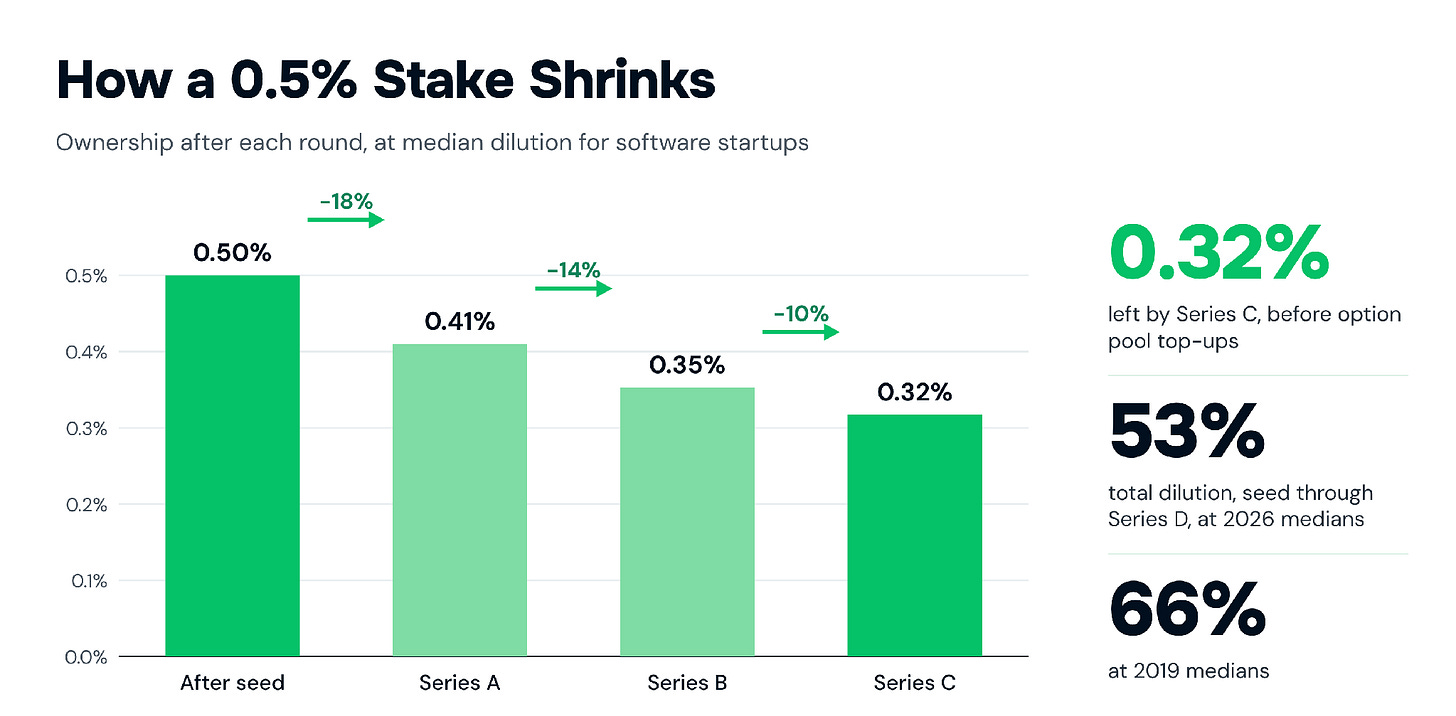
Say you join right after a seed round and get 0.5%. Here’s what happens if the company then raises a Series A, B and C at Carta’s median dilution for software startups: 18% at Series A, 14% at Series B and 10% at Series C.

By Series C, your 0.5% is about 0.32%. That’s before option pool top-ups, which usually take a bit more. The good news is that dilution has been falling. Carta estimates that raising every round from seed through Series D at 2026 medians dilutes a company by about 53% in total, compared with 66% at 2019 rates.
So what is 0.32% worth? It depends entirely on the outcome.
Value of 0.32%, before strike cost, taxes and preferences:
- Modest acquisition ($100M exit): $320K, possibly far less after preferences
- Strong acquisition or IPO ($1B exit): $3.2M
- Breakout ($10B exit): $32M
The first row is where liquidation preferences bite. If the company raises more than it sells for, investors get paid first, and that $320K can shrink to zero.
Tender offers: getting paid before the IPO
For a long time, the only ways to turn startup equity into cash were an IPO or an acquisition. Tender offers changed that. In a tender, the company or outside investors offer to buy shares from employees at a set price while the company stays private. A few recent ones:
- Anthropic ran a tender at a $350B pre-money valuation this spring. It closed below its target because employees chose to hold their shares. Those shares started trading yesterday.
- OpenAI completed a $6.6B tender at a $500B valuation in October 2025, then a roughly $7B tender at $852B in August.
- Clay ran its second tender in nine months in January, letting employees sell up to $55M of stock at a $5B valuation. CEO Kareem Amin wants employees to benefit “along the way, not only after an IPO.”
- Stripe has run a tender roughly every year since 2024, most recently at $159B in February.
- SpaceX ran insider tenders for years. Its last big one, in December 2025, valued it at around $800B, and it went public in June.

How execs decide whether to join
Startup equity is one of the ways an employee can own a real piece of what they help build, and this week showed how big that can get. It’s also a long-tail bet, and many factors that determine the outcome can be out of your hands. What you can control is which company you join.
We’ve asked a lot of GTM leaders on the podcast how they made that call. Five themes kept coming up.
1. Who’s the founder?
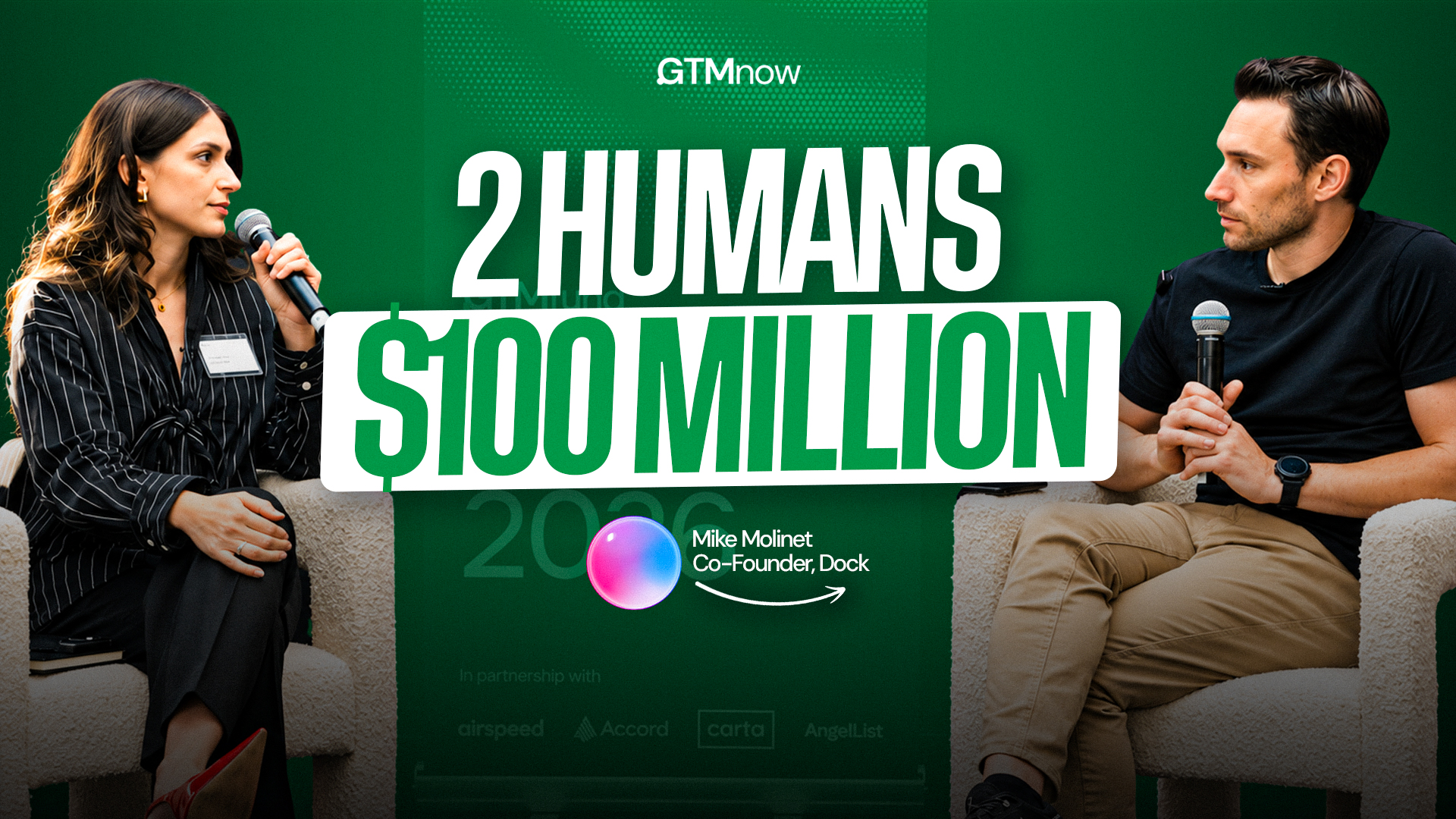
Reggie Marable (Chief Customer Officer, Sierra) said he joined because he was willing to “bet on myself and bet on the founders and bet on the space.” Patrick Forquer (CRO, Legora) puts it first on his list of things he thinks about: “who’s your boss going to be? Who’s the founder?”
2. How big can the market get?
Marcus Holm (CRO, Exa) borrows a VC lens: how big can the market get, and how likely is this company to take an outsized share of it? When he met Exa’s founders and saw how fast agents were starting to search the web, his reaction was “oh, this market’s going to be huge.”
3. Does the product excite you?
Patrick’s second test is a product that solves a big problem. When he first saw Legora, his reaction was “this is what enterprise AI can look like.” Marcus ran his own reference check, asking customers what they thought of Exa’s APIs, and kept hearing that they were tasteful and easy to get started with. You can hear the rest of his checklist here.
4. Who’s backing it, and what’s the culture?
Patrick’s third check was the investors, in his case Benchmark and Redpoint. Marcus puts culture right next to market size on his list.
5. Can you live with the trade-off?
Almost everyone gives something up. Reggie joined Sierra as employee #23, and “it was a tremendous pay cut. And my wife was like, are you insane?” Patrick said comp is what keeps a lot of people where they are, because “everyone’s afraid to walk away from that next big commission check.” His view is that the window for building companies this fast won’t stay open forever.
The bottom line
Before you sign, these are the four things that shape what a grant ends up being worth:
- The percentage, not the share count. 10,000 options means very little without knowing how many shares exist.
- The exercise terms. The strike price, the 409A and how long you have to exercise if you leave.
- How much the company has raised. Preferences sit ahead of common shares in a sale.
- Liquidity before an exit. Whether the company has run tenders and how often.
Bonus: our Claude playbooks to date
Since we’re on the subject of Anthropic, here are the Claude editions we’ve published so far to help you on your AI journey:
**Please note that this is educational content – not financial, tax or legal advice.
Tag @GTMnow so we can see your takeaways and help amplify them.
More for your eyeballs
Anthropic priced its IPO at $83 a share and raised about $81.3B, the largest IPO ever. It sold 980M shares at a fully diluted valuation of about $1.5T, then opened at $111.50 on its first day of trading, 34% above the IPO price.
Satya Nadella said AI agents will “reshuffle” the economics of the web. Speaking at DealBook, he said money will move from ads to transactions, and framed Microsoft’s buyout offers to about 60,000 employees as moving engineers from building products to managing AI agents.
Bending Spoons agreed to buy Mailchimp from Intuit at an enterprise value of $3.68B. Intuit paid about $12B for it in 2021. The all-cash deal includes Intuit reinvesting $368M in Bending Spoons equity, and it’s expected to close in early 2027.
More for your eardrums
Listen through the links in the page above or by searching wherever you get your podcasts “The GTMnow Podcast.”
Startups to watch
LangChain – raised a $300M Series C led by CapitalG at a $3B valuation for LangSmith, its platform for building and managing AI agents. Its valuation more than doubled from $1.25B a year earlier, and LangSmith has 7,000 customers, including Harvey, Rippling, Clay and Salesforce.
Payhawk – raised a $280M Series C led by Goldman Sachs’ growth equity arm at a $2B valuation for its AI-agent spend management platform. Greenoaks, Lightspeed and QED also invested, bringing total funding past $500M, and it operates in 33 countries.
Unsiloed AI – raised a $7.5M Seed round led by Felicis to turn messy enterprise documents into structured data that AI agents can use. The 7-person team reports 99.78% accuracy across about 84,000 data points pulled from financial documents.
Hottest GTM jobs of the week
- Account Executive at Vividly (Remote – US)
- VP, Customer Success at Statusphere (Orlando, FL / Remote)
- Community & Events Marketing Manager at Cube (New York, NY)
- Business Development Representative (BDR) at Stotles (London, UK)
- SMB CSM Team Lead at Nectar (Lindon, UT / Remote)
See more top GTM jobs on the GTMfund Job Board.
GTM industry events
Upcoming events you won’t want to miss:
- Crossbeam AI Summit 2026: December 9, 2026 (Virtual)
- Show & Tell: Selling with AI: December 9, 2026 (NYC, NY)
- The AI Summit New York: December 9, 2026 (New York, NY)
- AI Infra Summit 6: December 9, 2026 (San Francisco, CA)
We just hosted a GTMfund dinner in Toronto and a happy hour in NYC. Lots more events will coming in 2027, starting off in January!
GTMnow community love
Some GTMnow Network love to close it out – we appreciate you.