

Five years ago, “AI for sales” meant chatbots on your website and a lead-scoring model that quietly ranked your CRM. That world is gone.
Sales is still a people-to-people business. But the machine side of that equation has changed more in the last three years than in the previous twenty. Reps now work alongside AI that drafts their outreach, listens to their calls, updates their CRM without being asked, and in some cases, runs entire outbound motions on its own.
Companies that figure out where AI actually helps, and where it still falls short, are pulling ahead. This is where things stand in 2026, and how to put it to work.
What “AI for sales” actually means in 2026
It helps to think of this in three eras.
Predictive AI (roughly 2015–2021) was about scoring and sorting: which lead is most likely to convert, which account is most likely to churn. It’s pattern-matching on historical data. Useful, but narrow, it doesn’t create anything, it just ranks what’s already there.
Generative AI (2022–2024) added drafting to the mix. Reps could generate a first-pass cold email, summarize a call, or turn a messy set of notes into a clean CRM update. This is the ChatGPT-era shift, and it’s the one the sales tech stack absorbed the fastest.
Agentic AI (2025–now) is the current frontier: AI that doesn’t just draft or score, it acts. It can research an account, sequence outreach across channels, update records, and hand off a qualified conversation, with a human checking the work rather than doing it from scratch.
Most sales orgs today are running a mix of all three. Prospecting tools that use predictive scoring. Outreach tools that generate first drafts. A handful of workflows that are genuinely agentic. The mix is what matters, not any single tool.
How AI changes the sales workflow, function by function
Prospecting & research
AI-compiled account and contact intelligence has replaced most manual research. Instead of a rep spending hours digging through LinkedIn, company news, and funding databases, enrichment platforms pull that context automatically and surface it at the moment a rep needs it.
Outbound & personalization
AI drafts the first pass of a sequence; a human still edits before it sends. The teams that get this wrong treat AI drafting as “set and forget.” The teams that get it right use AI to kill the blank page problem, then apply judgment before anything goes out. Reply rates consistently favor the second group.
Lead scoring & routing
This is the oldest AI use case in sales and still one of the most reliable. Modern scoring models blend firmographic data, intent signals, and engagement history to route the right lead to the right rep at the right time, instead of a flat first-come, first-served queue.
Conversation intelligence
Nearly every sales call can now be recorded, transcribed, and analyzed automatically: talk-time ratio, objection handling, competitor mentions, next steps. What used to require a manager sitting in on a handful of calls a month now covers effectively every call a team runs.
Forecasting & pipeline hygiene
AI-assisted forecasting pulls from CRM data, call activity, and email engagement to flag deals that are at risk before a rep or manager notices something’s off. This is also where a lot of the CRM data entry problem gets solved: automatic activity capture means the pipeline reflects reality without reps logging every touchpoint by hand.
Rep coaching & enablement
AI coaching platforms can now run roleplay simulations, score calls against a defined methodology, and flag exactly where a rep’s pitch breaks down, all without waiting for a manager’s schedule to open up.
CRM & admin automation
Maybe the least glamorous use case, and arguably the one with the best ROI. Giving reps back the hours they used to spend on manual data entry is a direct, measurable productivity gain, not a hypothetical one.
The rise of the AI SDR, and where agentic selling actually stands
This is the part of the conversation that’s moved the most, and the part where the most confident claims deserve the most scrutiny.
Through 2024 and into 2025, “AI SDR” tools promised to fully replace entry-level prospecting roles: an AI that researches, writes, sends, replies, and books meetings with no human in the loop. It was one of the fastest-growing categories in sales tech, and the pitch was seductive.
By early 2026, the results are in, and they’re more complicated than the pitch. Teams that deployed AI SDRs as a full replacement for human prospecting have largely walked it back toward hybrid models. Fully autonomous outbound hasn’t matched human-plus-AI performance at meaningful scale. The tools that have staying power tend to be the ones that pair AI research and drafting with a human who still owns judgment calls, tone, and the final send.
That doesn’t mean agentic selling isn’t real. It means the current state of the art is narrower than the 2024 hype suggested: AI agents are genuinely good at compiling research, drafting first-pass messaging, and handling structured, repeatable qualification steps. They’re not yet reliably good at the judgment calls that separate a message that lands from one that gets ignored. (For the technical layer that makes agent-to-tool handoffs like this possible, see MCPs: The GTM Unlock.)
The practical takeaway for 2026: use agentic tools to eliminate the repetitive 80% of the SDR workflow, and keep a human on the 20% that actually requires reading a room.
The best AI sales tools in 2026
Every entry below was checked for one thing above all: is the company still independent and still operating under this name? A few notable changes since the last time a list like this got published: Clari and Salesloft completed a merger in December 2025 and now operate as one combined company. Chorus has been owned by ZoomInfo since 2021 and is marketed as “Chorus by ZoomInfo.” Salesforce itself added to the trend, acquiring Qualified (best known for its AI SDR chatbot, Piper) in late 2025. The pattern is clear: established platforms are absorbing AI-native point solutions faster than new standalone winners are emerging, which is exactly why checking “is this still a real company” matters more in this space than in most.
Forecasting, RevOps & AI-native execution
- Airspeed (formerly Glyphic) — best for teams that want the whole loop handled by one system: calls analyzed, CRM fields written, at-risk deals flagged, follow-up drafted. Raised $20M in May 2026 to push from insight into execution.
- Clari + Salesloft (merged December 2025) — best for enterprise pipeline inspection and forecasting, now combined with sales engagement under one company.
- Aviso — best for AI-driven deal scoring and what-if scenario modeling.
- People.ai — best for automatic CRM activity capture, no manual logging required.
- Reevo — best for teams that want forecasting, CRM, and pipeline intelligence in one AI-native system rather than stitched together. Launched with $80M spanning marketing, sales, and CS.
- Salesforce Einstein Forecasting — best for native forecasting inside Salesforce without adding a vendor.
Conversation intelligence
- Gong — best for enterprise deal analytics and coaching at scale.
- Chorus by ZoomInfo — best for teams already inside the ZoomInfo ecosystem.
- Avoma — best value for mid-market teams.
- Granola — best for reps and founders who want AI notes on every call without a bot joining the meeting.
- Fireflies.ai — best low-cost entry point for transcription and basic call insights.
- Attention — best for teams that want the call to trigger the work: follow-up drafted, CRM updated, next step executed. 500+ customers, 4x YoY ARR growth, $30M Series B in June 2026.
Prospecting & data enrichment
- Clay — best for custom, technical enrichment workflows (waterfall enrichment across 150+ data sources).
- Apollo.io — best all-in-one contact database and enrichment for budget-conscious teams.
- ZoomInfo — best for enterprise-scale data depth and buying-signal coverage.
- Cognism — best for EU/UK phone-verified, compliance-first data.
- Lusha — best for fast, self-serve contact data with buying signals layered on, without an enterprise contract.
- Nooks — best for turning that data into activity: signal-based prioritization, AI sequencing, and parallel dialing in one workspace, with reps still running the conversations.
Enablement & coaching
- Avarra — best for AI-avatar roleplay, where reps practice against a realistic on-screen buyer rather than a voice-only bot.
- Mindtickle — best for enterprise sales readiness and certification programs.
- Highspot — best for content-driven enablement, surfacing the right asset at the right deal stage.
- Hyperbound — best for AI roleplay and rep practice simulations.
AI SDRs & sales agents The category matured fast, then corrected. By early 2026, most teams that tried a fully autonomous AI SDR have moved toward hybrid setups instead.
- Artisan (Ava) — best for teams that want a fully autonomous AI SDR persona handling sending, replying, and booking.
- 11x.ai (Alice + Julian) — best for combined outbound and inbound coverage, with a separate agent handling voice-based qualification.
- Amplemarket (Duo Copilot) — best for automated prospect research feeding directly into personalized sequencing.
- Reply.io — best for hybrid teams where AI handles first outreach and humans close.
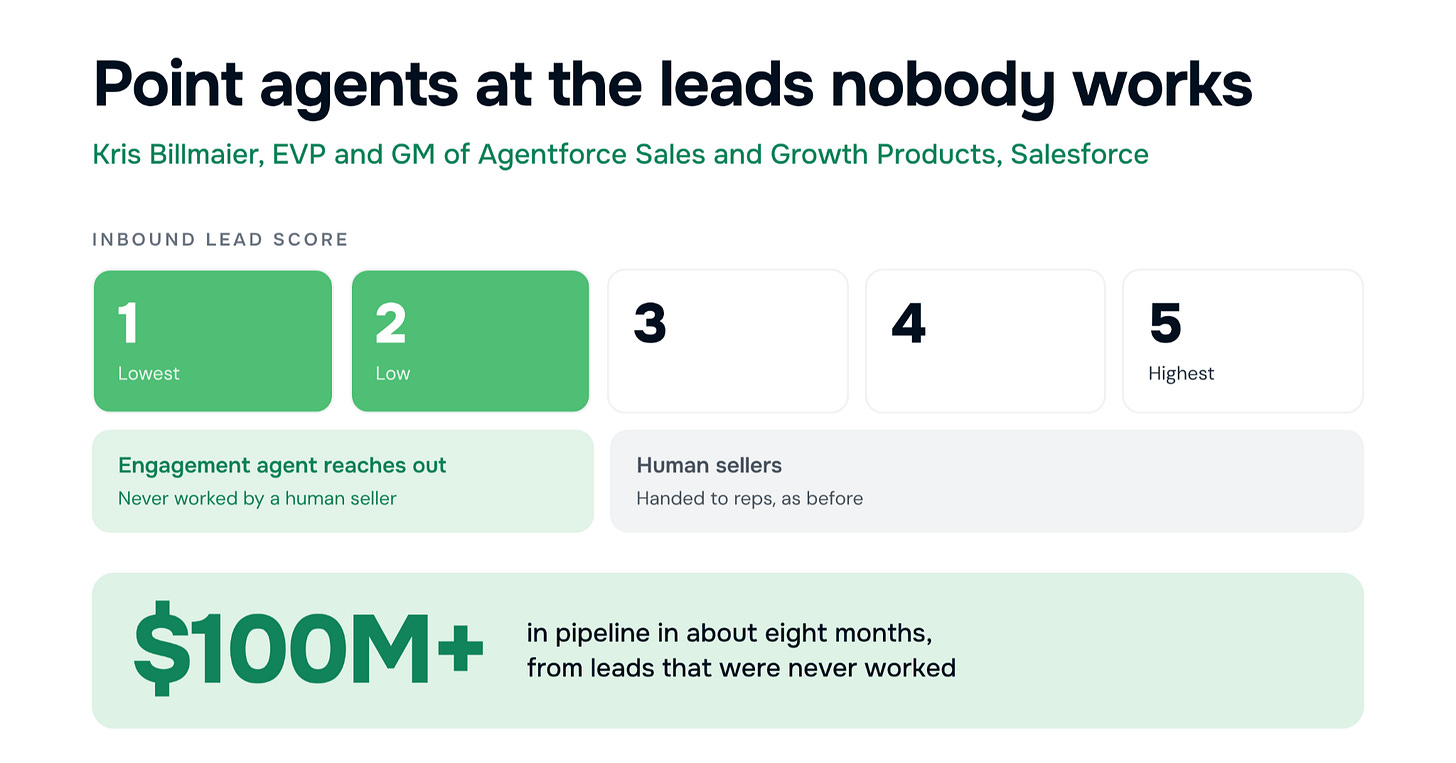
- Salesforce Agentforce — best for teams already deep in the Salesforce ecosystem who want agents native to their CRM. (For more on this shift, see Will Salesforce Win the AI Era Like It Won Cloud? with Salesforce’s Agentforce lead Kris Billmaier.)
A note on picking tools: the biggest mistake we see isn’t picking the wrong vendor within a category, it’s buying one tool per function and ending up with eight subscriptions that don’t talk to each other. Map your actual workflow gaps first, then buy.
How to actually roll out AI in your sales org
A rollout playbook, from watching this go right and wrong across GTMfund’s portfolio (see also: How to Drive AI Adoption: Lessons From 21 GTM Leaders):
Start with one function, not the whole stack. Pick the workflow costing your reps the most non-selling time (usually CRM admin or prospecting research) and fix that first. A narrow win builds internal trust for the next tool.
Measure before and after, not just after. If you don’t know your baseline (hours spent on data entry, reply rates, time-to-first-touch) you won’t be able to prove the tool worked, and you won’t catch it if it didn’t.
Keep a human on anything customer-facing until the AI earns trust. Draft-then-review beats full autonomy for most teams in 2026, even with agentic tools. Autonomy is something you graduate into, not something you buy on day one.
Avoid stacking overlapping tools. Conversation intelligence, forecasting, and engagement platforms increasingly bundle features that used to require three separate vendors. Check what you already have before adding a new one.
Someone needs to own the agents, not just the tools. As AI takes on more of the workflow, teams are finding they need a person responsible for configuring, monitoring, and correcting what the agents do, a role GTMnow has covered as “the Agent Operator”. Without clear ownership, agentic tools tend to drift unsupervised.
Revisit the stack quarterly. This space moves fast enough that a tool ranking that’s true today may not be true in six months. Treat AI tooling decisions as a recurring review, not a one-time purchase.
Pitfalls and what not to do
Don’t automate outbound faster than you can maintain quality. AI makes it easy to send more messages. It doesn’t automatically make those messages better. Volume without judgment just gets you unsubscribed at scale.
Don’t trust AI-generated data blindly. Enrichment and scoring models are only as good as their inputs. Spot-check what the AI is telling you against what you actually know about your market.
Don’t skip data hygiene. AI amplifies whatever is already in your CRM, including the mess. Garbage in, confidently-stated garbage out.
Don’t treat AI as a headcount replacement. The evidence so far points toward AI making reps more effective, not eliminating the need for judgment, relationship-building, and complex problem-solving that still requires a person.
What’s next: toward an autonomous pipeline
The direction of travel is clear even if the timeline isn’t: less time on research and admin, more of the workflow handled end-to-end by agents with a human checking the highest-stakes decisions. The teams winning right now aren’t the ones with the most AI tools. They’re the ones who know exactly which parts of the job to hand off, and which parts still need a person who can read a room.
FAQ
What is AI for sales? AI for sales refers to the use of machine learning, generative AI, and increasingly autonomous AI agents to support tasks across the sales process, from prospecting and outreach to forecasting, coaching, and CRM management.
How do sales teams use AI? Most teams use a mix: predictive scoring to prioritize leads, generative AI to draft outreach and summarize calls, and a smaller but growing set of agentic workflows that handle research and qualification with a human reviewing the output.
What is an AI SDR? An AI SDR is a tool or agent designed to handle sales development tasks, prospecting, research, outreach, and initial qualification, with varying degrees of autonomy. Fully autonomous AI SDRs have not replaced human SDR teams at meaningful scale as of 2026; most successful deployments are hybrid.
What are the best AI tools for sales? It depends on the function you’re solving for. See the category breakdown above, tools that lead in prospecting and enrichment are different from the ones that lead in forecasting or coaching.
Will AI replace sales reps? Not for roles built on complex problem-solving and relationship-building. Roles built primarily on repetitive, scriptable tasks are the ones most exposed to automation. Worth noting: the AI labs building the tools everyone assumes will replace sales teams are themselves hiring GTM roles faster than almost anything else.
Is AI worth it for a small sales team? Often yes, several tools in the categories above have accessible entry pricing built for smaller teams. The bigger risk for small teams isn’t cost, it’s buying more tools than you can actually operationalize.